Companies That Build Agentic Apps: How AI Agents Get Integrated Into Mobile Apps
Author : Webshark Web Services | Published On : 09 Nov 2026
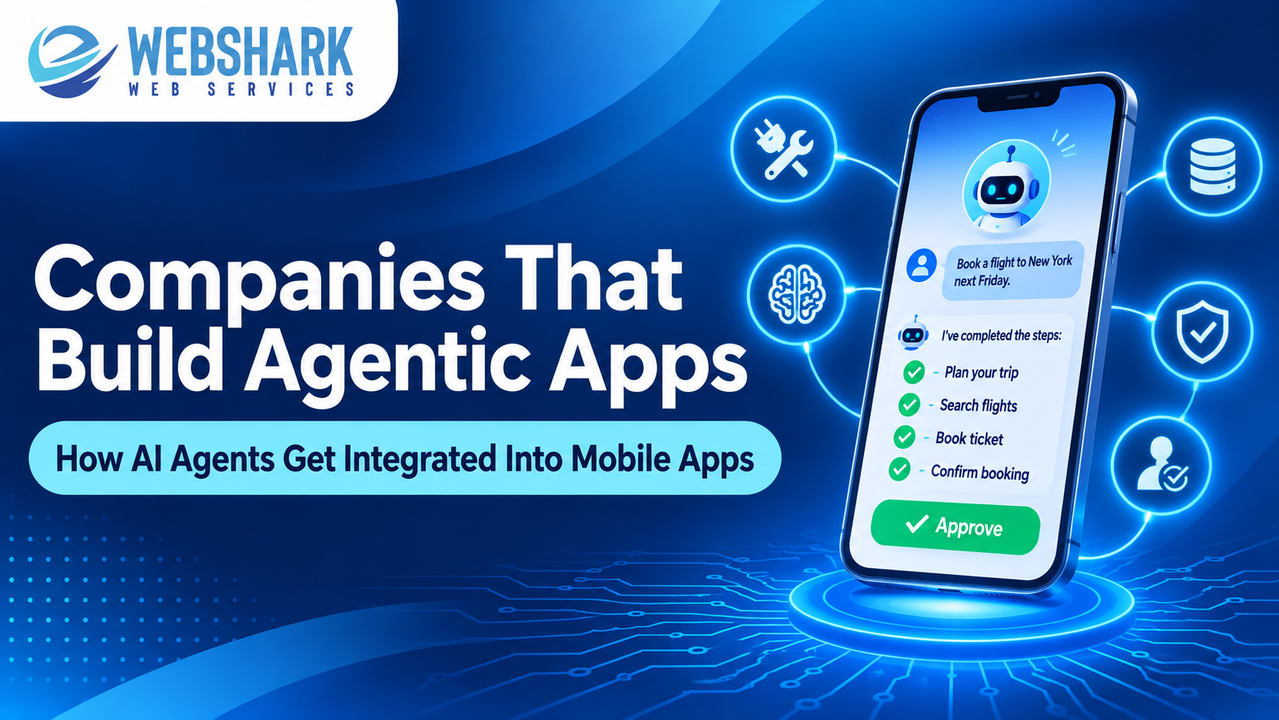
What Is an Agentic App?
An agentic app is a mobile or web application with an AI agent that can act, not just answer. A chatbot replies to a question. An AI agent takes a goal, such as "reschedule my delivery to Friday," then checks the order, finds open slots, and books the new time.
Agentic apps share four traits:
-
Goal understanding: The agent turns plain language into a clear task.
-
Planning: It breaks the task into smaller steps.
-
Tool use: It calls real app functions, APIs, and databases.
-
Feedback: It checks results, asks for confirmation, and reports back.
Demand is rising fast. Gartner predicts that 40% of enterprise applications will include task-specific AI agents by the end of 2026, up from less than 5% in 2025.
What Does an Agentic AI Development Company Do?
An agentic AI development company combines two skill sets that rarely sit in one team: mobile app engineering and AI agent development. Typical services include:
-
Agent strategy and use-case discovery
-
Model selection (on-device, cloud, or hybrid)
-
Tool and API integration with your backend, CRM, or ERP
-
Conversational and approval-based UX design
-
Native iOS, Android, or cross-platform app development
-
Security, testing, monitoring, and ongoing tuning
Many AI agent development companies only build backend bots. Many app agencies only build screens. The value comes from connecting both, so the agent can act safely inside the app your users already have.
How AI Agents Get Integrated Into Mobile Apps
Every agentic mobile app is built on the same core layers. The table below shows what each layer does.
|
Layer |
What It Does |
Common Tools |
|
Interface |
Captures goals by chat, voice, or buttons |
SwiftUI, Jetpack Compose, Flutter, React Native |
|
Reasoning model |
Understands intent and plans steps |
Cloud LLMs, on-device models |
|
Tools and actions |
Performs real tasks |
Backend APIs, function calling, MCP |
|
Memory and context |
Grounds answers in your data |
RAG, vector databases, user history |
|
OS-level hooks |
Lets system assistants use the app |
Apple App Intents, Android AppFunctions |
|
Guardrails |
Keeps actions safe and auditable |
Permissions, approvals, audit logs |
1. The Interface: Chat, Voice, and Smart Buttons
Good agentic UX mixes natural language input with suggested actions, progress updates, and clear confirm or cancel buttons.
2. The Reasoning Model: On-Device, Cloud, or Hybrid
Simple tasks, such as summarizing or classifying text, can run on the phone for privacy and speed. Complex planning usually needs a cloud large language model. Most production apps use a hybrid setup that routes each request to the right model.
3. Tools and Actions: How Agents Actually Do Things
An agent becomes useful when it can call functions such as searchOrders, bookSlot, or createTicket. Developers define these tools with clear names, inputs, and descriptions. The Model Context Protocol (MCP), an open standard introduced by Anthropic in November 2024, is now a common way to connect agents to backend tools and data. This is where AI integration services do most of the heavy lifting.
4. Memory and Context
Agents need the right facts. Retrieval-augmented generation (RAG) lets the agent pull answers from your documents, product catalog, or records instead of guessing. Short-term memory keeps track of the current task, while long-term memory stores user preferences with consent.
5. OS-Level Hooks: Siri, Gemini, and System Agents
Mobile platforms are opening apps to system-level agents. On iOS, Apple's App Intents framework exposes app actions and content to Siri, Apple Intelligence, Shortcuts, and Spotlight. On Android, Google's AppFunctions lets apps share functions that agents and assistants like Gemini can discover and run. Google calls AppFunctions the mobile equivalent of MCP tools. It is still an experimental preview for Android 16 and higher, so plan for it now.
6. Guardrails and Human Approval
An agent that can act can also make mistakes. Strong builds include role-based permissions, confirmation before payments or data changes, audit logs, rate limits, and fallbacks when the model is unsure. The NIST AI Risk Management Framework is a useful reference for these controls.
Step-by-Step: How Agentic App Development Works
A reliable agentic app development process usually follows six steps:
-
Discovery: Pick one high-value workflow and define success metrics, such as fewer support tickets or faster bookings.
-
Proof of concept: Test the agent on your real data before a full build.
-
Tool design: Expose safe, well-documented functions from your backend and app.
-
App integration: Build the agent UX into your iOS, Android, or cross-platform app.
-
Testing: Check accuracy, latency, cost per task, and safety, including prompt injection risks.
-
Launch and monitor: Track task success rates and tune prompts, tools, and models over time.
Agentic Mobile App Examples by Industry
-
Ecommerce: An AI shopping agent finds products, applies offers, and tracks returns.
-
Healthcare: A healthcare app agent schedules visits and organizes records, with HIPAA-aligned data handling in the US.
-
Fintech: An agent explains spending, flags unusual activity, and drafts payment requests for approval.
-
Field services and logistics: An agent updates job status, reorders parts, and reroutes deliveries.
-
B2B and GovTech: An agent searches documents, checks eligibility, and summarizes long PDFs.
Why Many Agentic Projects Fail
Agentic AI is powerful, but it is easy to get wrong. Gartner predicts that over 40% of agentic AI projects will be canceled by the end of 2027 because of rising costs, unclear business value, or weak risk controls. Gartner also warns about "agent washing," where vendors rebrand basic chatbots as agents. It estimates that only about 130 of the thousands of agentic AI vendors offer real agentic capabilities.
The lesson: start with a clear use case, measure value early, and build guardrails from day one.
How to Choose Among AI Agent Development Companies
Before you hire an AI agent development company, ask these questions:
-
Can you show live apps where an agent takes real actions, not just chats?
-
Which tasks will run on-device, which in the cloud, and why?
-
How will the agent connect to our APIs, and who controls its permissions?
-
How do you estimate and cap monthly model costs?
-
How do you test for wrong answers, unsafe actions, and prompt injection?
-
Do you build both the mobile app and the agent backend?
-
Can we start with a proof of concept on our own data?
How Webshark Builds Agentic Mobile Apps
Webshark Web Services builds AI agents and mobile apps under one roof, from its Atlanta office and engineering team in Bangalore. The company states that its agents connect to CRMs, ERPs, helpdesks, and internal tools, with human approval steps, permissions, and audit logs built in, backed by ISO 27001 certified delivery. Every project starts with a short proof of concept on the client's own data.
Two examples show this approach in practice:
-
Tender 9: Webshark is building the Tender 9 mobile app in React Native for Android and iOS. Its AI features include prompt-based tender search, profile-based recommendations, eligibility analysis against tender criteria, and AI summaries of long government tender PDFs. Summaries are stored after the first request to avoid repeat processing costs. The app extends Tender 9's AI-powered web platform.
-
Webshark Health: Webshark's own Gen-AI personal health record app, live on iOS and Android, turns uploaded medical documents into organized records and explains reports in simple language.
Webshark's team covers the full stack, including generative AI development, AI chatbot development, and Flutter and React Native app builds.
Build an Agentic App That Users Actually Trust
The best companies that build agentic apps do not start with a model. They start with a user goal, connect the agent to safe tools and real data, and design every action so users stay in control. Getting this wrong can mean high model bills, unpredictable behavior, and a project that never reaches production.
Planning to add AI agents to your mobile app? Webshark combines mobile app development for US companies with AI development services to build agentic apps that are secure, measurable, and ready for real users. Talk to our team about your agentic app idea and start with a proof of concept on your own data.
FAQs
1. What is an agentic AI development company?
An agentic AI development company designs and builds software where AI agents can plan and complete multi-step tasks, not just answer questions. For mobile apps, that means connecting a reasoning model to the app's APIs, data, and interface, and adding permissions, approvals, and monitoring so the agent acts safely.
2. What is the difference between an AI agent and a chatbot in a mobile app?
A chatbot responds to messages, usually by answering questions. An AI agent takes a goal, breaks it into steps, and uses the app's tools to complete it, such as checking an order, booking a new delivery slot, and sending a confirmation. Many products marketed as agents are really chatbots, so ask vendors to show real actions.
3. How much does AI agent development cost?
AI agent development cost depends on the number of workflows, how many systems the agent connects to, whether models run on-device or in the cloud, compliance needs, and ongoing model usage fees. A focused proof of concept for one workflow costs far less than a multi-agent platform. Ask for a discovery phase to get a reliable estimate.
4. Can AI agents be added to an existing mobile app?
Yes. Most apps can add an agent without a full rebuild by exposing existing backend functions as secure tools, adding a conversational interface, and connecting a model through an API. On iOS and Android, App Intents and AppFunctions can also make app actions available to system assistants like Siri and Gemini.
5. How do I choose among AI agent development companies?
Look for live apps where agents take real actions, clear answers on on-device versus cloud models, a plan for controlling model costs, testing for unsafe actions and prompt injection, and the ability to build both the mobile app and the agent backend. Start with a small proof of concept on your own data before committing.
