Common CNC Machining Problems and How to Solve Them
Author : Surya makeyoueasy | Published On : 05 Oct 2026
Introduction
CNC machining can produce highly accurate components, but problems such as chatter, excessive tool wear, poor surface finish, burrs, overheating, and dimensional errors can affect productivity and part quality. Most machining problems are connected to cutting parameters, tool selection, machine rigidity, workholding, tool overhang, or chip evacuation. Identifying the symptom and checking these factors systematically can help restore stable machining performance.
1. Excessive Tool Wear
Rapid flank wear, edge chipping, or crater wear can reduce tool life and affect component accuracy and surface finish. Excessive cutting speed is a common contributor, while unsuitable grades, insufficient feed, vibration, and heat can also accelerate wear.
Possible causes:
-
Cutting speed is too high
-
Incorrect insert or tool grade
-
Excessive cutting temperature
-
Poor coolant delivery
-
Vibration or unstable setup
-
Incorrect feed or depth of cut
How to solve it:
-
Check the manufacturer’s recommended cutting range
-
Reduce cutting speed when excessive heat or wear occurs
-
Select a grade suitable for the workpiece material
-
Check tool overhang and workholding
-
Replace worn or damaged tooling
2. CNC Chatter and Vibration
Chatter creates visible vibration marks, poor surface finish, excessive noise, and sometimes premature tool failure. It can occur when the tool, holder, workpiece, or machine setup becomes dynamically unstable. Long tool overhangs can increase vibration risk.
How to solve it:
-
Reduce tool overhang
-
Improve workpiece clamping
-
Check tool holder and collet condition
-
Adjust cutting speed and feed
-
Reduce radial or axial engagement where appropriate
-
Use a more rigid or vibration-damped tooling solution for long overhangs
3. Poor Surface Finish
A rough or inconsistent machined surface can result from vibration, incorrect cutting parameters, worn tools, excessive runout, or an unsuitable insert geometry.
Check these first:
-
Tool condition
-
Insert nose radius
-
Feed rate
-
Cutting speed
-
Tool overhang
-
Machine and workholding rigidity
-
Tool runout
For turning, cutting parameters have a significant influence on surface finish and tool life. Very low feed can also contribute to rubbing and built-up edges in some applications.
4. Dimensional Inaccuracy
When a finished component is outside tolerance, the problem may not always be the CNC program.
Possible causes include:
-
Tool wear
-
Tool deflection
-
Workpiece movement
-
Tool runout
-
Thermal expansion
-
Incorrect tool offset
-
Excessive tool overhang
-
Unstable cutting conditions
Solution: Measure the component at appropriate stages, verify tool offsets, inspect the workholding, and check the tool assembly for runout and deflection.
For long overhang turning applications, tool deflection can make close tolerances particularly difficult to maintain.
5. Excessive Heat During Machining
Too much heat can accelerate tool wear, damage the cutting edge, affect surface quality, and contribute to dimensional variation.
Common causes:
-
Excessive cutting speed
-
Insufficient coolant
-
Poor chip evacuation
-
Tool rubbing
-
Worn cutting edge
-
Incorrect cutting geometry
How to solve it:
-
Check cutting speed
-
Ensure coolant reaches the cutting zone
-
Improve chip evacuation
-
Replace worn tooling
-
Verify that the tool is actually cutting rather than rubbing
Cutting speed has a particularly strong effect on tool life, while inappropriate feed and cutting depth can also create excessive cutting forces or heat.
6. Poor Chip Control
Long, tangled chips can interfere with machining, damage the workpiece, and create safety and productivity problems.
Possible causes:
-
Incorrect feed
-
Incorrect cutting speed
-
Wrong chipbreaker
-
Incorrect depth of cut
-
Poor coolant or chip evacuation
-
Unsuitable insert geometry
How to solve it:
Select a chipbreaker and geometry appropriate for the operation and material, then adjust feed and cutting speed within the manufacturer’s recommended range. Effective chip evacuation is particularly important when chips are being recut.
7. Burr Formation
Burrs can appear along machined edges, especially when cutting conditions, tool condition, or workpiece material cause the material to deform instead of separating cleanly.
Possible causes:
-
Worn cutting edge
-
Incorrect cutting parameters
-
Tool deflection
-
Incorrect tool geometry
-
Material-specific cutting behavior
How to solve it:
-
Check tool sharpness
-
Select suitable geometry
-
Optimize feed and speed
-
Improve workholding rigidity
-
Consider a suitable finishing pass
8. Tool Breakage
Sudden tool failure can stop production and potentially damage the workpiece or machine.
Common causes:
-
Excessive cutting forces
-
Excessive depth of cut
-
Incorrect cutting parameters
-
Chatter
-
Tool runout
-
Excessive tool overhang
-
Wrong tool grade or geometry
Prevention:
Use the correct tool for the material and operation, keep the setup rigid, minimise unnecessary overhang, and verify cutting data before increasing productivity.
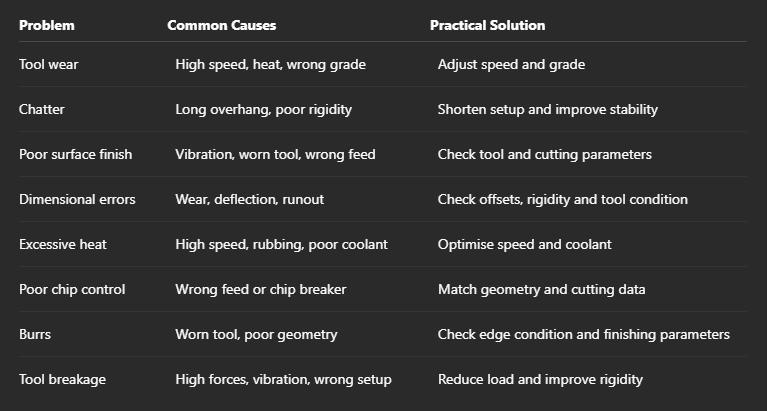
CNC Machining Troubleshooting Table
A Simple Troubleshooting Sequence
When a CNC machining problem appears, avoid changing several parameters at once.
Use this sequence:
1. Check the Tool
Look for wear, chipping, damage, and incorrect geometry.
2. Check the Setup
Inspect toolholder, workholding, runout, and tool overhang.
3. Check Cutting Data
Review speed, feed, depth of cut, and radial engagement.
4. Check Chip Evacuation and Coolant
Make sure chips are not being recut and coolant reaches the cutting zone.
5. Make One Controlled Change
Change one important parameter and observe the result before making another adjustment.
This makes it easier to identify the actual cause instead of treating symptoms.
Why Choose MakeYouEasy?
MakeYouEasy helps simplify CNC tooling procurement by bringing cutting tools, inserts, holders, drills, milling tools, and machining accessories together in one place.
Having the right tooling for the material, operation, machine, and cutting conditions is an important part of maintaining a stable machining process.
Conclusion
CNC machining problems rarely come from one factor alone. Tool wear, chatter, poor surface finish, dimensional errors, heat, chip control, burrs, and tool breakage can be influenced by the relationship between the tool, workpiece, machine, cutting parameters, and setup.
Instead of immediately changing the tool or increasing cutting speed, identify the symptom, check the setup, verify the cutting data, and make controlled adjustments. A systematic troubleshooting approach can help improve machining stability, tool life, component quality, and overall productivity.
Frequently Asked Questions
1. What is the most common cause of CNC machining problems?
Incorrect cutting parameters, tool wear, vibration, poor rigidity, and unsuitable tooling are common causes.
2. How can CNC chatter be reduced?
Reduce unnecessary tool overhang, improve workholding and toolholding rigidity, and optimize cutting conditions.
3. Why does CNC machining produce a poor surface finish?
Vibration, worn tools, incorrect feed or speed, tool runout, and unsuitable tool geometry can contribute to poor surface finish.
4. How can CNC tool life be improved?
Use the correct tool grade and geometry, optimize cutting parameters, maintain a rigid setup, and control heat and chip evacuation.
5. What should I check first when a CNC machining problem occurs?
Start with the cutting tool and setup, then check tool runout, overhang, workholding, cutting parameters, coolant, and chip evacuation.
Popular Search Keywords
CNC machining problems, CNC machining troubleshooting, CNC problems and solutions, common CNC machining problems, CNC tool wear, CNC chatter, CNC vibration, poor surface finish CNC, CNC tool breakage, CNC dimensional accuracy, CNC chip control, CNC machining defects
