CNMG 120408 Turning Inserts: Grades, Chipbreakers, Applications & Selection Guide
Author : Surya makeyoueasy | Published On : 16 Nov 2026
Introduction
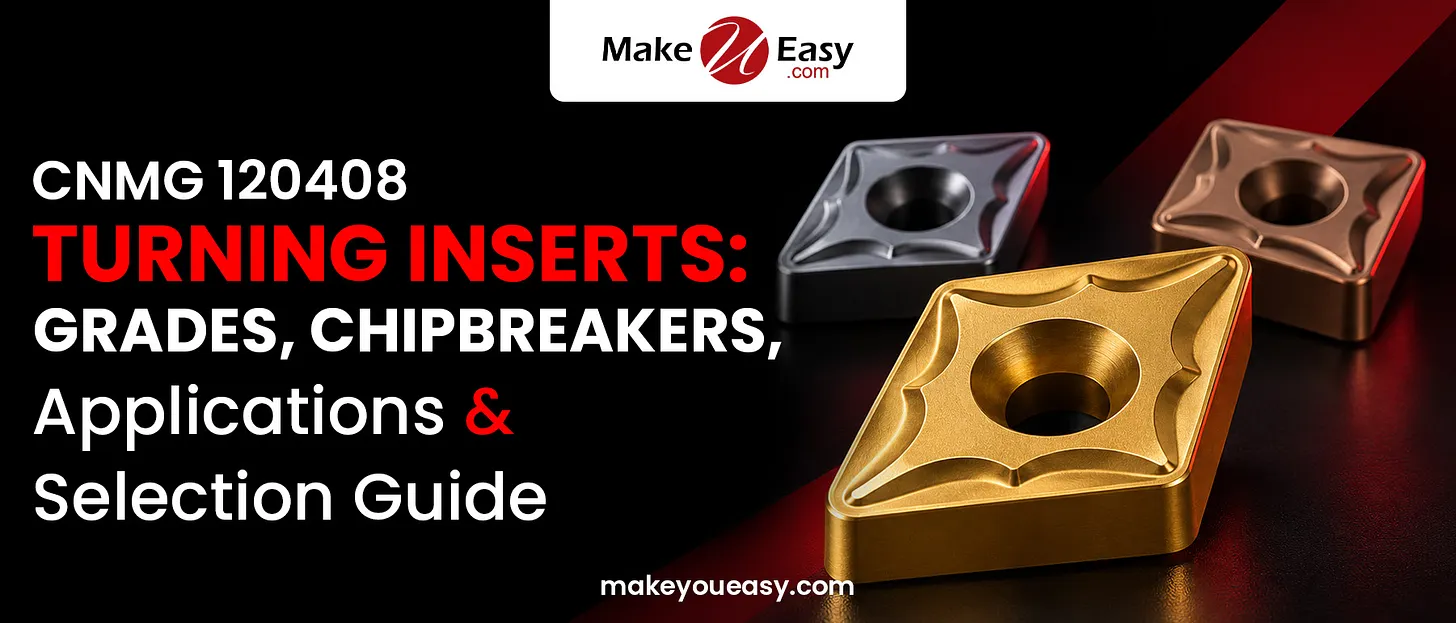
CNMG 120408 is a widely used negative carbide turning insert for general-purpose CNC machining. Its 80° rhombic shape and 0.8 mm nose radius make it suitable for several turning operations when matched with the correct grade, chipbreaker and tool holder. Understanding these specifications helps machinists choose an insert that meets their workpiece material, cutting conditions and production requirements.
What Is a CNMG 120408 Turning Insert?
A CNMG 120408 is an indexable carbide insert used in compatible CNC turning tools. It has a negative cutting geometry, a central fixing hole and a chipbreaker configuration defined by the manufacturer’s design.
The ISO designation identifies the basic insert geometry and dimensions. The carbide grade, coating and chipbreaker designation are selected separately.
Understanding the CNMG 120408 Insert Code
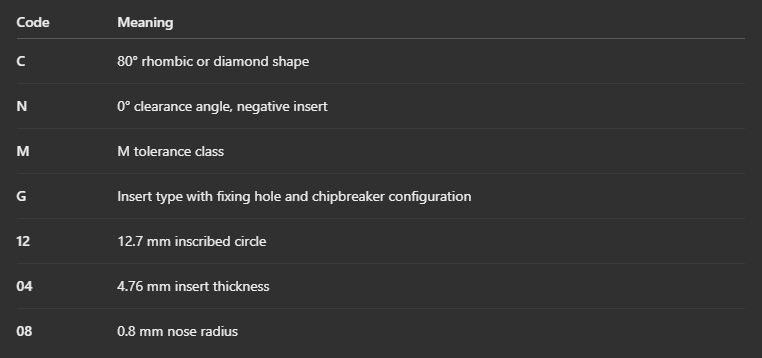
The standard CNMG 120408 geometry is commonly available with four usable cutting corners. Always confirm the exact insert and holder compatibility before replacement.
CNMG 120408 Carbide Grades
The carbide grade influences wear resistance, toughness, heat resistance and suitability for different workpiece materials. A single CNMG 120408 geometry can be available in several grades from the same manufacturer.
Common ISO material groups include:
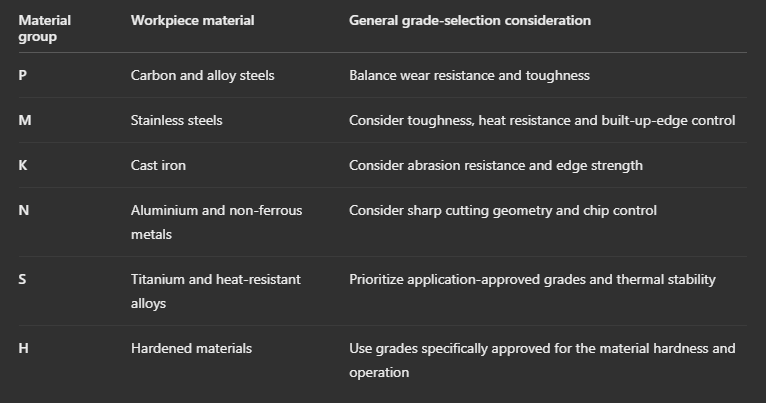
For example, TaeguTec’s catalogue lists multiple grade options for CNMG 120408, demonstrating that the insert geometry alone does not identify its grade.
Important: Grade codes are manufacturer-specific. Check the manufacturer’s material application chart instead of assuming that a grade from one brand is equivalent to another brand’s grade.
CNMG 120408 Chipbreaker Types
A chipbreaker controls chip formation and evacuation by shaping the chip as it passes over the insert’s rake face. Selecting the right geometry helps prevent long, tangled chips and supports stable machining.
1. Finishing Chipbreaker
Designed for lighter feeds and smaller depths of cut. It supports chip control during finishing operations where surface quality and lower cutting forces are important.
2. Medium Chipbreaker
Designed for a broader range of feed and depth-of-cut combinations. It is commonly selected for general-purpose turning and semi-finishing.
3. Roughing Chipbreaker
Designed for higher feeds and greater depths of cut. It generally provides a stronger cutting edge for demanding machining conditions.
Chipbreaker codes differ between manufacturers. For example, Sandvik Coromant uses designations such as PF for finishing, PM for medium machining and PR for roughing. These codes should not be treated as universal across brands.
Applications of CNMG 120408 Turning Inserts
When matched with a suitable grade, chipbreaker and holder, CNMG 120408 inserts can be used for:
-
External turning: Reducing the outside diameter of cylindrical workpieces.
-
Facing: Producing flat end surfaces on components.
-
Rough turning: Removing material at higher feeds and depths of cut with a suitable edge geometry.
-
Semi-finishing: Preparing surfaces for subsequent finishing operations.
-
Boring: Machining internal diameters with a compatible boring bar and sufficient tool clearance.
-
Production machining: Performing repeated turning operations on suitable steel, stainless steel and cast-iron components.
The actual application range depends on the manufacturer’s insert design and grade recommendations.
How to Select the Right CNMG 120408 Insert
1. Identify the Workpiece Material
Determine whether the component is steel, stainless steel, cast iron or another material group. Select a carbide grade approved for that material.
2. Choose the Correct Chipbreaker
Match the chipbreaker to the operation. Use a finishing geometry for lighter cuts, a medium geometry for general machining and a roughing geometry for heavier cutting conditions.
3. Check the Nose Radius
The 0.8 mm nose radius is a common general-purpose option. Smaller radii can help with profiling and lighter cuts, while larger radii can improve edge strength but may increase cutting forces and vibration sensitivity.
4. Verify Tool Holder Compatibility
Confirm that the holder accepts the CNMG 120408 size and negative insert geometry. Check the clamping method, insert seat and recommended approach angle.
5. Follow Recommended Cutting Data
Use the manufacturer’s recommended cutting speed, feed rate and depth of cut for the exact grade and chipbreaker. Adjust for machine rigidity, workpiece hardness, overhang and cutting conditions.
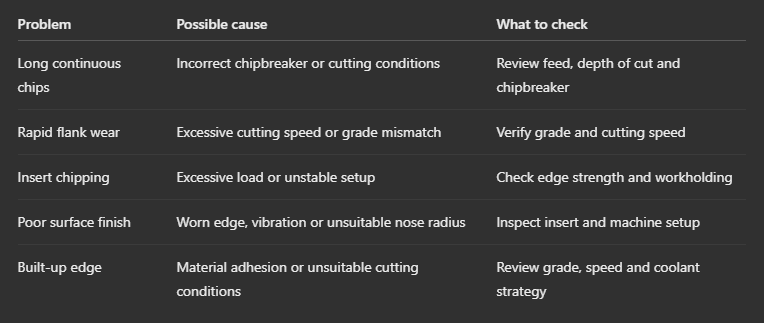
Common Problems and Practical Checks
Why Choose MakeYouEasy for CNC Turning Inserts?
MakeYouEasy helps machining professionals explore CNC cutting inserts, tool holders, and machining accessories for different turning requirements. Before selecting a CNMG 120408 insert, confirm the complete designation, carbide grade, chipbreaker, and holder compatibility.
Conclusion
CNMG 120408 turning inserts offer a versatile geometry for compatible CNC turning, facing and boring operations. However, choosing the correct insert involves more than matching its ISO code. The carbide grade must suit the workpiece material, while the chipbreaker should match the feed and depth of cut.
By checking the grade, chipbreaker, nose radius and holder compatibility, machinists can select a suitable insert for reliable machining and consistent tool performance.
Explore CNC turning inserts and machining accessories at MakeYouEasy.com.
FAQs
1. What is a CNMG 120408 turning insert used for?
It is used for compatible CNC turning, facing, and boring operations, depending on its grade, chipbreaker, and tool setup.
2. What does 120408 mean in CNMG inserts?
It identifies a 12.7 mm inscribed circle, 4.76 mm thickness, and 0.8 mm nose radius.
3. What is the difference between CNMG finishing and roughing chipbreakers?
Finishing chipbreakers are designed for lighter cutting conditions, while roughing chipbreakers are designed for higher feeds and greater cutting depths.
4. Can CNMG 120408 inserts machine stainless steel?
Yes, when the selected carbide grade and chipbreaker are approved for the specific stainless steel and machining operation.
5. Are all CNMG 120408 inserts interchangeable between brands?
The basic ISO geometry may match, but grade, chipbreaker, edge preparation, and manufacturer specifications must still be checked.
Popular Search Keywords
CNMG 120408 turning inserts, CNMG 120408 carbide insert, CNMG 120408 grades, CNMG chipbreaker types, CNMG 120408 specifications, CNC turning inserts, negative turning inserts, carbide turning inserts, CNMG insert applications, CNMG insert selection guide
