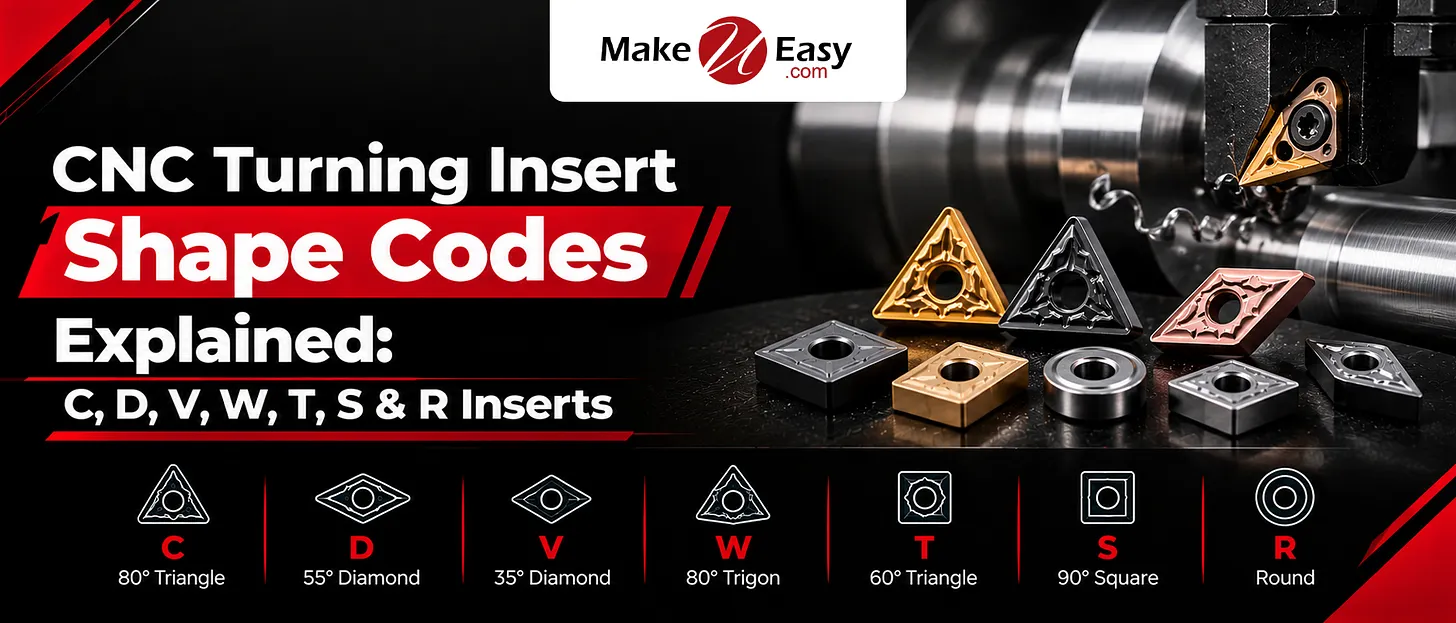
CNC Turning Insert Shape Codes Explained: C, D, V, W, T, S & R Inserts
Author : Surya makeyoueasy | Published On : 27 Oct 2026
Introduction
Selecting the right carbide turning insert is essential for achieving accurate dimensions, good surface finish, and reliable tool life. However, insert codes such as CNMG, DNMG, VNMG, and WNMG can be confusing if you do not understand their geometry.
The first letter identifies the insert shape, which influences corner strength, profile accessibility, and the types of turning operations the insert can perform. This guide explains the seven common CNC turning insert shapes: C, D, V, W, T, S, and R, including their advantages, limitations, and applications.
What Are CNC Turning Insert Shape Codes?
Turning insert shape codes are part of standardized insert designation systems, such as ISO 1832. The first letter identifies the insert’s basic shape and, for many common shapes, its included corner angle.
Shape selection affects how the cutting edge engages the workpiece, how easily it reaches shoulders or contours, and how much cutting load the corner can withstand.
Important: Insert shape is only one selection factor. Clearance angle, chipbreaker, carbide grade, nose radius, insert size, and toolholder compatibility also affect performance.
Types of CNC Turning Insert Shapes
1. C-Type Insert: 80° Rhombic
C-type inserts have an 80° included corner angle and are widely used for general-purpose CNC turning.
Advantages:
-
Good balance between corner strength and profile access.
-
Suitable for many external turning and facing operations.
-
Available in a wide range of grades and chipbreaker geometries.
Applications: General turning, semi-finishing, and suitable for roughing operations.
Common code: CNMG. The actual performance depends on the insert’s other designation letters and cutting geometry.
2. D-Type Insert: 55° Rhombic
D-type inserts have a 55° included corner angle, making them useful for profiling and machining more detailed contours.
Advantages:
-
Better access to angled profiles and selected narrow features.
-
Suitable for contour turning and finishing.
-
Useful when an 80° insert cannot reach the required profile.
Applications: Copy turning, contour machining, shoulder transitions, and profile finishing.
Limitation: The smaller corner angle generally offers less cutting-edge support than a comparable C-type insert under heavy cutting loads.
Common code: DNMG.
3. V-Type Insert: 35° Rhombic
V-type inserts have a narrow 35° included corner angle. Their geometry allows access to intricate contours and tight profiles.
Advantages:
-
Excellent access to detailed profiles.
-
Suitable for fine contouring and finishing.
-
Useful for machining narrow grooves or angled features when the tool setup permits.
Applications: Precision profiling, complex contours, and light finishing cuts.
Limitation: The sharp corner is relatively delicate and may chip under heavy feeds, deep cuts, or unstable conditions.
Common code: VNMG.
4. W-Type Insert: 80° Trigon
W-type inserts use a trigon shape with an 80° corner geometry. Depending on the insert design, they can provide several usable cutting corners.
Advantages:
-
Offers multiple cutting edges in suitable designs.
-
Useful for general turning and facing.
-
Can provide an economical option when cost per usable edge matters.
Applications: General external turning, facing, and selected production machining operations.
Limitation: Confirm the insert’s seating, clearance, and toolholder compatibility before replacing another shape with a W-type insert.
Common code: WNMG.
5. T-Type Insert: 60° Triangle
T-type inserts have a triangular shape with 60° corners. They are used in turning operations where their geometry and holder arrangement provide suitable cutting access.
Advantages:
-
Three corners per face in a typical triangular design.
-
Useful for selected turning and facing applications.
-
Offers an alternative where a triangular insert fits the required holder.
Applications: General turning, facing, and selected profiling operations.
Limitation: Corner strength and usable cutting edges depend on whether the insert is positive or negative and on its specific design.
Common code: TNMG.
6. S-Type Insert: Square
S-type inserts are square, with 90° corners. Their geometry provides strong corners and can support demanding machining when the setup is sufficiently rigid.
Advantages:
-
Strong cutting corners.
-
Suitable for higher-load machining with compatible geometry.
-
Multiple usable corners may reduce insert changes.
Applications: Rough turning, facing, and machining components where rigidity is adequate.
Limitation: The square shape may restrict access to some tight contours and narrow shoulders.
Common code: SNMG.
7. R-Type Insert: Round
R-type inserts have a circular cutting geometry rather than a defined polygonal corner angle. Their curved edge distributes cutting load across a larger contact area under suitable conditions.
Advantages:
-
Strong cutting edge with no sharp polygonal corner.
-
Suitable for high material-removal rates in appropriate setups.
-
Useful for machining certain curved surfaces and profiles.
Applications: Heavy roughing, profiling, selected cast-iron machining, and operations requiring a robust cutting edge.
Limitation: Round inserts can generate high cutting forces, especially at larger depths of cut. Check machine power, workpiece rigidity, and chip control.
Common code: RNMG.
CNC Turning Insert Shape Comparison
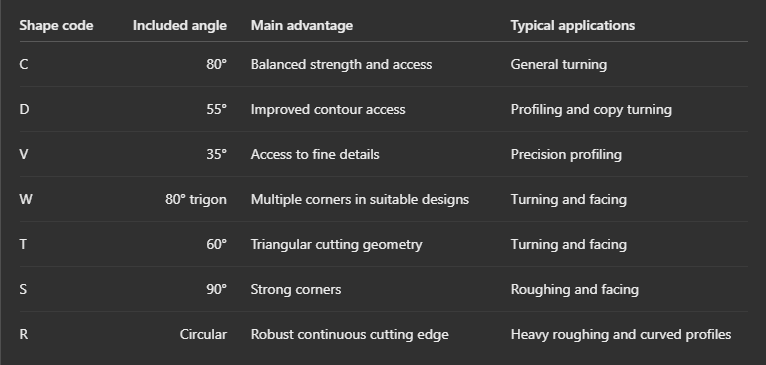
These are general tendencies. Actual performance depends on insert design, clearance, chipbreaker, grade, nose radius, cutting parameters, and machine rigidity.
How to Read a CNC Turning Insert Code
Consider the example CNMG 120408:
-
C: Insert shape, 80° rhombic.
-
N: Clearance angle of 0°.
-
M: Tolerance class.
-
G: Insert style or feature configuration.
-
12: Size designation.
-
04: Thickness designation.
-
08: Nose-radius designation, commonly 0.8 mm in this ISO-style example.
The exact interpretation of size fields and additional suffixes depends on the designation system and manufacturer. Always check the supplier’s catalogue before ordering a replacement.
How to Choose the Right Insert Shape
-
For general turning: Start by considering C-type inserts for a practical balance of strength and access.
-
For detailed contours: Consider D-type or V-type inserts, depending on the required profile and cutting load.
-
For multiple cutting corners: Compare suitable W-type, T-type, or S-type designs and calculate cost per usable edge.
-
For heavy roughing: Consider S-type or round R-type inserts when the machine and workpiece can handle the cutting forces.
-
For tight shoulders: Check the insert corner angle, holder approach angle, and clearance to ensure the tool can reach the feature.
-
Before ordering: Match the complete insert code, dimensions, chipbreaker, grade, and holder compatibility.
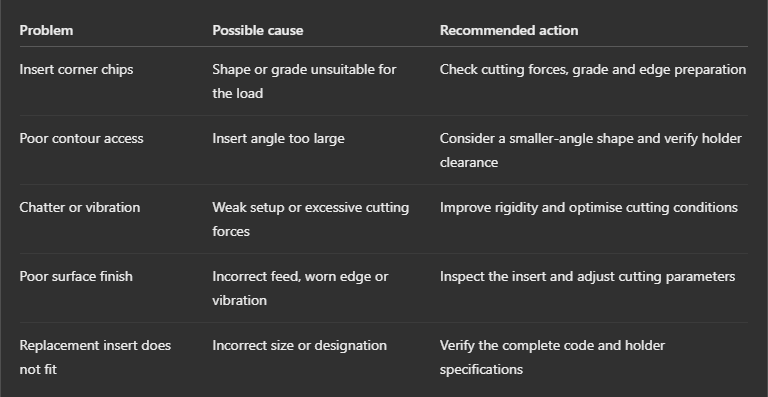
Common Insert Selection Problems
Why Choose MakeYouEasy?
MakeYouEasy provides CNC tooling information and machining resources to help manufacturing professionals understand cutting tools and make informed tooling decisions.
Understanding insert geometry and application requirements can help reduce selection errors, improve machining consistency, and support more efficient production.
Explore machining resources at MakeYouEasy.com.
Conclusion
CNC turning insert shape codes help machinists identify cutting geometry and choose suitable inserts for different operations. C-type inserts are versatile; D-type and V-type inserts support detailed profiling; W-type inserts offer multiple corners in suitable designs; T-type inserts provide triangular geometry; S-type inserts offer strong square corners, and R-type inserts provide a robust circular cutting edge.
The best insert is not determined by shape alone. Always consider the workpiece material, cutting operation, holder compatibility, chipbreaker, grade, and machine rigidity before making your selection.
FAQs
1. Which CNC turning insert shape is best for general turning?
C-type inserts are a common starting point because they balance corner strength and profile access.
2. What is the difference between C-type and D-type inserts?
C-type inserts have an 80° included angle, while D-type inserts have a 55° angle for improved access to many contours.
3. Which insert shape is best for fine profiling?
V-type inserts are often suitable for fine profiling because their 35° corner can reach detailed contours, provided cutting loads remain appropriate.
4. Are round R-type inserts suitable for roughing?
Yes, round inserts can suit heavy roughing when the machine, workpiece, and cutting conditions can handle their cutting forces.
5. Does the first letter of a turning insert code indicate its shape?
Yes, in common ISO-style designations, the first letter identifies the insert shape.
Popular Search Keywords
CNC turning insert shape codes, C-type turning insert, D-type turning insert, V-type carbide insert, WNMG insert, TNMG insert, SNMG insert, RNMG insert, carbide turning insert types, CNC lathe insert selection
