CNC Milling Inserts vs Turning Inserts | Complete Comparison Guide
Author : Surya makeyoueasy | Published On : 15 Jul 2026
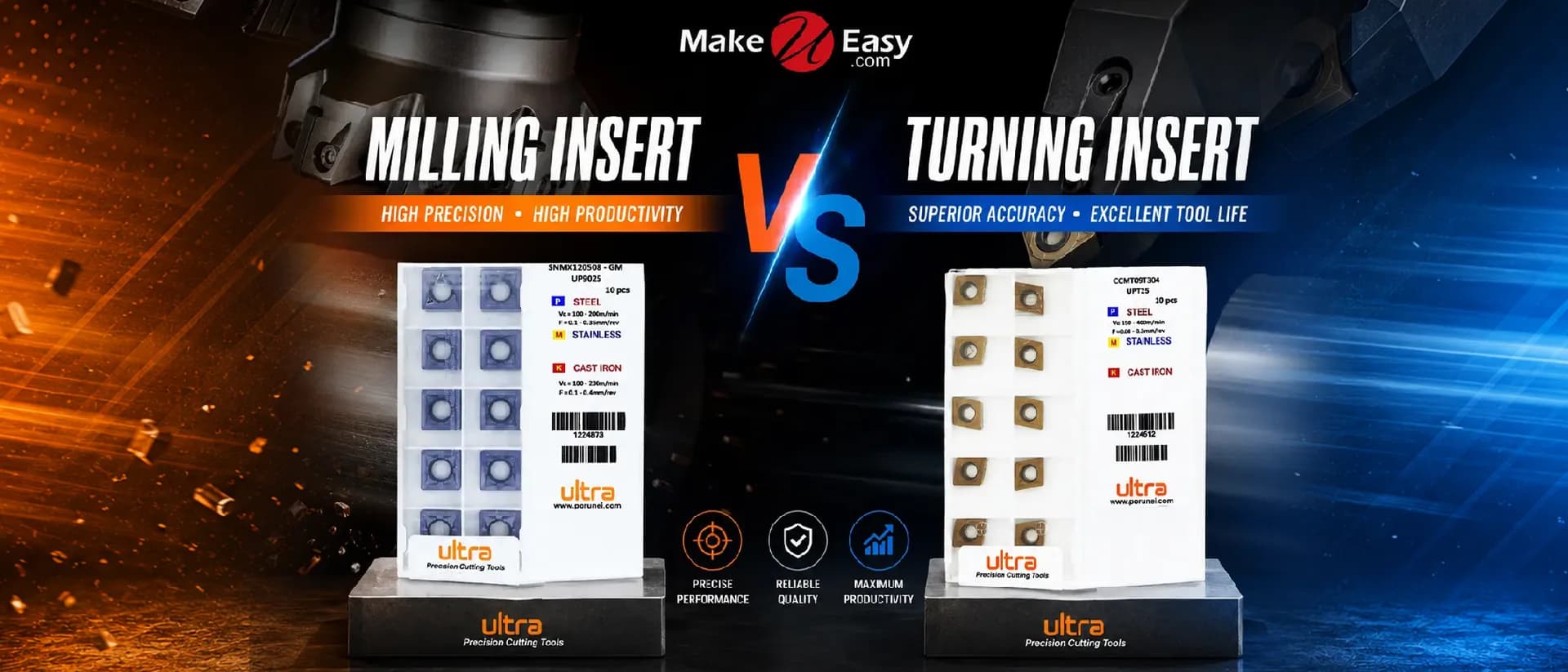
Introduction
Choosing the right cutting insert is one of the most important decisions in CNC machining. Whether you're operating a VMC machining center or a CNC lathe, selecting the correct insert directly affects machining accuracy, surface finish, productivity, and tool life.
Among the most commonly used CNC cutting tools are milling inserts and turning inserts. Although both are replaceable carbide inserts, they are designed for different machining operations and should not be used interchangeably.
This guide explains the difference between milling and turning inserts, their applications, benefits, and how to choose the right insert for your machining requirements.
What Are Milling Inserts?
Milling inserts are replaceable carbide cutting tips mounted on milling cutters. They rotate with the cutter to remove material from the workpiece.
These inserts are commonly used in CNC milling machines and VMCs for producing flat surfaces, slots, contours, and complex shapes.
Common Milling Operations
- Face Milling
- Shoulder Milling
- Slot Milling
- Profile Milling
- Pocket Milling
- High Feed Milling
Benefits of Milling Inserts
- High material removal rate
- Excellent surface finish
- Easy insert replacement
- Lower tooling cost
- Longer tool life
- Suitable for high-speed machining
What Are Turning Inserts?
Turning inserts are replaceable carbide inserts used in CNC lathes. During turning operations, the workpiece rotates while the insert remains stationary and removes material.
Turning inserts are available in various shapes and grades for roughing, finishing, threading, grooving, and boring.
Common Turning Operations
- External Turning
- Internal Turning
- Facing
- Profiling
- Boring
- Chamfering
Benefits of Turning Inserts
- High dimensional accuracy
- Smooth surface finish
- Excellent wear resistance
- Fast insert indexing
- Reduced machine downtime
- Cost-effective machining
Milling Inserts vs Turning Inserts
| Feature | Milling Inserts | Turning Inserts |
|---|---|---|
| Machine Type | CNC Milling Machine / VMC | CNC Lathe |
| Cutting Motion | Rotating Tool | Rotating Workpiece |
| Main Purpose | Milling Operations | Turning Operations |
| Applications | Face milling, slotting, profiling | Facing, turning, boring |
| Tool Holder | Milling Cutter | Turning Holder |
| Material Removal | Intermittent Cutting | Continuous Cutting |
| Productivity | High | High |
| Accuracy | Excellent | Excellent |
Types of Milling Inserts
Different milling applications require different insert geometries.
Face Milling Inserts
Ideal for machining flat surfaces with an excellent finish.
Shoulder Milling Inserts
Used for creating accurate 90-degree shoulders.
High Feed Milling Inserts
Designed for high-speed machining and increased productivity.
Round Milling Inserts
Suitable for heavy roughing and contour machining.
Aluminum Milling Inserts
Specially designed for aluminum and non-ferrous materials.
Types of Turning Inserts
Turning inserts are available in various shapes and cutting styles.
CNMG Inserts
Suitable for heavy roughing and general machining.
DNMG Inserts
Ideal for finishing and profiling applications.
VNMG Inserts
Perfect for contouring and precision machining.
TNMG Inserts
Commonly used for medium-duty turning operations.
Threading Inserts
Used for external and internal thread cutting.
Grooving Inserts
Designed for groove cutting and parting operations.
How to Choose the Right Insert
Selecting the correct insert depends on several factors.
Workpiece Material
Different materials require different insert grades.
- Steel
- Stainless Steel
- Cast Iron
- Aluminum
- Titanium
Machining Operation
Choose inserts based on the machining process.
- Face Milling
- Slot Milling
- External Turning
- Internal Turning
- Profiling
- Boring
Insert Geometry
Insert shape affects cutting performance.
Common geometries include:
- Square
- Round
- Diamond
- Triangle
- Rhombic
Insert Coating
Coatings improve wear resistance and heat protection.
Popular coatings include:
- TiN
- TiCN
- TiAlN
- AlTiN
Cutting Speed & Feed
Always select inserts suitable for your machining parameters to maximize tool life.
Common Mistakes to Avoid
Avoid these common errors when selecting CNC inserts:
❌ Using turning inserts for milling operations
❌ Choosing the wrong insert grade
❌ Incorrect cutting speed and feed
❌ Poor tool holder clamping
❌ Ignoring insert nose radius
❌ Using worn-out inserts
Why High-Quality Inserts Matter
Using premium carbide inserts helps:
- Improve machining accuracy
- Increase production efficiency
- Extend tool life
- Reduce tooling costs
- Improve surface finish
- Minimize machine downtime
Investing in quality inserts leads to better machining performance and lower long-term operating costs.
Conclusion
Understanding the difference between milling and turning inserts helps machinists choose the right tool for each operation. While milling inserts are designed for rotating cutters in milling machines, turning inserts are optimized for CNC lathes where the workpiece rotates.
Using the correct insert improves machining accuracy, extends tool life, reduces production costs, and delivers superior surface finishes. Whether you're machining steel, aluminum, or stainless steel, selecting the right carbide insert is essential for efficient CNC machining.
If you're looking for high-quality CNC milling inserts, turning inserts, carbide cutting tools, and CNC accessories, explore the complete product range at Makeyoueasy and equip your workshop with reliable machining solutions.
Frequently Asked Questions (FAQs)
Milling inserts are used on rotating milling cutters for operations like face milling and slotting, while turning inserts are used on CNC lathes where the workpiece rotates for turning and facing operations.
No. Turning inserts are specifically designed for turning operations and should not be used as milling inserts.
Tool life depends on the workpiece material, machining parameters, insert grade, and coating. High-quality carbide inserts generally provide longer service life.
Consider the workpiece material, machining operation, insert geometry, coating, and machine compatibility before selecting an insert.
You can find a wide range of CNC milling inserts, turning inserts, milling cutters, and CNC accessories at .
POPULAR SEARCHES
Best CNC Milling Inserts for Precision Machining
CNC Milling Inserts vs Turning Inserts
How to Increase End Mill Tool Life in CNC Machining
ER Collets for CNC Machines
How to Choose the Right Carbide Cutter
VMC Fine Boring Heads
Indexable Cutters for CNC Machining
Solid Carbide Thread Mills
CNC Pull Studs
Boring Bar Cartridge (Rigibore Equivalent)
POPULAR SEARCHES
Best CNC Milling Inserts for Precision Machining
CNC Milling Inserts vs Turning Inserts
How to Increase End Mill Tool Life in CNC Machining
How to Choose the Right Carbide Cutter
