CNC Milling Cutter Selection Based on Workpiece Size and Geometry
Author : Surya makeyoueasy | Published On : 30 Sep 2026
Introduction
Selecting the correct CNC milling cutter depends heavily on the size and geometry of the workpiece. A cutter suitable for a large flat surface may not be appropriate for a deep pocket, narrow slot, thin wall, or small internal corner. Workpiece features, cutting depth, radial engagement, required surface finish, machine capability, and tool rigidity should all be considered before selecting the cutter.
1. Analyze the Workpiece Before Selecting the Cutter
Start by studying the component drawing or CAD model.
Identify:
-
Overall workpiece size
-
Flat surfaces
-
Pockets and cavities
-
Slots
-
Shoulders
-
Thin walls
-
Internal corners
-
Curved or contoured surfaces
-
Required machining depth
-
Tolerance and surface-finish requirements
The geometry of the feature determines how much access the cutter needs and which cutter type can machine it efficiently.
2. Select the Cutter Diameter According to the Feature
Cutter diameter is one of the first dimensions to check.
Large Flat Surfaces
For large surfaces, a larger face mill or milling cutter can cover more material per pass and improve productivity.
Small Features
For narrow slots, small pockets, and detailed profiles, a smaller cutter may be necessary to reach the feature without interference.
However, smaller cutters can be more sensitive to deflection and may require more passes.
Key point: Choose the largest practical cutter that can access the feature while maintaining the required rigidity and clearance.
3. Consider Pocket Size and Corner Radius
Internal pockets require special attention to cutter diameter and corner geometry.
If a pocket has a small internal corner radius, an oversized cutter may not be able to reach the corner without leaving excess material.
For example, a pocket with a 5 mm internal corner radius requires a cutter geometry that can physically access that radius.
A useful strategy is:
-
Use a larger cutter for bulk material removal.
-
Use a smaller cutter for corners and remaining material.
-
Use a finishing cutter when tighter geometry or surface finish is required.
This combination can be more efficient than using one small cutter for the entire pocket.
4. Match the Cutter to Slot Width
For full-slot milling, the cutter engages the workpiece across its full diameter.
The cutter diameter should therefore correspond appropriately to the required slot width and the selected milling strategy.
Full-slotting produces high radial engagement, which can significantly increase cutting load. Cutter pitch, machine power, tool rigidity, and chip evacuation become particularly important.
For wider slots, multiple passes may be preferable instead of forcing a small cutter into an unnecessarily heavy full-width cut.
5. Consider Thin Walls
Thin walls are vulnerable to vibration and deflection.
Using an unnecessarily large cutter or aggressive cutting engagement can push the wall away from the tool, resulting in:
-
Dimensional errors
-
Chatter
-
Poor surface finish
-
Wall deformation
-
Uneven tool wear
For thin-wall machining, consider a suitable cutter geometry, lower cutting load, controlled radial engagement, and a rigid tool assembly.
The cutter should provide enough access without creating unnecessary cutting pressure on the wall.
6. Check the Required Cutting Depth
The required axial depth of cut (ap) must be compatible with the cutter.
A shallow feature may be machined efficiently with a standard cutter, while a deep cavity may require:
-
Extended-reach tooling
-
A smaller cutter
-
Multiple depth passes
-
A suitable long-edge cutter
-
A specialized cavity-milling strategy
Sandvik defines ap as the axial depth removed by the tool and ae as the radial width engaged with the workpiece. Both should be evaluated when selecting a milling concept.
Do not choose a cutter based only on diameter. Check its effective cutting length and recommended maximum depth of cut.
7. Consider Tool Reach and Overhang
Deep features often require longer tool assemblies, but excessive overhang reduces rigidity and can increase vibration.
Whenever possible:
-
Use the shortest practical tool.
-
Keep the toolholder rigid.
-
Avoid unnecessary extensions.
-
Select the cutter diameter according to the required reach.
-
Reduce cutting load when long reach is unavoidable.
For slender tool assemblies, cutter and insert selection become particularly important because stability can limit the usable cutting conditions.
8. Choose the Cutter Type for the Geometry
Different workpiece features call for different milling concepts.
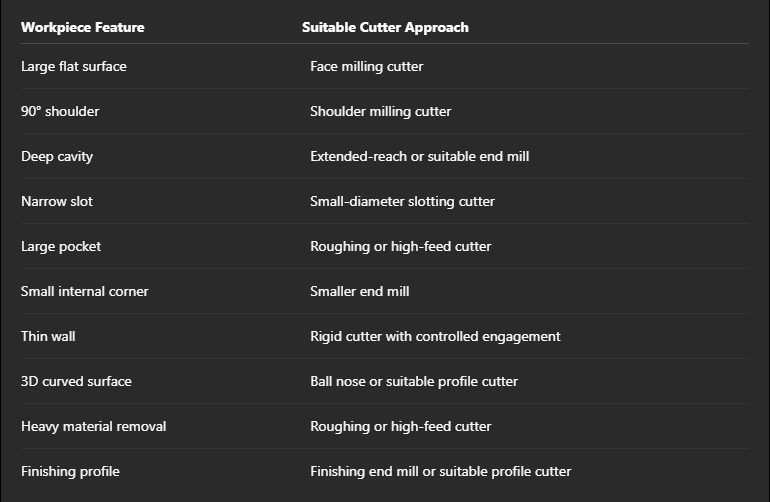
Modern milling concepts can often perform multiple operations, but the best choice still depends on the specific component geometry and machining strategy.
9. Match Cutter Pitch to Workpiece and Machine Conditions
For indexable milling cutters, cutter pitch also matters.
A coarse-pitch cutter with fewer cutting edges can be useful when:
-
Machine power is limited
-
The setup is unstable
-
Tool overhang is long
-
Full-slotting is required
Medium-pitch cutters are suitable for many general machining conditions, while close-pitch cutters can provide higher productivity when the machine and setup are stable.
10. Consider Workpiece Size and Machine Capacity Together
A large workpiece does not automatically require a large cutter.
The actual feature being machined is more important than the overall component size.
For example:
-
A large plate with a small pocket may need a small end mill.
-
A small block with a large flat surface may benefit from a larger face mill.
-
A deep cavity may require a smaller cutter even when the workpiece itself is large.
Always check spindle power, torque, maximum tool diameter, toolholder capacity, and available machine travel before selecting the cutter.
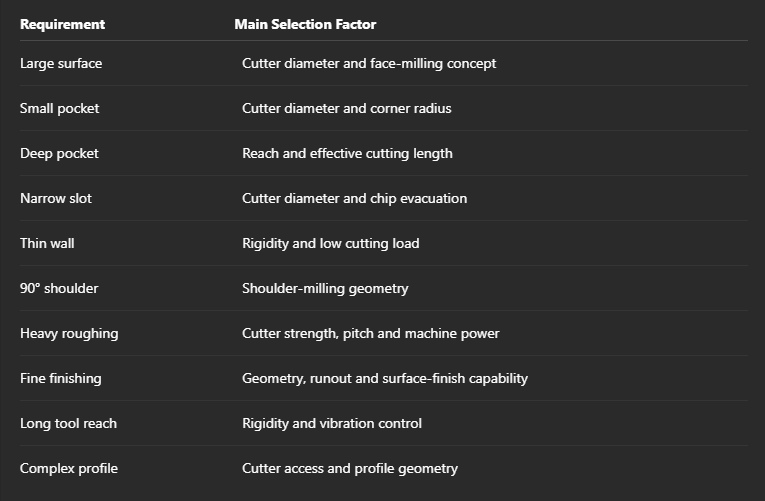
Quick Cutter Selection Guide
Common Cutter Selection Mistakes
Choosing Only by Workpiece Size
The overall size of the component does not determine the cutter by itself. The individual machining feature is more important.
Using One Cutter for Every Operation
Roughing, pocketing, slotting, profiling, and finishing may require different cutter sizes and geometries.
Ignoring Internal Corner Radius
An oversized cutter may remove material quickly but leave unwanted material in small internal corners.
Using Excessive Tool Overhang
Long reach can reduce rigidity and increase vibration, particularly with smaller-diameter cutters.
Ignoring Machine Capability
A large cutter may require more spindle power and torque than the machine can provide effectively.
Why Choose MakeYouEasy?
At MakeYouEasy, you can explore CNC milling cutters, end mills, inserts, drills, holders, and other machining tools for different applications.
Before selecting a cutter, compare the workpiece feature, cutter diameter, cutting depth, radial engagement, corner radius, tool reach, material, machine capability, and required finish.
Conclusion
CNC milling cutter selection should begin with the workpiece geometry and machining feature, not simply the overall component size. Large surfaces may benefit from larger cutters, while pockets, slots, thin walls, small corners, and deep cavities require more specialized choices.
The correct cutter balances accessibility, diameter, depth, rigidity, cutter pitch, machine capability, and cutting conditions. An efficient machining strategy may also use different cutter sizes for roughing, corner cleanup, and finishing rather than relying on one tool for the complete component.
Frequently Asked Questions
1. How do I choose a CNC milling cutter for a workpiece?
Select the cutter according to the feature geometry, workpiece material, cutter diameter, depth, radial engagement, machine capability, and required surface finish.
2. Should I always use a larger cutter?
No, use the largest practical cutter that can access the feature while maintaining sufficient clearance, rigidity, and suitable cutting conditions.
3. What cutter is suitable for deep pockets?
A suitable extended-reach or long-edge cutter can be used, but tool overhang and rigidity must be carefully controlled.
4. Which cutter is suitable for small internal corners?
A smaller-diameter end mill with a suitable corner radius can provide better access to small internal corners.
5. Why is cutter pitch important?
Cutter pitch determines the number and spacing of cutting edges and should be matched to machine stability, power, material, and cutting engagement.
Popular Search Keywords
CNC milling cutter selection, milling cutter selection guide, CNC cutter selection based on workpiece, milling cutter diameter selection, CNC end mill selection, milling cutter for pockets, milling cutter for slots, CNC milling tool selection, cutter selection for machining, CNC milling cutter size
