CNC Drill Point Geometry Explained: What Does It Mean for Performance?
Author : Surya makeyoueasy | Published On : 29 Sep 2026
Introduction
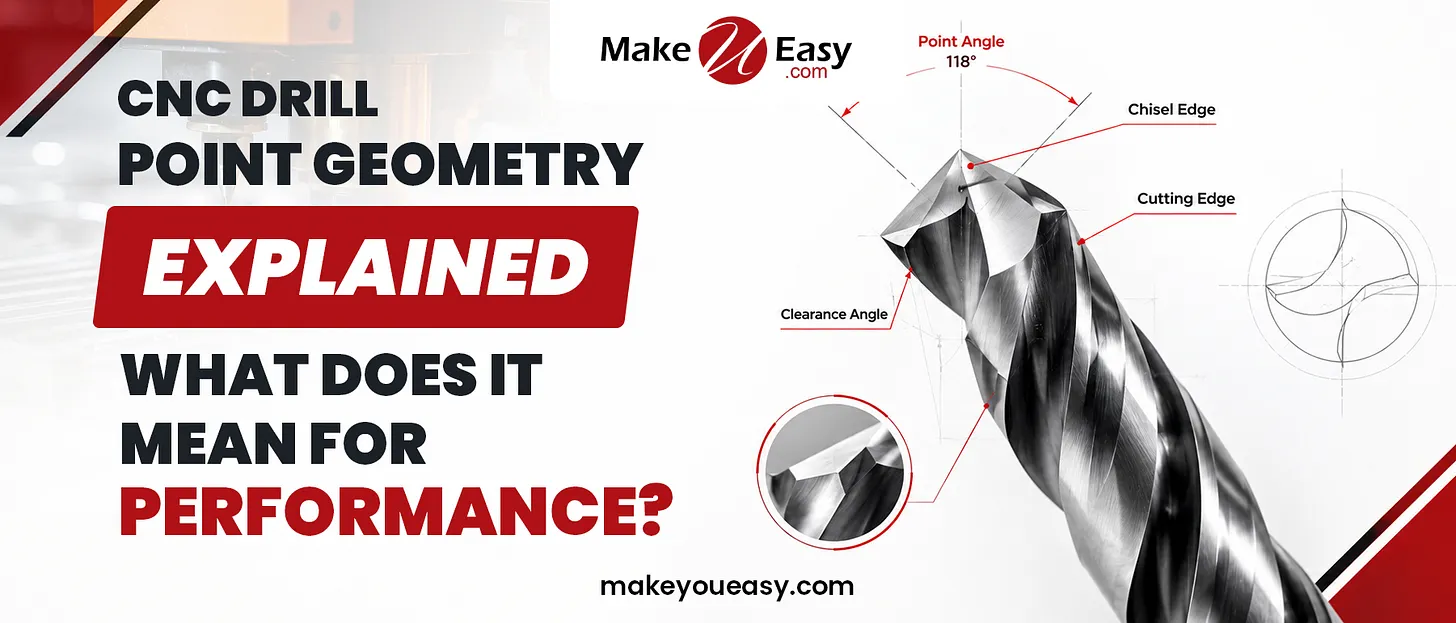
The geometry of a CNC drill directly affects how it enters the workpiece, handles cutting forces, forms chips, and produces holes. Two drills with the same diameter can perform very differently because of their point angle, split-point design, web thickness, helix angle, and relief geometry. Understanding these features helps machinists select the right drill for the material, hole depth, machine, and required accuracy.
1. What Is Drill Point Geometry?
Drill point geometry refers to the shape and angles formed at the cutting end of the drill.
Important features include:
-
Point angle
-
Split-point geometry
-
Web thickness
-
Lip relief angle
-
Rake angle
-
Chisel-edge geometry
-
Helix angle
These features work together, so point angle should not be considered in isolation. Different combinations can change thrust force, centering behaviour, chip formation, heat generation, and tool life.
2. What Does the Point Angle Mean?
The point angle is the included angle between the two main cutting lips.
Two commonly encountered drill point angles are 118° and 135°.
118° Point
A 118° point has a relatively sharp, longer point and is widely used as a general-purpose geometry.
It can be suitable for:
-
General drilling
-
Mild and low-carbon steels
-
Aluminium
-
Brass
-
General workshop applications
The sharper point provides a familiar general-purpose cutting geometry, but the exact performance still depends on the drill material, web design, coating, helix, and workpiece.
135° Point
A 135° point is flatter and shorter than a conventional 118° point of the same diameter.
It is commonly used in drills designed for:
-
Stainless steel
-
Alloy steels
-
Tougher materials
-
CNC production drilling
-
Applications where controlled entry is important
The flatter point provides a stronger cutting edge, while a split-point grind can improve centering and reduce the load on the central chisel edge.
3. What Is a Split Point?
The split point is different from the point angle.
At the centre of a conventional twist drill is a chisel edge. This area does not cut in the same way as the main cutting lips and contributes significantly to the thrust required to start the hole.
A split-point grind modifies this central region and creates additional cutting edges closer to the centre.
Main benefits include:
-
Better self-centering
-
Reduced tendency to walk
-
Lower starting thrust
-
More controlled hole entry
-
Improved consistency in CNC drilling
A split point can therefore make a major difference even when two drills have the same point angle.
4. Why Does Web Thickness Matter?
The web is the central portion of the drill between the flutes.
A thicker web provides greater structural support, but it also creates a larger central chisel region. This can increase thrust during drilling.
Web thinning reduces the thickness of the web near the point and helps reduce the size and effect of the chisel edge.
This is particularly useful for larger-diameter drills and CNC applications where reducing axial load and improving entry behaviour are important.
5. How Does Helix Angle Affect Performance?
The helix angle describes the angle of the drill’s helical flutes.
It influences:
-
Chip evacuation
-
Cutting action
-
Rake characteristics
-
Heat removal
-
Performance in different materials
Higher-helix designs can be useful for materials that produce long, continuous chips, while other materials and drilling conditions may require different flute geometries.
Therefore, selecting a drill only by point angle can overlook an important part of the cutting system.
6. What Is Lip Relief?
The lip relief angle provides clearance behind the cutting edge so the drill can cut without excessive rubbing.
Insufficient relief can increase friction and heat, while excessive or inconsistent relief can weaken the cutting edge.
Correct relief geometry helps maintain a balance between:
-
Cutting efficiency
-
Edge strength
-
Heat generation
-
Tool life
-
Hole quality
This is one reason manufacturer-specific drill geometries can perform differently even when their point angles appear identical.
118° vs 135° Drill Geometry
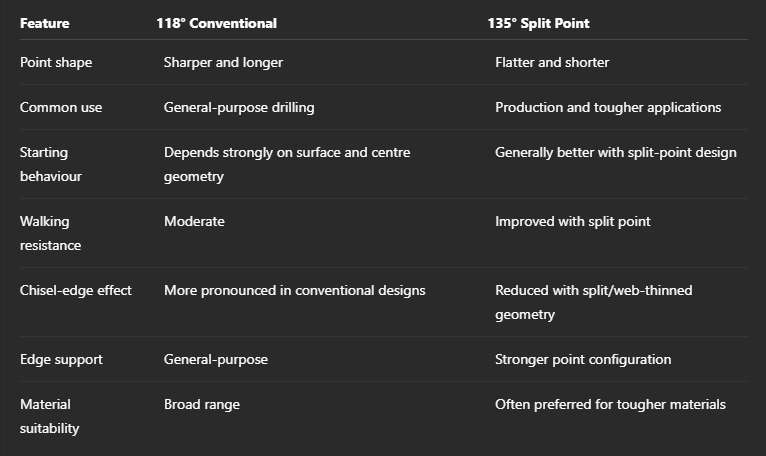
The table describes common geometry characteristics, not universal rules. The complete drill design and manufacturer’s recommended application should always take priority.
7. How Drill Geometry Affects CNC Performance
Correct geometry can influence several important machining results.
Hole Location
A suitable split-point design can reduce walking during entry and improve consistency.
Thrust Force
Web thinning and split-point geometry can reduce the load associated with the central chisel region.
Chip Evacuation
Helix and flute geometry influence how effectively chips move away from the cutting zone.
Tool Life
Correct geometry distributes cutting forces and heat more appropriately for the application, helping prevent premature wear or edge damage.
Hole Quality
Point geometry, rigidity, runout, cutting parameters, coolant, and tool condition all contribute to hole accuracy and surface quality.
8. Common Drill Geometry Selection Mistakes
Choosing Only by Point Angle
A 135° drill is not automatically better than a 118° drill. Split point, web thickness, helix, coating, relief, and drill material also matter.
Ignoring the Workpiece Material
The ideal geometry for aluminium may not be suitable for stainless steel or hardened material.
Using the Wrong Spotting Strategy
When spotting is required, the spot geometry should be compatible with the main drill. Some self-centering drill designs may not require the same spotting approach.
Ignoring Tool Runout
Even an advanced drill geometry can produce poor holes when excessive runout or poor tool holding is present.
Using Incorrect Cutting Parameters
Point geometry cannot compensate for excessive speed, feed, insufficient coolant, or poor chip evacuation.
Why Choose MakeYouEasy?
At MakeYouEasy, you can explore CNC drills, indexable drills, milling cutters, inserts, holders, and other machining tools for different applications.
When selecting a CNC drill, compare the diameter, point angle, split-point design, web geometry, helix, coating, cutting length, workpiece material, and recommended cutting parameters rather than choosing by diameter alone.
Conclusion
CNC drill point geometry plays an important role in drilling performance. The 118° and 135° point angles create different point shapes, while split-point and web-thinning designs can improve centering and reduce the effect of the central chisel edge.
However, point angle is only one part of drill design. Helix angle, relief, web geometry, coating, drill material, machine rigidity, coolant, and cutting parameters all influence the final result. Selecting the complete drill geometry according to the workpiece and application can help achieve better hole quality, tool life, and machining consistency.
Frequently Asked Questions
1. What is the most common CNC drill point angle?
118° is a widely used general-purpose point angle, while 135° geometries are common in many production and tougher-material drilling applications.
2. Is a 135° drill better than an 118° drill?
Neither is universally better; the appropriate point geometry depends on the material, machine, hole requirements, and complete drill design.
3. What is a split-point drill?
A split-point drill has modified centre geometry that reduces the conventional chisel-edge effect and improves starting and centering behaviour.
4. Does drill point angle affect thrust force?
Yes, point geometry can influence thrust, but web thickness, chisel-edge design, split point, feed, and other geometry also contribute.
5. What other drill geometry should I check?
Check the helix angle, web thickness, relief, rake, split-point design, coating, cutting length, and manufacturer’s recommended application.
Popular Search Keywords
CNC drill point geometry, drill point angle, 118-degree drill, 135-degree drill, 118 vs 135 drill, split point drill, CNC drill geometry, web thinning drill, drill geometry for CNC, CNC drilling tools
