Cloud Storage Pricing: Understanding Costs and Choosing the Right Storage Solution
Author : 10petabyte 10PB | Published On : 04 Nov 2026
As businesses generate and manage increasing amounts of digital information, choosing the right storage infrastructure has become an important operational decision. Documents, customer records, application data, multimedia files, and business backups all require secure and accessible storage. Traditional storage systems can meet some requirements, but growing organizations often need more flexible ways to manage their data.
Cloud storage provides an alternative by allowing businesses to store information on remotely accessible infrastructure rather than relying exclusively on local storage devices. However, before adopting a solution, organizations need to understand the costs involved and determine which option best fits their requirements.
Understanding cloud storage pricing helps businesses compare storage solutions, plan their budgets, and avoid paying for resources they do not need.
What Is Cloud Storage?
Cloud storage is a service that allows users to store digital information on infrastructure managed through a cloud platform. Instead of keeping all files on computers or physical storage devices at their workplace, users can access stored information through an internet connection or an appropriate private network.
Depending on the service, cloud storage may support file sharing, automated backups, data synchronization, collaboration, archival storage, and integration with business applications.
Individuals can use cloud storage to manage personal documents and photographs, while businesses may rely on it for operational data, project files, databases, and large digital archives.
The infrastructure and service features vary between providers. Therefore, organizations should evaluate storage capacity, access requirements, security controls, and service terms before making a decision.
Why Does Cloud Storage Pricing Matter?
Storage costs can become significant as an organization accumulates more information. A company that stores a few documents has very different requirements from a business maintaining large media libraries, customer datasets, or years of archived records.
Evaluating cloud storage pricing helps organizations understand how storage decisions affect their operating budgets.
A suitable pricing model should reflect how much data a business stores, how frequently that data is accessed, and what additional services are required.
For example, a business that regularly collaborates on large files may prioritize fast access and convenient sharing. Another organization that retains historical records may place greater importance on long-term retention and retrieval costs.
Comparing these requirements before selecting a plan helps businesses make informed decisions rather than choosing a service based only on its advertised storage capacity.
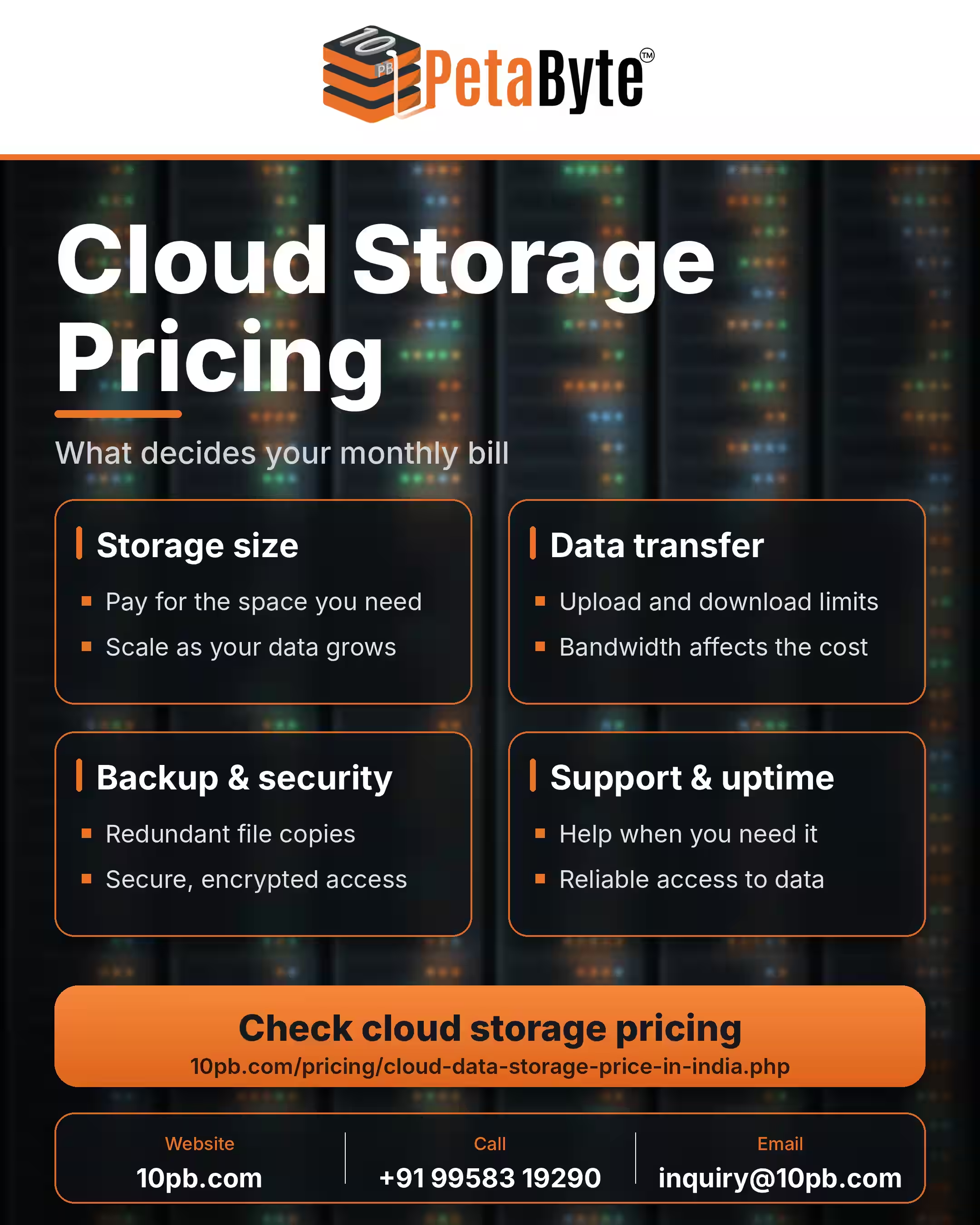
Factors That Influence Cloud Storage Costs
Several factors can influence the overall cost of a cloud storage solution.
1. Storage Capacity
The amount of data stored is one of the most important considerations.
Businesses should estimate their current storage requirements and consider how quickly their data is likely to grow. Choosing insufficient capacity can create operational challenges, while purchasing substantially more capacity than necessary may increase costs without providing immediate value.
A practical approach is to review existing data, identify unused files, and estimate future storage requirements before selecting a plan.
2. Data Access Frequency
Not all stored information needs to be accessed equally often.
Active project files, frequently used documents, and application data may require regular access. Historical records and older backups may be retrieved only occasionally.
Some providers offer different storage classes according to access frequency and retrieval requirements. Lower-cost archival options may be suitable for infrequently accessed information, but businesses should review retrieval fees, access delays, and minimum storage periods before choosing them.
3. Data Transfer
Moving information into or out of a cloud environment can affect the total cost of storage.
Depending on the provider and service, charges may apply to certain data transfers, downloads, or network operations. Businesses that regularly move large files should examine these terms carefully.
Understanding transfer requirements is especially important for organizations managing multimedia content, large datasets, or distributed teams.
4. Security and Data Protection
Businesses often need more than basic file storage. They may require access controls, encryption, monitoring, backup capabilities, and recovery procedures.
These features can vary across service plans. Organizations should determine which protections are included and which may require additional services.
It is also important to remember that storing information in the cloud does not automatically eliminate the need for a data protection strategy. Businesses should establish appropriate access policies and recovery procedures to reduce the risk of data loss.
5. Additional Features
Some cloud storage services provide collaboration tools, file synchronization, version history, automated backups, or integration with existing applications.
These features can improve productivity and simplify data management. However, organizations should assess which capabilities they actually need instead of paying for features that will not be used.
How Businesses Can Evaluate Cloud Storage Pricing
A meaningful comparison should consider the complete cost of using a storage service rather than looking at a single advertised rate.
Businesses can begin by documenting their storage capacity requirements, expected data growth, access frequency, transfer activity, and security needs.
Next, they should compare available plans and examine the conditions attached to each option.
Important questions include:
-
How much storage capacity is included?
-
Are there limits on file size or data transfer?
-
Are download or retrieval charges applicable?
-
What security and access management features are available?
-
Are backups and version history included?
-
Can the storage capacity be expanded when needed?
-
What support options are provided?
-
Are there minimum commitments or additional service charges?
Answering these questions helps organizations compare providers on a consistent basis.
Businesses evaluating cloud storage pricing in India should also check the applicable billing currency, taxes, payment terms, and any region-specific service conditions.
Cloud Storage for Small Businesses
Small businesses often need storage that is straightforward to manage and capable of supporting day-to-day operations.
Employees may need to share documents, collaborate on projects, access files remotely, and maintain copies of important records.
Cloud storage can help simplify these activities by providing a centralized environment for managing digital information.
However, smaller organizations should avoid selecting a plan based solely on the lowest starting price. They should also consider ease of use, user management, security, recovery options, and the cost of expanding storage capacity as the business grows.
A solution that meets current needs while allowing practical expansion can help reduce unnecessary changes later.
Cloud Storage for Enterprises
Larger organizations frequently manage multiple departments, applications, and data environments. Their storage requirements may include collaboration, business continuity, regulatory record retention, and integration with existing IT infrastructure.
For these organizations, the evaluation process should include performance requirements, administrative controls, access policies, and the ability to manage data across different teams.
Enterprises may also need different storage arrangements for active business information, backup copies, and long-term archives.
Separating these requirements can help organizations choose appropriate storage options for different workloads.
The best solution is not necessarily the one with the largest capacity. It is the one that supports business requirements while providing a manageable balance between cost, performance, and data protection.
Practical Ways to Manage Storage Expenses
Businesses can take several steps to make their storage budgets more predictable.
Audit existing data: Identify duplicate files, obsolete documents, and information that no longer needs to remain in active storage.
Estimate future growth: Review historical storage usage and plan for expected increases in data volume.
Choose storage according to usage: Keep frequently accessed files in appropriate storage environments and evaluate archival options for information that is rarely retrieved.
Monitor consumption: Review storage utilization, transfer activity, and billing reports regularly.
Review backup policies: Establish suitable retention periods and determine how many copies of important information must be maintained.
Compare complete costs: Include relevant transfer, retrieval, support, and additional service charges when evaluating providers.
These practices help organizations maintain better visibility into their storage expenses without compromising essential operational requirements.
Choosing the Right Cloud Storage Solution
Selecting a cloud storage provider requires balancing affordability with reliability, accessibility, security, and flexibility.
Before making a decision, businesses should identify their primary use cases and establish clear technical requirements. They should then compare service plans based on storage capacity, access patterns, data transfer, management features, and the provider's service terms.
Reviewing the available information can help businesses understand their options and determine which solution is appropriate for their requirements.
Conclusion
Cloud storage has become an important part of modern data management, supporting everything from everyday document sharing to large-scale business information storage.
Understanding cloud storage pricing allows organizations to evaluate the factors that influence costs, compare service plans, and make better infrastructure decisions.
By estimating storage requirements, monitoring usage, reviewing additional charges, and selecting suitable security and access features, businesses can build a storage strategy that supports both current operations and future growth.
The goal is not simply to find the cheapest storage plan. It is to select a solution that provides the right combination of capacity, accessibility, protection, and cost efficiency.
1. What is cloud storage pricing?
Cloud storage pricing refers to the cost of storing and managing digital information using cloud-based infrastructure. Costs can depend on storage capacity, access frequency, data transfer, and additional service features.
2. What factors affect cloud storage costs?
Storage volume, data retrieval, transfer activity, backup requirements, security features, and service-level options can influence the overall cost.
3. Is cloud storage suitable for small businesses?
Yes. Cloud storage can help small businesses store documents, share files, maintain backups, and provide access to information across different locations.
4. How can businesses reduce cloud storage expenses?
Businesses can review stored data, remove unnecessary duplicates, monitor usage, evaluate archival storage, and compare the complete costs of different service plans.
5. Is cloud storage pricing the same for every provider?
No. Providers may use different billing models, storage classes, capacity limits, and additional service charges. Comparing these details helps businesses understand the actual cost of a solution.
6. What should businesses compare before choosing cloud storage?
Businesses should evaluate capacity, accessibility, security, backup features, transfer costs, scalability, support, and billing conditions before selecting a provider.
