Circular Economy for SMBs: Monetizing Construction Demolition Waste
Author : Shawn Fisher | Published On : 15 Sep 2026
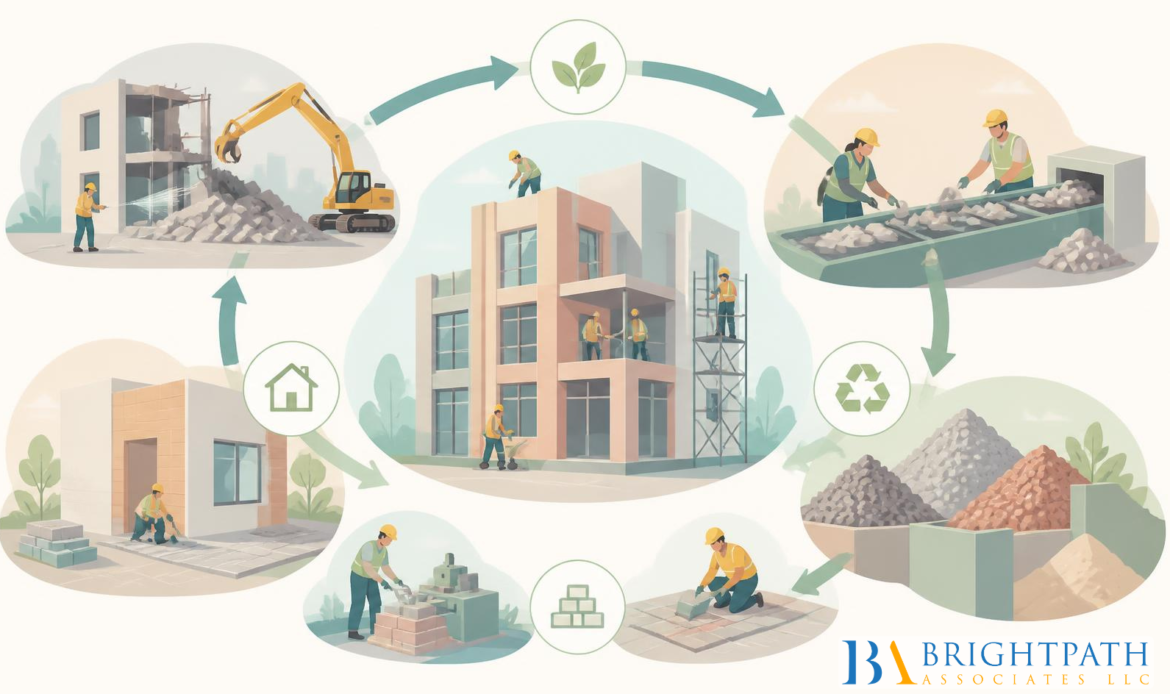
Construction and demolition waste has traditionally been treated as an unavoidable cost of doing business. Materials leave a project site, are hauled away, and often end up in landfills or low-value recycling streams. But that traditional approach is increasingly being challenged by a more strategic question: What if construction waste were treated as an economic resource rather than a disposal problem?
For small and mid-sized businesses in the building materials sector, this shift could create opportunities to reduce costs, develop new revenue streams, strengthen supply chains, and differentiate themselves in a market increasingly influenced by sustainability.
The circular economy offers a framework for making that transition. Instead of following a linear model of extracting resources, producing materials, using them, and discarding them, circular businesses attempt to keep materials in productive use for as long as possible.
For SMBs, the opportunity is not necessarily to transform an entire operation overnight. It can begin by identifying materials already leaving the business and asking whether they could have another commercial life.
Construction Waste Is Becoming a Business Opportunity
Construction and demolition activities generate enormous quantities of materials, including concrete, asphalt, wood, metals, bricks, drywall, glass, roofing products, and other components. Historically, many companies have focused primarily on the cost of collecting and disposing of these materials. A circular approach reverses the perspective. Instead of asking, “How much will it cost to dispose of this material?” leaders can ask, “What value can we recover from this material?”
Concrete can be processed into recycled aggregate. Metals can enter established secondary markets. Reclaimed timber and architectural components can potentially be reused. Certain materials can be sorted and sold to specialized processors.
The economic opportunity depends heavily on quality, consistency, contamination control, logistics, and access to buyers. This means circularity is not simply an environmental initiative. It is a business model that requires operational discipline.
The First Step: Know What Is Leaving the Business
For an SMB considering circular construction, the most practical starting point is a material-flow assessment. Leadership teams should identify which materials are being discarded, how frequently they appear, where they originate, how much they cost to transport or dispose of, and whether there are potential buyers or processors nearby.
A material that appears insignificant on an individual project may become commercially meaningful when aggregated across multiple sites. Similarly, a company may discover that it is purchasing materials that could potentially be recovered from its own operations or sourced through local secondary markets. The goal is to create visibility before investing heavily in new infrastructure.
Not All Recycling Creates the Same Value
One of the most important distinctions in circular construction is the difference between recycling for volume and recovery for value. Simply diverting materials from a landfill does not necessarily create a strong business model. If a high-quality material is mixed with contaminants and eventually sold as a low-value commodity, much of its potential economic value has already been lost.
Higher-value recovery requires better sorting, documentation, storage, processing, and quality control. Concrete provides a useful example. Processing systems can crush, grade, and prepare recovered concrete for recycled aggregate applications. The more consistently the resulting material meets technical requirements, the greater the range of potential uses.
Leadership Determines Whether Circularity Scales
The transition to a circular model requires more than an environmental commitment. It requires leadership capable of connecting operations, procurement, finance, technology, sales, and sustainability.
A company may have excellent recycling equipment but lack the commercial expertise to find profitable markets for recovered materials. Another may have strong customer demand but lack the operational discipline required to maintain consistent material quality.
This makes leadership and talent acquisition increasingly important within the building materials sector. Companies need executives and managers who can understand both traditional manufacturing economics and emerging sustainability opportunities.
Organizations looking to strengthen leadership capabilities across this evolving market can explore BrightPath Associates’ Building Materials Industry recruitment expertise for specialized talent strategies aligned with operational growth and industry transformation.
From Waste Management to Resource Management
Construction waste should not automatically be viewed as something that must disappear from a project site. Some of it can become a feedstock for another process, a product for another customer, or an input that reduces dependence on virgin resources.
That requires businesses to redesign how they think about material flows. The opportunity explored in Circular Economy for SMBs: Monetizing Construction & Demolition Waste is ultimately about changing the economic equation around waste.
For small and mid-sized businesses, circularity does not have to begin with a massive capital investment. It can begin with better measurement, smarter segregation, strategic partnerships, improved logistics, and a willingness to identify value where the traditional linear model sees only disposal.
The Strategic Question for Building Materials Leaders
The circular economy is moving construction toward a different definition of efficiency. Efficiency is no longer only about producing more materials faster or reducing manufacturing costs. Increasingly, it means getting more value from every resource throughout its lifecycle.
The companies willing to investigate that question may discover that sustainability is not simply an expense or compliance requirement. It can become a pathway to stronger margins, more resilient supply chains, new customer relationships, and long-term competitive advantage.
As circular construction continues to develop, the winners may be the businesses that learn to see waste differently—and build the leadership capabilities required to turn that vision into measurable results.
If your organization is exploring circular business models, operational transformation, or leadership requirements within the building materials sector, now is the time to evaluate whether your current team has the expertise to capture the opportunity.
