Choosing Colocation Hosting Providers in the UAE: A Practical Business Checklist
Author : NetForChoice Storage solution UAE | Published On : 21 Oct 2026
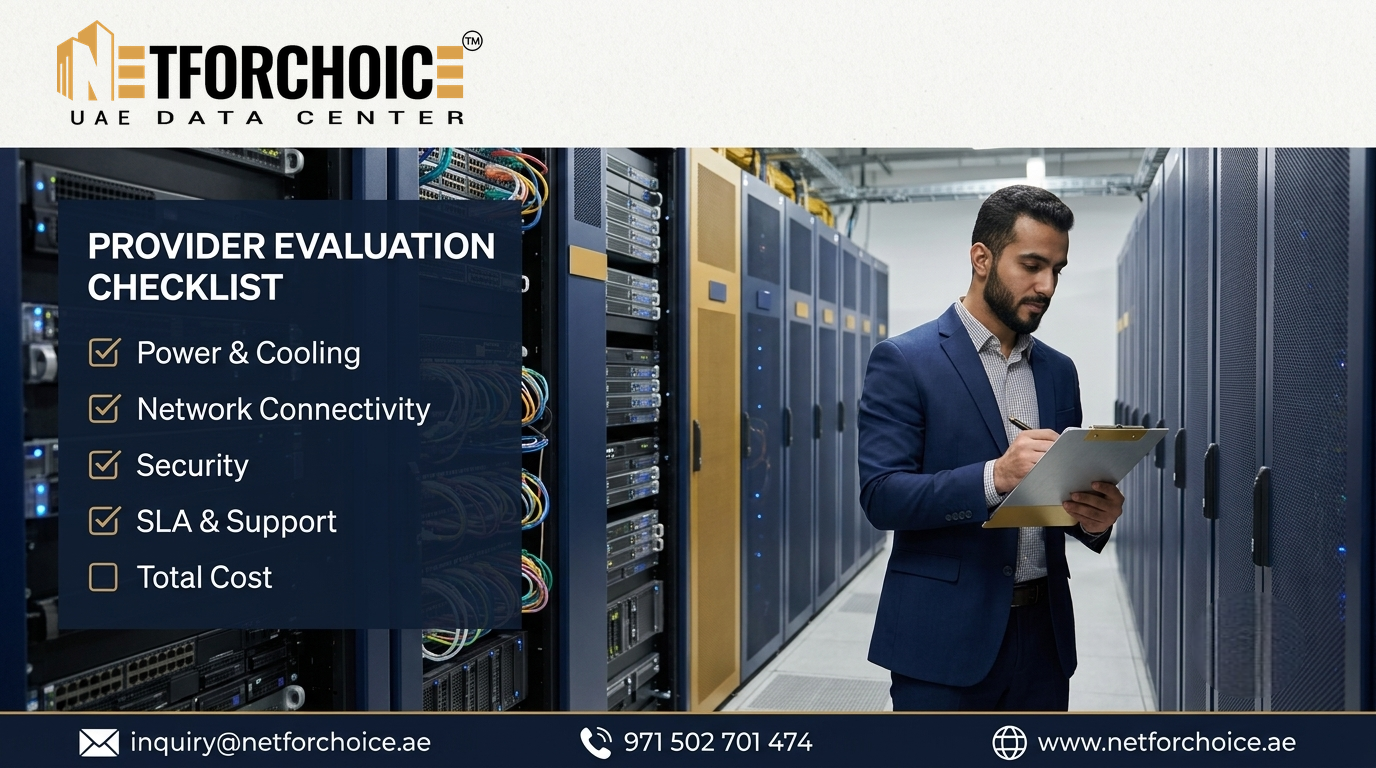
Choosing colocation hosting providers is an important infrastructure decision for businesses that want to operate their own servers without managing an entire data center. The right provider can give your IT team access to suitable power, cooling, network connectivity, physical security and technical support. The wrong choice can create unexpected costs, operational delays and difficulties when your infrastructure needs to grow.
For businesses in the UAE, comparing providers requires more than checking rack-space prices or reading uptime claims. You need to understand how each facility operates, what its service agreements cover and whether its capabilities match your workloads.
Use the following checklist to evaluate providers before committing to a colocation contract.
1. Define Your Infrastructure Requirements First
Start by documenting what you need to host. Your requirements will influence the type of space, power allocation, network connectivity and support services you should request.
Prepare a list covering:
-
Equipment: Server dimensions, rack units, networking hardware and storage systems.
-
Power: Expected consumption, power connections and any planned increases in demand.
-
Workload: Application criticality, traffic patterns, storage needs and availability requirements.
-
Location: Access for your technical team, proximity to users and connectivity requirements.
-
Growth: Additional rack space, power capacity and equipment you may need over the contract period.
Ask each provider to confirm whether it can support your current configuration and likely expansion. This helps prevent choosing a facility that meets today's needs but becomes restrictive as your infrastructure grows.
2. Evaluate Power, Cooling and Facility Resilience
Power and cooling directly affect the operation of physical servers. However, a provider's general statement about redundancy does not tell you exactly how your equipment will be protected.
Ask how power reaches your rack, what backup arrangements are available and how maintenance is handled. Clarify whether the quoted service includes redundant power feeds and whether your equipment must support dual power supplies to use them.
Cooling deserves similar attention. High-density servers and storage equipment may require more cooling capacity than a standard rack configuration. Confirm the facility's supported power density and ask how it handles changes in heat load.
Useful questions include:
-
What power capacity is allocated to our rack?
-
Are redundant power paths available for our configuration?
-
What happens during planned electrical maintenance?
-
How is cooling capacity assessed for high-density equipment?
-
What facility monitoring and incident procedures are in place?
Request documentation that supports the answers. The objective is to understand the actual service available to your equipment rather than relying on broad descriptions of a resilient facility.
3. Check Network Connectivity and Carrier Options
A well-equipped facility is only useful if your servers can communicate reliably with customers, employees, cloud platforms and other systems.
Review the provider's available carriers, internet connectivity options and cross-connect services. If your applications depend on low latency or consistent network performance, ask about the available routes and how network issues are investigated.
It is also worth checking whether the facility offers diverse network paths. Two connections do not necessarily provide meaningful redundancy if both depend on the same underlying route or infrastructure.
Before signing, confirm:
-
Which carriers and connectivity services are available.
-
Whether cross-connects involve separate installation or recurring fees.
-
How network incidents are monitored and escalated.
-
Whether your required connections can be arranged before migration.
-
What options exist for connecting to cloud services or other facilities.
Ask the provider to distinguish between services it operates directly and services delivered by third-party network operators. This clarifies who is responsible when a connectivity issue occurs.
4. Review Security and Compliance Evidence
Physical security is a core part of colocation, but providers can differ in their access procedures, monitoring arrangements and documentation.
Ask how visitors are authorised, how access to restricted areas is controlled and how equipment access is recorded. You should also understand the procedures for emergency access and for authorising third-party technicians to work on your servers.
If your business has contractual, industry or regulatory obligations, determine which controls and certifications are relevant to your environment. Do not assume that a provider's general compliance statement automatically covers your specific requirements.
Request evidence appropriate to the service, such as relevant certification details, audit documentation or a description of the controls included in your agreement. Confirm the scope and validity of any evidence rather than relying only on a logo or marketing claim.
Your own responsibilities matter too. Colocation generally means that you retain responsibility for your servers, operating systems, applications and data unless the contract explicitly includes additional managed services.
5. Compare the Full Cost of Colocation Hosting
The advertised rack or space price may not represent the complete cost of operating your infrastructure. A fair comparison should include recurring charges, setup expenses and the services you are likely to use.
Build a cost checklist that includes:
-
Rack space or cabinet rental.
-
Allocated power and any additional power consumption charges.
-
Internet connectivity, bandwidth and cross-connects.
-
Remote-hands support and after-hours assistance.
-
Initial installation, equipment handling and migration.
-
Additional rack space or power capacity as you expand.
-
Contract renewal, termination and equipment-removal charges.
Ask providers to explain how power is measured and billed. Also confirm whether support tasks are included in the base service or charged separately.
Compare quotations using the same equipment footprint, power requirement, connectivity and support assumptions. Otherwise, a lower headline price may simply reflect a narrower service.
6. Understand the SLA and Support Arrangements
A service-level agreement (SLA) should explain what the provider commits to deliver, how performance is measured and what happens if the agreed service level is not met.
Read the definitions carefully. A facility availability commitment may not cover every component of your service. For example, facility power, network connectivity, remote-hands response and your own server availability can fall under different responsibilities.
Check the following before agreeing to the contract:
-
Availability: What service is covered, and how is availability calculated?
-
Exclusions: Which maintenance events or external circumstances are excluded?
-
Incident response: How quickly must the provider acknowledge and escalate a reported issue?
-
Remedies: What service credits or other remedies apply when commitments are missed?
-
Support coverage: Is assistance available around the clock, and which tasks are included?
-
Remote hands: Can technicians perform reboots, cable checks, visual inspections or other agreed tasks?
Ask for realistic response and escalation procedures, not just a general promise of technical support. If your operations depend on rapid intervention, make sure the required coverage is explicitly documented.
7. Confirm Expansion and Migration Support
Moving servers into a colocation facility involves coordination, scheduling and operational risk. Before selecting a provider, establish how equipment will be delivered, installed and connected.
Confirm delivery rules, installation support, access arrangements and any restrictions on working hours. If the provider offers migration assistance, ask what it covers and whether the service has a separate fee.
Consider future expansion at the same time. Check whether additional racks, power capacity and network connections can be made available when required. Ask about lead times and whether the contract protects your ability to expand under agreed terms.
For a business moving from an existing data center, also plan rollback procedures, connectivity testing, application validation and access to technical staff during the transition.
8. Compare Providers Using the Same Checklist
Once you have collected information, evaluate each provider against the same requirements. A simple comparison can help your technical and procurement teams identify trade-offs without relying on sales presentations alone.
| Evaluation area | What to verify |
|---|---|
| Infrastructure | Rack capacity, power allocation and cooling suitability |
| Resilience | Power arrangements, maintenance procedures and documented controls |
| Connectivity | Carrier choices, cross-connects and route diversity |
| Security | Access procedures and relevant evidence |
| Pricing | Recurring fees, additional services and exit costs |
| Support | SLA scope, escalation and remote-hands coverage |
| Growth | Expansion capacity, lead times and contract flexibility |
Give more weight to requirements that directly affect your operations. For example, a business running latency-sensitive services may prioritise connectivity, while a company with limited on-site IT staff may place greater importance on remote-hands support.
For each shortlisted provider, record what has been verified, what remains unclear and what needs to be included in the final contract. This makes the decision easier to justify internally.
Conclusion
Selecting colocation hosting providers requires a clear view of your infrastructure, operating costs and support expectations. Evaluate power and cooling, connectivity, security, SLA terms, migration arrangements and future capacity before comparing final quotations.
NetForChoice UAE offers colocation services for businesses that need a facility for their own server infrastructure. Businesses evaluating the service should discuss their rack, power, connectivity and support requirements directly with the provider to establish whether the available configuration fits their needs.
FAQs
What should businesses look for in colocation hosting providers?
Businesses should assess power and cooling capacity, network connectivity, physical security, transparent pricing, SLA terms, technical support and expansion options. They should also verify important claims through service documentation and contract terms.
How much does colocation hosting cost in the UAE?
Pricing depends on the space required, power allocation, connectivity, support services and contract terms. Additional charges may apply for cross-connects, remote hands, installation and expansion. Request an itemised quotation based on your actual requirements for a meaningful comparison.
What is the difference between colocation hosting and dedicated server hosting?
With colocation hosting, a business places and operates its own physical servers in a provider's data center. With dedicated server hosting, the provider supplies a dedicated physical server as part of the service. The best option depends on whether the business needs control over its own hardware or prefers the provider to supply the server.
