Charitable Trust: Objectives, Functions, and Its Role in Social Welfare
Author : Nitish Rane | Published On : 23 Aug 2026
A charitable trust provides an organised way to work towards social welfare objectives and support people who need access to essential services. Unlike commercial organisations that primarily focus on financial returns, charitable institutions are established around defined social purposes. Their work can include healthcare, rehabilitation, education, mobility assistance, and social support for communities and individuals who require assistance.
For differently abled individuals, such initiatives can address several interconnected needs. Corrective healthcare can help with physical conditions, artificial limbs can improve mobility, rehabilitation can support recovery, and education can provide opportunities for continued development. Understanding the objectives and functions of charitable institutions helps explain how these initiatives can create meaningful social impact.
What Are the Objectives of a Charitable Trust?
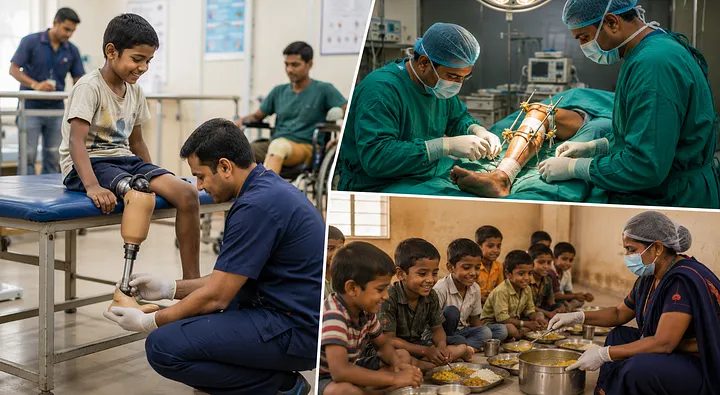
The objectives of a charitable trust depend on the purpose for which it is established. These objectives are generally focused on public welfare and may cover areas such as healthcare, education, rehabilitation, or social development.
An organisation working for differently abled individuals may establish objectives around providing medical assistance, supporting corrective surgeries, distributing artificial limbs, offering rehabilitation services, and creating educational opportunities.
Clearly defined objectives help an organisation maintain a focused approach. They also allow donors and beneficiaries to understand the causes that the organisation is working to support.
How Does a Charitable Trust Function?
A charitable trust functions through an organised framework designed to manage resources and implement its stated charitable objectives. Its activities can include developing programmes, identifying beneficiaries, arranging services, and directing available resources towards relevant causes.
For healthcare and rehabilitation initiatives, this may involve organising medical treatment, corrective procedures, artificial limb distribution, physiotherapy, and other support services.
The exact structure and activities can differ between organisations, but the underlying purpose is to use resources for defined social welfare objectives.
Healthcare as a Social Welfare Objective
Healthcare is an important area of social welfare because access to timely treatment can influence an individual's quality of life and independence.
A charitable trust working in healthcare can support initiatives that make medical treatment more accessible to eligible beneficiaries. For differently abled individuals, this may include corrective surgeries and related healthcare services.
Corrective treatment can address certain physical conditions and may help improve mobility or functionality. However, medical treatment is often only one part of the overall rehabilitation journey.
Rehabilitation as a Core Function
Rehabilitation can help individuals work towards improved movement and greater independence following medical treatment or when adapting to mobility aids.
A charitable trust can support rehabilitation services such as physiotherapy and related programmes. These services can help beneficiaries develop greater functional ability and make better use of the treatment or assistive devices they receive.
Rehabilitation is particularly relevant for differently abled individuals because their requirements may extend beyond a single medical procedure.
Artificial Limbs and Assistive Devices
Mobility assistance is another important area of social welfare. Artificial limbs can help eligible individuals improve their ability to move and perform everyday activities.
A charitable trust can support programmes that provide artificial limbs and other assistive aids. These initiatives can make mobility support more accessible to individuals who may otherwise face financial or practical barriers.
Effective support may also include assessment, fitting, guidance, and rehabilitation. Combining these services can help beneficiaries adapt to their mobility aids and use them more effectively.
Educational Support for Differently Abled Children
Education can help children develop knowledge, confidence, and opportunities for their future. Differently abled children may require additional assistance to access learning and continue their education.
A charitable trust can include education within its social welfare objectives and support programmes designed to provide learning opportunities.
When educational support is combined with healthcare and rehabilitation, children can receive assistance across different areas of their development. This can help them continue learning while receiving support for their physical requirements.
Social Rehabilitation and Inclusion
Social welfare can extend beyond healthcare and education. Social rehabilitation can help differently abled individuals participate more actively in family and community life.
Charitable initiatives can support important social needs alongside medical and educational assistance. Mass marriage programmes for eligible couples are one example of a social initiative that can provide practical support and help couples begin married life with dignity.
Such programmes demonstrate that social welfare can address different aspects of an individual's life.
How Different Functions Work Together
The functions of a charitable trust can have greater impact when different programmes complement one another.
For example, corrective treatment may address a physical condition, while physiotherapy supports rehabilitation. An artificial limb can improve mobility, and educational support can help a child continue learning.
This connected approach can be particularly valuable for differently abled individuals because their requirements may involve several stages and areas of support.
Narayan Seva Sansthan works across healthcare, corrective treatment, artificial limbs, rehabilitation, education, and social welfare initiatives for differently abled individuals. Its work demonstrates how multiple social welfare programmes can be brought together around the needs of beneficiaries.
Why Clear Objectives Matter to Donors
People considering support for a charitable trust can benefit from understanding its objectives before contributing. Clear information about the causes and programmes supported by an organisation can help donors decide whether its work aligns with their interests.
Those looking to support differently abled individuals may consider organisations working in areas such as corrective healthcare, artificial limbs, rehabilitation, education, and social welfare.
Understanding the organisation's programmes can also provide donors with a clearer picture of how their contributions are intended to support beneficiaries.
Conclusion
A charitable trust can provide a structured approach to pursuing social welfare objectives. Its functions may include supporting healthcare, corrective treatment, artificial limbs, rehabilitation, education, and social initiatives.
For differently abled individuals, these areas can work together to address immediate requirements while contributing to greater independence and participation in society.
Clear objectives, organised programmes, and a focus on genuine social needs can help charitable institutions create meaningful impact. By understanding how these organisations function and the causes they support, donors can make more informed decisions about contributing to social welfare.
