CBN Inserts vs Carbide Inserts: Which Is Better for Hard Turning?
Author : Surya makeyoueasy | Published On : 21 Aug 2026
Introduction
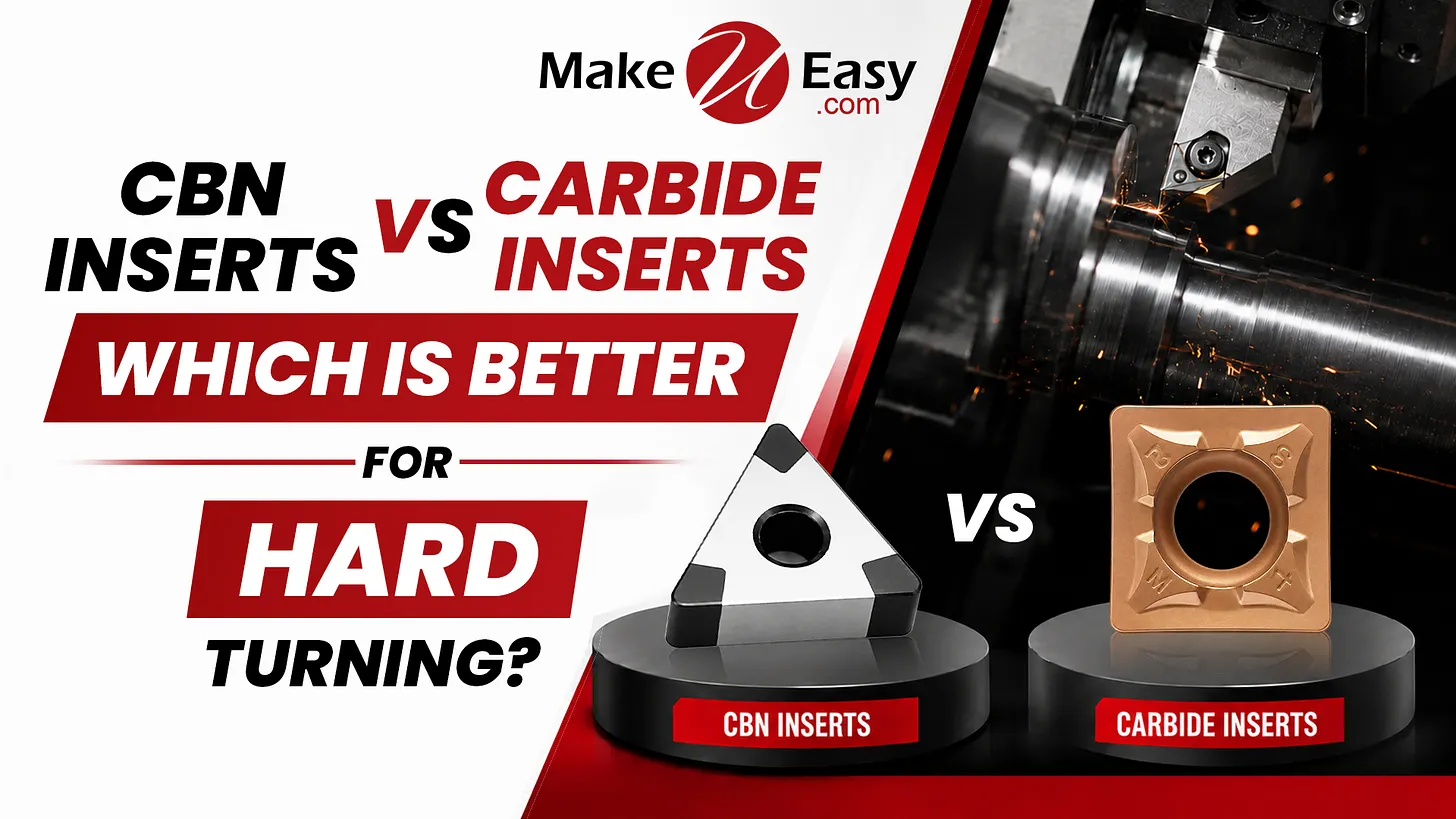
Choosing between CBN inserts and carbide inserts for hard turning can significantly affect tool life, surface finish, machining speed, and production cost. Carbide inserts are versatile and economical for general CNC turning, while CBN (Cubic Boron Nitride) inserts are designed for machining hardened steels and other difficult ferrous materials at higher hardness levels. Understanding their differences helps CNC manufacturers select the right cutting tool for productivity and precision.
What Are CBN Inserts?
CBN inserts are cutting tools made using cubic boron nitride, an extremely hard cutting material commonly used for machining hardened ferrous components.
CBN inserts are particularly suitable for:
-
Hardened steel
-
Tool steel
-
Bearing steel
-
Hardened alloy steel
-
Certain cast irons
-
Powder metallurgy components
Their excellent thermal stability and wear resistance make them highly effective for hard turning applications.
What Are Carbide Inserts?
Carbide inserts are typically made from cemented carbide, commonly tungsten carbide combined with a metallic binder.
They are among the most widely used cutting tools in CNC turning because they provide a strong balance of:
-
Hardness
-
Toughness
-
Wear resistance
-
Versatility
-
Cost efficiency
Carbide inserts are available in numerous grades, coatings, geometries, and chip breakers for different machining conditions.
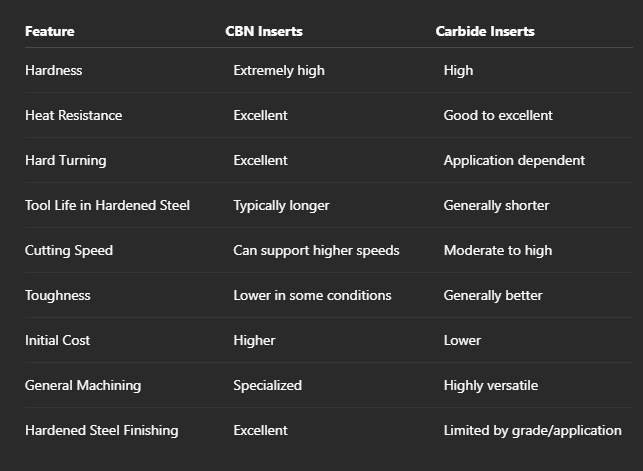
CBN vs Carbide Inserts: Key Differences
Which Is Better for Hard Turning?
For hard turning of hardened steel, CBN is generally the preferred cutting material, especially when workpiece hardness is around 45 HRC and above, although the ideal choice depends on the specific application.
CBN becomes particularly attractive when machining components around 55–65 HRC, where conventional carbide may experience rapid wear.
However, carbide can still be economical for:
-
Lower hardness ranges
-
Interrupted or unstable conditions where a suitable tough grade is required
-
Lower cutting speeds
-
General-purpose turning
-
Cost-sensitive applications
The best insert depends on workpiece hardness, machining stability, production volume, and required finish.
Why CBN Performs Well in Hard Turning
1. Extreme Hardness
CBN maintains a highly wear-resistant cutting edge when machining hardened ferrous materials.
2. High Thermal Stability
Hard turning generates significant heat at the cutting zone, and CBN can maintain cutting performance at elevated temperatures.
3. Longer Tool Life
For suitable hardened-steel applications, CBN can provide significantly longer tool life than conventional carbide.
4. Excellent Surface Finish
A stable CBN cutting edge can produce high-quality finishes, sometimes allowing hard turning to replace or reduce subsequent grinding operations.
5. Higher Productivity
Higher permissible cutting speeds and longer tool life can reduce cycle time and tool-change frequency in production machining.
When Should You Choose Carbide Inserts?
Despite CBN’s advantages, carbide remains an excellent choice for many CNC turning applications.
Choose carbide when:
-
The workpiece is not extremely hard.
-
General-purpose turning is required.
-
Machining conditions require greater toughness.
-
Tooling budget is limited.
-
Different materials are machined frequently.
-
Cutting conditions do not justify the cost of CBN.
Modern coated carbide grades can deliver excellent productivity when correctly matched to the material and cutting conditions.
When Should You Choose CBN Inserts?
Consider CBN when:
-
Turning hardened steel
-
Machining bearing components
-
Finishing hardened gears
-
Machining hardened shafts
-
Working with tool steels
-
High-dimensional accuracy is required
-
Long production runs justify higher tooling costs
-
Reducing grinding operations is desirable
CBN is particularly valuable in high-volume hard turning, where tool life and cycle time can offset its higher initial cost.
CBN vs Carbide: Tool Life
Tool life depends on many factors, including:
-
Workpiece hardness
-
Cutting speed
-
Feed rate
-
Depth of cut
-
Insert geometry
-
Machine rigidity
-
Continuous or interrupted cutting
-
Insert grade
For hardened steels, CBN generally provides better wear resistance and longer cutting life.
For softer materials or unstable machining, an appropriate carbide grade may provide a more economical solution.
CBN vs Carbide: Surface Finish
Both cutting materials can produce excellent finishes when correctly applied.
CBN has a major advantage in hard finishing operations because it can maintain cutting-edge stability at elevated temperatures and against highly abrasive hardened materials.
This makes CBN popular for precision components requiring tight tolerances and smooth finishes.
Can CBN Replace Grinding?
In certain applications, hard turning with CBN inserts can replace or reduce grinding operations.
Potential benefits include:
-
Shorter production cycles
-
Fewer machining operations
-
Reduced setup requirements
-
Greater manufacturing flexibility
-
Improved productivity
However, grinding may still be necessary when extremely tight tolerances, specific surface textures, or component geometries demand it.
Tips for Choosing Between CBN and Carbide
Before selecting an insert, consider:
Workpiece Hardness
Higher hardness generally increases the advantage of CBN.
Production Volume
CBN’s higher initial cost can become economical in high-volume production due to longer tool life.
Cutting Conditions
Stable, rigid machining conditions help CBN perform effectively.
Surface Finish
For precision hard finishing, CBN is often the stronger choice.
Machine Rigidity
Hard turning requires a rigid CNC machine, stable workholding, and minimal tool overhang.
Common Applications of CBN Inserts
CBN inserts are widely used for:
-
Hardened gear components
-
Bearing races
-
Hardened shafts
-
Automotive transmission parts
-
Tool steels
-
Dies and molds
-
Hardened machine components
-
High-hardness cast iron
Carbide inserts remain widely used for general turning of steel, stainless steel, cast iron, and many other engineering materials.
Why Choose MakeYouEasy?
At MakeYouEasy, we provide CNC cutting tools and machining accessories for industrial manufacturing applications.
Our product range includes:
-
CBN Inserts
-
Carbide Turning Inserts
-
Grooving Inserts
-
Threading Inserts
-
Milling Inserts
-
Face Milling Cutters
-
U Drills
-
Thread Milling Cutters
-
BT Tool Holders
-
Precision Measuring Instruments
Explore CNC cutting tools:
Conclusion
So, CBN inserts vs carbide inserts: which is better for hard turning? For machining hardened steels, particularly at higher hardness levels, CBN inserts are generally the better choice because of their exceptional hardness, thermal stability, wear resistance, and ability to maintain a stable cutting edge.
Carbide inserts remain the more versatile and economical option for general turning and lower-hardness applications. The correct choice should be based on workpiece hardness, cutting conditions, production volume, required surface finish, and overall cost per component rather than insert price alone.
Frequently Asked Questions
1. Are CBN inserts better than carbide for hard turning?
Yes, CBN inserts generally provide better wear and heat resistance when turning high-hardness steels.
2. What hardness is suitable for CBN inserts?
CBN inserts are commonly used for hardened ferrous materials around 45 HRC and above.
3. Can carbide inserts machine hardened steel?
Yes, suitable carbide grades can machine hardened steel, particularly at lower hardness levels.
4. Can CBN hard turning replace grinding?
Yes, CBN hard turning can replace or reduce grinding when the required accuracy and surface finish are achievable.
5. Which is more cost-effective, CBN or carbide inserts?
Carbide costs less than nitride inserts. Initially, CBN can be more economical for high-volume hard turning.
