Can Sapphire FUE Deliver More Natural Hair Transplant Results?
Author : Dr. Haror's Wellness | Published On : 23 Jul 2026
The worry that stops most people from committing to a hair transplant isn't really about the procedure itself. It's about the result. Will it look natural? Will anyone be able to tell? Will the transplanted hair actually stay, or will it fall out six months later and leave you back where you started?
These are fair questions — and they're exactly why the technique a hair transplant surgeon uses matters as much as the decision to have the procedure at all. Sapphire hair transplant has become one of the more talked-about methods in recent years, largely because of how it handles the part of the procedure that most determines whether results look real or artificial. Here's what's actually behind the name, and whether it lives up to what people are saying about it.
What Sapphire Hair Transplant Actually Is
It's not a completely different procedure — it's a refined version of standard FUE. The extraction side of things works the same way: individual follicles are harvested from the donor area, usually the back and sides of the scalp, using the same FUE approach most people have heard of. The difference is in how the recipient area gets prepared.
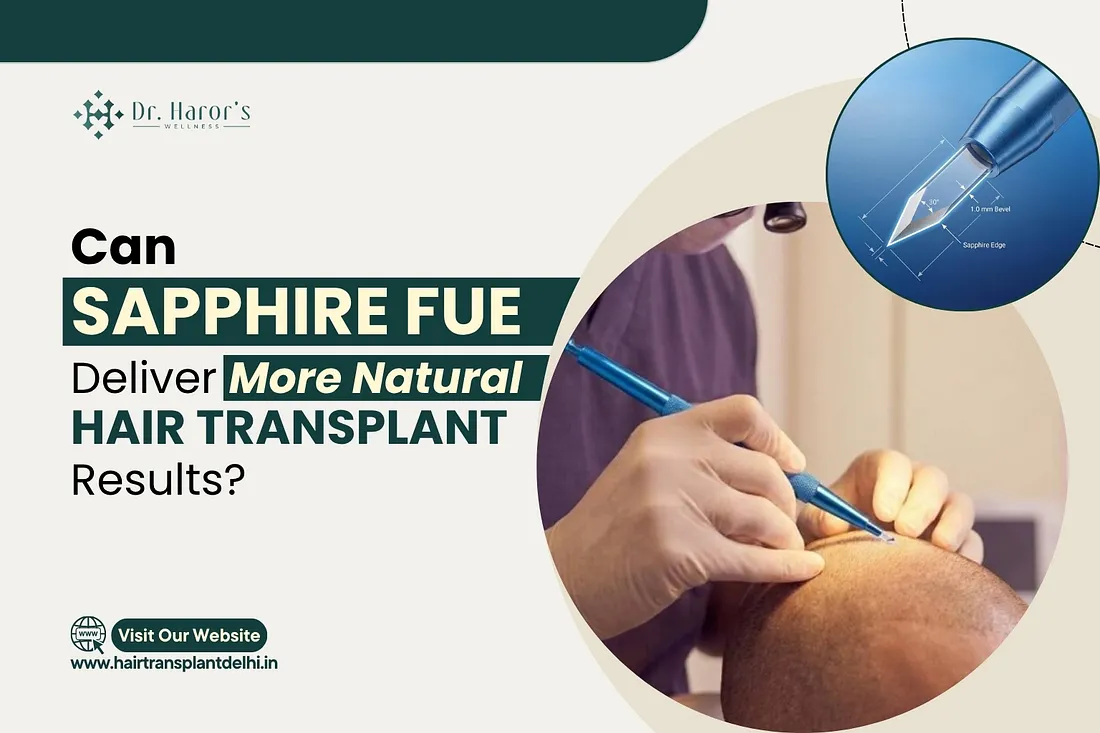
In a standard FUE procedure, the hair transplant surgeon creates small channels in the balding area using steel-based blades or similar instruments before placing the grafts. In a sapphire hair transplant, those channels are created using blades made from crystallized synthetic sapphire. The material allows for finer, more precise incisions — and that precision is what the whole method is really built around.
How the Procedure Actually Runs
Assessment first. Before anything else, the hair transplant surgeon looks at donor hair density, how far the loss has progressed, and the overall quality of available grafts to figure out what's realistic and how many follicles will be needed.
Extraction. Individual follicular units are carefully removed from the donor region using standard FUE technique — one at a time, with precision instruments.
Channel creation — the key step. Using sapphire blades, the surgeon opens tiny microchannels in the recipient area. The angle, direction, and depth of each incision is controlled carefully here, because this is what determines how the final hair grows in and whether it blends with the surrounding hair or looks like it was placed there.
Implantation. The extracted follicles go into those prepared channels, with attention paid throughout to matching the natural direction and growth angle of existing hair. That's where the natural look either comes together or doesn't.
Does It Actually Produce More Natural Results?
When performed by an experienced hair transplant surgeon — yes, genuinely. The sapphire blade allows for finer channel creation than standard instruments, which means more control over the exact placement of each graft. That control shows up in the result.
That said, the blade is only part of the equation. A few things shape the final outcome regardless of technique:
-
How experienced the hair transplant surgeon is specifically with follicle placement and hairline design
-
The quality and characteristics of the donor hair
-
How carefully grafts are handled between extraction and implantation — rough handling kills survival rates
-
The angle and direction each graft is placed at
-
How closely post-procedure aftercare is followed
-
Whether the hairline design itself suits the patient's face
A sapphire hair transplant in the wrong hands still produces poor results. And a skilled hair transplant surgeon using standard FUE can still produce excellent ones. The technique improves the odds — it doesn't replace skill.
Who's Actually a Good Candidate
Sapphire hair transplant tends to work well for people who:
-
Want a hairline that looks genuinely natural and undetectable
-
Are looking to build density in thinning areas rather than covering complete baldness
-
Have a solid donor supply to work with
-
Have realistic expectations — this is about improvement and natural blending, not overnight transformation
Is There a More Advanced Version?
Yes — some clinics now offer what's called a Sapphire Bio Hair Transplant, which layers biological regenerative treatments on top of the standard sapphire procedure. PRP (Platelet Rich Plasma) or GFC (Growth Factor Concentrate) — derived from the patient's own blood — gets applied during or around the procedure to support scalp recovery and encourage healthier regrowth in the surrounding native hair. For patients who want every possible advantage during healing, it's worth asking about.
Conclusion
Sapphire hair transplant can absolutely deliver results that look natural and undetectable — the precision of the blade during channel creation is a genuine advantage over standard instruments. But the technique is only as good as the hair transplant surgeon performing it. Hairline design, graft handling, placement angles — these are judgment calls that come from experience, not equipment. If faster healing is also a priority, the Sapphire Bio version is worth exploring in your consultation. Dr. Haror's Wellness offers sapphire hair transplant with surgeons who've handled a wide range of cases — the consultation starts with a proper evaluation of your scalp, donor area, and what you're realistically hoping to achieve, before any technique is recommended. Book a consultation and find out whether sapphire hair transplant is the right fit for your specific situation
