can rfid tags be reused?
Author : Jaming Wong | Published On : 26 Aug 2026
Yes, many RFID tags can be reused, provided their memory is writable and the tag remains physically functional. Reusable UHF RFID tags can be read, rewritten, reassigned, and returned to service. However, permanent memory locks, tag-kill commands, damaged antennas, adhesive failure, or application-specific security policies can make a tag unsuitable for another cycle.
In practical RFID projects, I do not treat “reusable” as a simple yes-or-no specification. During tag deployment and recovery work, the more important questions are whether the EPC can be rewritten, whether the previous data can be cleared or replaced, and whether the tag still performs reliably after repeated handling.
GS1’s current EPC Tag Data Standard defines the memory structure used by Gen 2 RFID tags, while the Gen2 standard provides commands for writing and controlling tag memory.
What makes an RFID tag reusable?
A reusable RFID tag normally has three characteristics:
- Writable memory — the EPC or User Memory must not be permanently locked.
- Functional RF structure — the chip and antenna must still communicate reliably.
- A suitable application lifecycle — the tag must be designed for repeated identification rather than one-way disposal.
This distinction matters on a warehouse floor.
A hard plastic RFID tag attached to a reusable tool can circulate for years. A low-cost paper RFID label attached to disposable retail packaging may technically support rewriting, but removing and reapplying it is rarely economical.
GS1 notes that RAIN RFID tags commonly carry no more than 8 KB of data, while simple license-plate-style tags may use only 96-bit or 128-bit identifiers. That makes many RFID applications naturally suited to storing an identifier and updating the associated record in software rather than repeatedly writing large amounts of information to the tag.
Rewritable RFID tags and memory locking
The part that often gets missed is memory control.
A Gen2/RAIN RFID tag contains several logical memory areas. GS1 identifies Reserved, EPC, TID, and optional User Memory areas. The EPC memory normally carries the electronic product identifier, while User Memory can hold additional application information when supported.
For reusable tags, this means an operator can potentially:
- Read the existing EPC.
- Verify the tag identity.
- Rewrite the EPC or permitted User Memory.
- Associate the tag with a new item.
- Test the rewritten data.
- Return the tag to service.
But not every memory area is equally reusable.
GS1’s RAIN RFID guidance explains that memory can be protected with password-based lock mechanisms, and permalock can make a lock status permanent. Once the relevant memory has been permanently locked, ordinary rewriting is no longer available.
That is why “rewritable RFID tag” should be treated as a system requirement, not simply a product label.
Where reusable RFID tags make practical sense
The strongest reuse cases are environments where the tagged object itself returns to the organization.
| Application | RFID reuse potential | Typical reason |
|---|---|---|
| Tool management | High | Tools circulate repeatedly |
| Reusable transport containers | High | Containers return to warehouses |
| Library assets | High | Books and equipment remain in circulation |
| Hospital equipment | High | Equipment is repeatedly issued and returned |
| Garment samples | High | Items move between stores and facilities |
| Returnable packaging | High | Containers complete multiple logistics cycles |
| Disposable retail packaging | Low | Tag often leaves with the product |
| Single-use labels | Low | Removal and reapplication are inefficient |
This is where RFID engineering becomes less about the chip and more about the physical lifecycle.
A reusable plastic tag mounted to a metal tool needs a different construction from a paper label attached to a carton. If the adhesive fails after cleaning, the chip may still be perfectly healthy—but the deployment has failed.
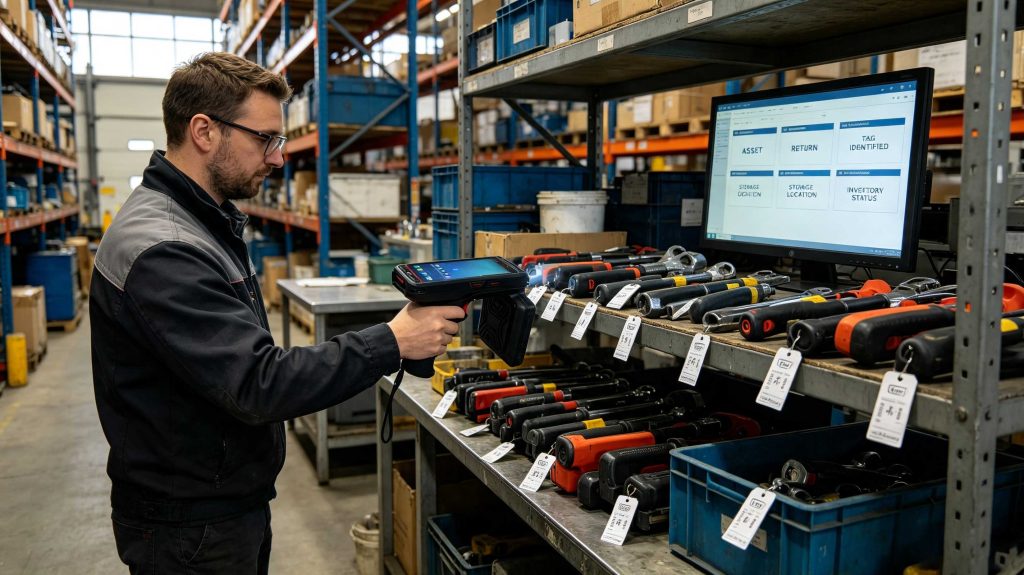
Durable RFID tags can circulate with reusable tools and assets through repeated issue, return, and inventory cycles.
How Cykeo approaches RFID tag reuse
For practical RFID deployments, tag management and reader performance have to be considered together.
A reusable tag is only useful if the system can reliably identify it before and after rewriting. Cykeo RFID solutions can be configured around workflows such as tag registration, data writing, filtering, verification, inventory, and item reassignment.
For desktop tag-management work, a controlled near-field reading zone is particularly useful. It reduces the chance of accidentally writing the wrong tag when several tagged objects are sitting nearby.
A good reuse workflow therefore separates:
Identify → Verify → Rewrite → Confirm → Reassign
That sequence sounds simple. On a busy registration desk, it prevents a surprisingly expensive mistake: changing the identifier on the wrong physical asset.
GS1 describes the RFID infrastructure itself as a combination of readers and tags, with readers sending standardized commands to read and write tag data. Passive UHF tags receive operating energy from the reader’s radio signal and respond through backscatter.
Reuse does not mean unlimited reuse
An RFID tag has no universal “reuse count” that applies to every tag model.
Actual service life depends on:
- Chip and memory technology
- Number and type of write operations
- Antenna construction
- Tag substrate
- Adhesive
- Temperature exposure
- Water, chemicals, and abrasion
- Mounting surface
- Reader power and operating conditions
- Whether memory has been locked or permanently locked
For this reason, I recommend evaluating reusable RFID tags through actual operating cycles, not simply laboratory read distance.
A tag that works perfectly on a test bench may behave differently after hundreds of cleaning cycles, repeated attachment and removal, or installation on a metal tool.
A practical RFID tag reuse checklist
Before selecting a reusable RFID tag, confirm:
- Memory: Is EPC memory rewritable?
- Security: Is permanent locking required?
- Physical design: Can the tag survive the asset’s environment?
- Mounting: Will adhesive, screws, rivets, or a housing be used?
- Reading: Can the installed tag be reliably identified?
- Writing: Can the required reader rewrite it consistently?
- Software: Can the old asset association be removed from the database?
- Verification: Is there a read-after-write validation step?
For deployments using GS1 identifiers, EPC encoding should also be planned carefully. GS1 explains that EPC provides a way to encode GS1 identifiers on RAIN RFID tags and supports serialized identification for visibility and traceability applications.
The key engineering point
Reuse is a lifecycle decision, not merely a memory feature.
A tag may be technically rewritable but commercially unsuitable for reuse. Conversely, a durable RFID tag with controlled writing, verification, and asset reassignment can become a long-term identification component.
That difference is usually visible only after the system has been operating for months.
Cykeo RFID Tag Technical Advantages for Reusable Applications
For reusable RFID projects, the tag itself is only one component. The reader, writing software, antenna, database and physical mounting method determine whether reuse is actually practical.
Cykeo RFID solutions are particularly suited to workflows where tags need to be registered, written, verified, filtered and reassigned rather than simply read once.
A typical reusable-tag workflow looks like this:
Tag → RFID Reader → Data Processing → Database → Verification → Reassignment
This architecture matters in tool rooms, hospital equipment management, reusable containers, libraries and internal asset circulation. GS1 confirms that RAIN RFID tags can store and update additional information in User Memory, while the EPC can act as a pointer to information held in an external database.
Why Cykeo RFID equipment fits tag-reuse workflows
- Controlled writing: Suitable for registration and reassignment processes.
- Tag filtering: Helps operators isolate the intended tag before writing.
- Read-after-write verification: Allows the newly written EPC or data to be checked immediately.
- Near-field desktop operation: Useful where accidental reads or writes to nearby tags must be minimized.
- Developer support: C# and Java development resources can simplify integration with existing management software.
- USB/Type-C desktop connectivity: Practical for tag registration stations and administrative workstations.
For a registration desk, I generally prefer a controlled reading zone over simply increasing RF power. More power is not automatically better. If the operator is rewriting one recovered tag while six other tagged objects sit on the same desk, excessive read coverage creates a process-control problem.
RFID Tag Reuse System Architecture Deep Dive
A reliable reusable RFID system normally has five layers.
1. RFID Tag Layer
The tag provides the physical identity attached to the object.
For RAIN RFID, the memory architecture can include:
| Memory area | Typical function | Reuse consideration |
|---|---|---|
| Reserved | Passwords and security functions | Normally not application data |
| EPC | Item identifier | Often rewritten when permitted |
| TID | Tag/chip identification | Factory-associated identity |
| User Memory | Additional application data | Rewritable when supported and unlocked |
GS1 specifies four logical memory banks for RAIN RFID tags and notes that TID information is associated with the tag itself, while EPC identifies the object and User Memory can hold additional information.
2. Reader Layer
The RFID reader supplies the RF interface and performs tag inventory, reading and writing.
For reusable tags, reader selection should consider more than advertised read distance:
- Writing stability
- Output-power control
- Anti-collision performance
- Tag filtering
- Communication interface
- Antenna design
- Read/write zone control
3. Application Layer
This is where the physical tag becomes useful operationally.
A tag ID can be associated with:
- Asset number
- Tool number
- Product SKU
- Container ID
- Location
- Employee or department
- Maintenance status
- Issue/return history
The RFID tag does not need to carry the entire business record. GS1 specifically describes EPC as an identifier that can point to additional information stored in a database.
4. Database Layer
The database maintains the lifecycle.
For example:
TAG-000582 → Tool A17 → Maintenance → Available
After reassignment:
TAG-000582 → Tool B24 → Maintenance → Available
The physical RFID tag remains the same. The business association changes.
5. Management Layer
The final layer handles:
- Registration
- Inventory
- Issuing
- Returns
- Rewriting
- Verification
- Audit logs
- User permissions
- Exception handling
This is where RFID reuse delivers its operational value.
Rewritable vs Disposable RFID Tags
Not every RFID tag should be reused.
| Factor | Rewritable RFID Tag | Disposable RFID Label |
|---|---|---|
| EPC rewriting | Usually possible if unlocked | Often unnecessary |
| Physical durability | Usually higher | Usually lower |
| Initial cost | Higher | Lower |
| Long-term asset use | Excellent | Poor |
| Returnable packaging | Excellent | Usually unsuitable |
| Retail disposable packaging | Often excessive | Practical |
| Tool management | Excellent | Poor |
| Hospital equipment | Strong candidate | Depends on workflow |
GS1 notes that simple RAIN RFID tags can contain only a 96-bit or 128-bit identifier, while higher-memory tags can provide up to 8 KB depending on the chip and application.
That difference is important when designing a reuse program. A tag does not need enormous memory simply because the system is sophisticated.
RFID Memory Security: The Detail That Determines Reuse
A reusable tag can become non-reusable through configuration.
GS1 documents both reversible memory locking and permanent permalock. A locked EPC memory bank prevents overwriting, while permalock can permanently make the lock state unchangeable.
The Kill command is even more significant. GS1 explains that a killed RAIN RFID tag becomes permanently silent and will not respond to subsequent commands.
Therefore, a tag-reuse project should establish clear rules before deployment:
Do not permanently lock or kill a tag that is intended to return to the reuse pool.
That sounds obvious. In a production system, it belongs in the software permissions and operating procedure—not in someone’s memory.
RFID Tag Reuse Across Industries
Tool and Equipment Management
Reusable tools are one of the clearest applications.
A tool can be:
Registered → Issued → Used → Returned → Inspected → Reissued
GS1 US identifies tool and asset tracking as a practical RFID application and gives examples including hospitals tracking surgical tools and organizations tracking physical assets throughout their lifecycle.
Healthcare
Reusable medical equipment creates a particularly strong case for durable RFID tags.
The tag can identify:
- Surgical instruments
- Medical equipment
- Reusable containers
- Hospital assets
- Sterilization-related equipment
GS1 Healthcare’s RFID implementation guidance specifically discusses encoding product information such as GTIN, serial number, batch/lot and date for healthcare applications.
Retail and Apparel
Retail RFID is usually associated with item-level identification, but reusable tags also have a role in samples, fixtures, reusable transport equipment and internal inventory assets.
GS1 US reports that RAIN RFID can reduce average inventory time by approximately 95% in relevant inventory applications, while emphasizing that suitability depends on the use case.
Returnable Transport Containers
Plastic totes, bins and containers repeatedly moving between warehouses are natural candidates.
Instead of printing a new identifier every cycle, one durable RFID tag can remain associated with the container throughout its service life.
RFID Tag Reuse Deployment Strategy
I recommend starting with the physical lifecycle rather than the reader specification.
Step 1 — Define the reuse cycle
Determine exactly what happens to the tag:
Issue → Return → Inspection → Rewrite → Reuse
If the tag will remain permanently attached to the same asset, rewriting may not even be necessary.
Step 2 — Select the physical tag
Evaluate:
- Plastic, paper or encapsulated construction
- Metal compatibility
- Adhesive requirements
- Water resistance
- Chemical exposure
- Temperature
- Mechanical abrasion
- Cleaning procedures
Step 3 — Define memory policy
Decide which fields can be rewritten and which must remain protected.
For example:
| Data | Policy |
|---|---|
| TID | Preserve |
| EPC | Rewrite when reassigned |
| User Memory | Update when required |
| Access password | Controlled by system |
| Kill function | Restricted |
Step 4 — Build verification into the workflow
Do not assume a successful write.
Use:
Write → Read → Compare → Confirm
The system should reject the transaction if the read-back value does not match the intended value.
Step 5 — Pilot with real handling
Test the tag where it will actually live.
A warehouse tool exposed to oil, dust and repeated impacts is a different engineering problem from a plastic library container sitting indoors.
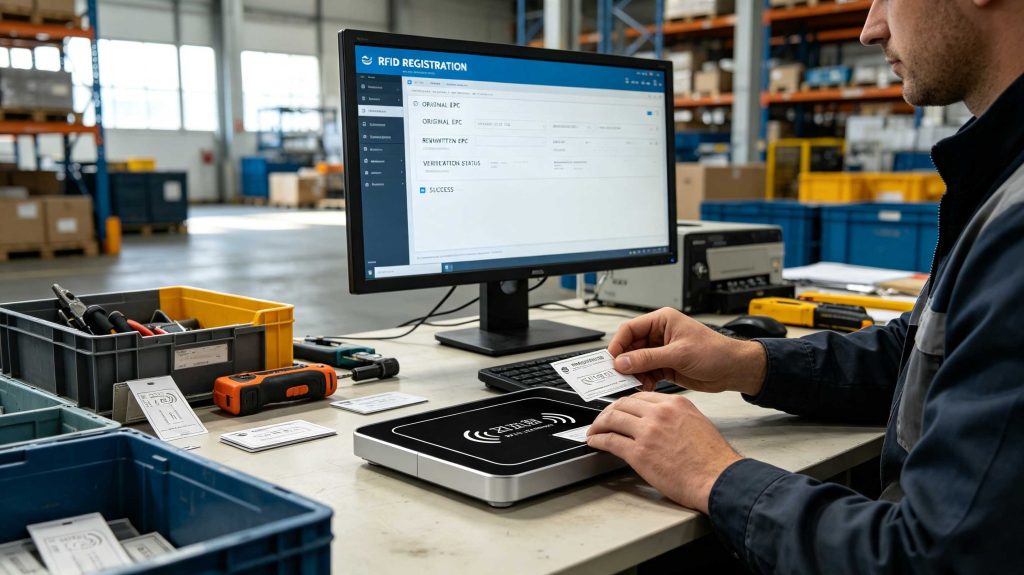
A controlled RFID desktop station can rewrite, read back, and verify reusable tags before they are assigned to another asset.
RFID Tag Reuse FAQ
1. Can RFID tags be reused after being removed from an item?
Yes. If the tag remains physically functional and its writable memory has not been permanently locked or otherwise disabled, it can potentially be reassigned.
2. Can you rewrite an RFID tag?
Yes. Compatible RFID readers can write supported tag memory. Whether the EPC or User Memory can be rewritten depends on the tag’s configuration and security state.
3. Does reusing an RFID tag change its TID?
Normally, no. TID is associated with the RFID chip and is distinct from the application-level EPC.
4. Can a permanently locked RFID tag be reused?
Not for rewriting the permanently locked memory area. Permalock is specifically designed to make the lock status permanent.
5. Can a killed RFID tag be reused?
No. A tag that has been successfully killed is designed to become permanently silent.
6. Are reusable RFID tags more expensive?
Usually, durable reusable tags cost more than disposable paper labels. The correct comparison, however, is lifecycle cost rather than purchase price: tag replacement, labor, relabeling and data-management effort all matter.
7. Which RFID applications benefit most from reusable tags?
Tool management, reusable containers, equipment tracking, libraries, hospital assets and other closed-loop applications are strong candidates because the physical asset repeatedly returns to the same operating system.
SEO Ending
Can RFID tags be reused? Yes—when the tag, memory configuration, reader and software workflow are designed for reuse. A rewritable EPC can support repeated assignment, while controlled memory locking protects production data when a tag reaches its final lifecycle.
Cykeo approaches RFID tag reuse as an equipment-and-software problem rather than simply a chip specification. Controlled reading, reliable writing, filtering and verification are particularly important at registration and reassignment stations.
For organizations managing reusable tools, equipment, containers or inventory, the right RFID tag is the one that survives the physical environment and fits the operational lifecycle.
That is the practical answer behind can RFID tags be reused.
