Calibration of RTDs, Thermocouples and Temperature Indicators: What's Different?
Author : Ncqc laboratory | Published On : 24 Sep 2026
Accurate temperature measurement is essential across laboratories, manufacturing, pharmaceutical, food processing, healthcare, and other industries. RTDs, thermocouples, and temperature indicators are commonly used to measure and monitor temperature, but they operate according to different principles. Therefore, each requires an appropriate calibration approach, reference standard, and measurement considerations to obtain reliable results.
Understanding RTD Calibration
A Resistance Temperature Detector (RTD) measures temperature based on the change in electrical resistance of its sensing element. During RTD calibration, the sensor is exposed to known and stable temperature conditions using an appropriate temperature source and compared with a traceable reference standard.
The calibration process can involve measuring the RTD’s resistance at specific temperature points and evaluating the relationship between resistance and temperature. Factors such as the RTD configuration, wiring arrangement, temperature range, reference standard, and measurement uncertainty can influence the calibration results. Maintaining stable temperature conditions during calibration is important for obtaining reliable measurements.
Understanding Thermocouple Calibration
A thermocouple operates differently from an RTD. It generates a small electrical voltage based on the temperature difference between its measuring junction and reference junction. Calibration therefore involves comparing the thermocouple’s output with a suitable reference under controlled temperature conditions.
The thermocouple type, junction condition, extension or compensating wires, reference junction compensation, and operating temperature range are important considerations. Using the correct thermocouple type and appropriate connections is essential because different thermocouple types have different temperature-voltage characteristics.
Temperature Indicator Calibration
A temperature indicator receives a temperature-related input and displays the corresponding temperature value. Unlike calibrating a temperature sensor itself, indicator calibration focuses primarily on verifying whether the displayed value corresponds correctly to the applied input.
Depending on the instrument, calibration may involve applying known input signals or simulating the expected RTD or thermocouple signal and comparing the indicator’s display with the reference value. Calibration may be performed at several points across the instrument’s operating range. Input signal accuracy, display resolution, set points where applicable, and response across the measurement range can all be relevant.
RTD vs. Thermocouple vs. Temperature Indicator: Key Differences
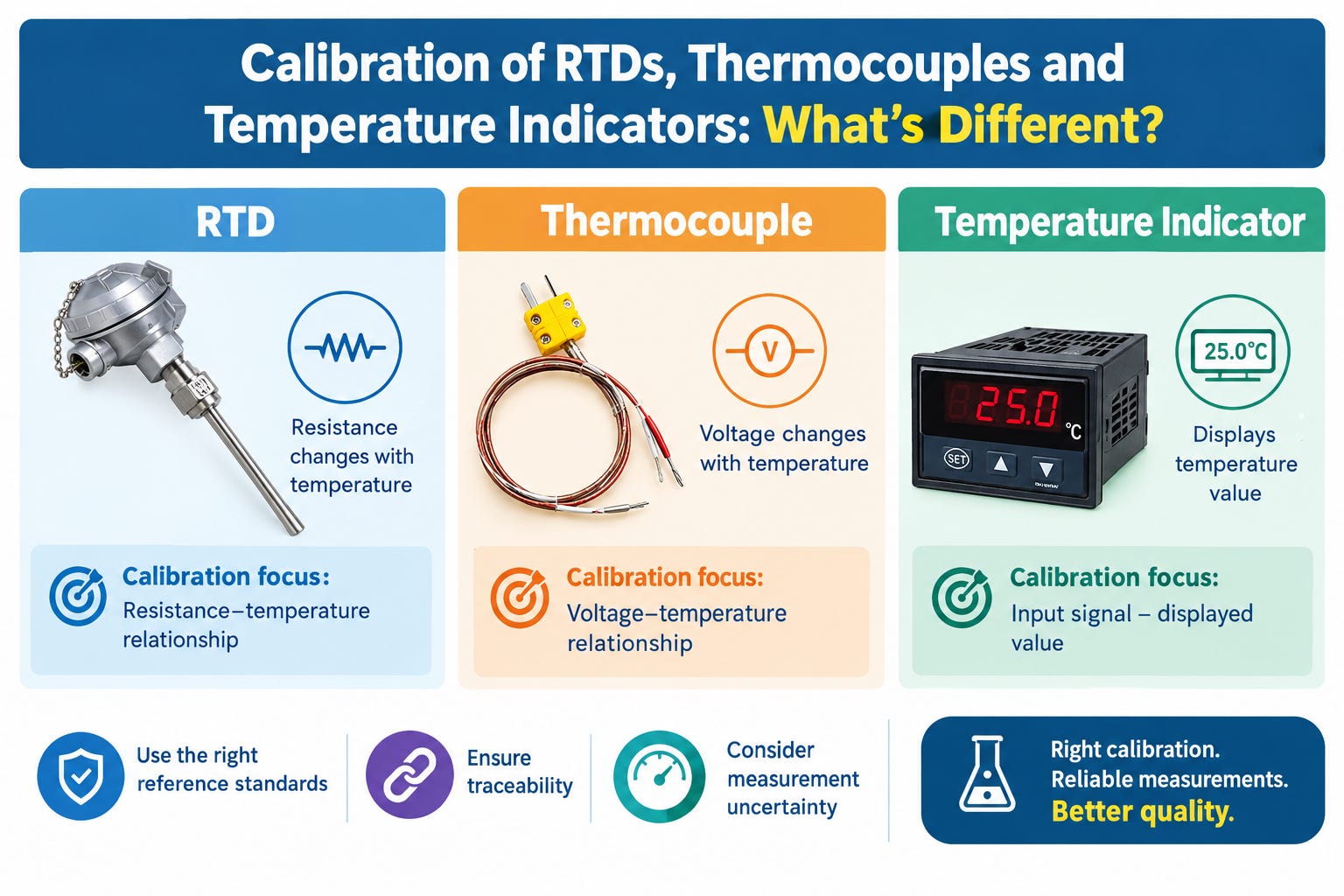
Although these devices are all associated with temperature measurement, their calibration requirements are different. An RTD calibration primarily evaluates the resistance-temperature relationship, while thermocouple calibration evaluates the voltage-temperature relationship. Temperature indicator calibration, on the other hand, focuses on the relationship between the applied input and displayed temperature.
Understanding these differences helps ensure that the appropriate calibration method and reference standard are selected for each instrument.
Why Traceability and Measurement Uncertainty Matter
Reliable calibration depends on suitable reference standards and controlled conditions. A competent calibration laboratory uses appropriate reference standards and documented procedures to support reliable calibration results.
Measurement traceability establishes a documented connection between measurement results and recognized standards through an appropriate chain of calibrations. Measurement uncertainty is also important because no measurement is completely free from uncertainty. Calibration results should therefore be evaluated and documented with relevant uncertainty considerations.
Choosing the Right Calibration Approach
RTDs, thermocouples, and temperature indicators may all be used for temperature measurement, but they should not automatically be calibrated using the same procedure. Their different operating principles require appropriate calibration methods, reference standards, and controlled conditions.
A properly planned calibration program helps organizations maintain reliable temperature measurements, measurement traceability, and effective quality control across their operations. Choosing the right calibration laboratory can support effective instrument management and quality control.
