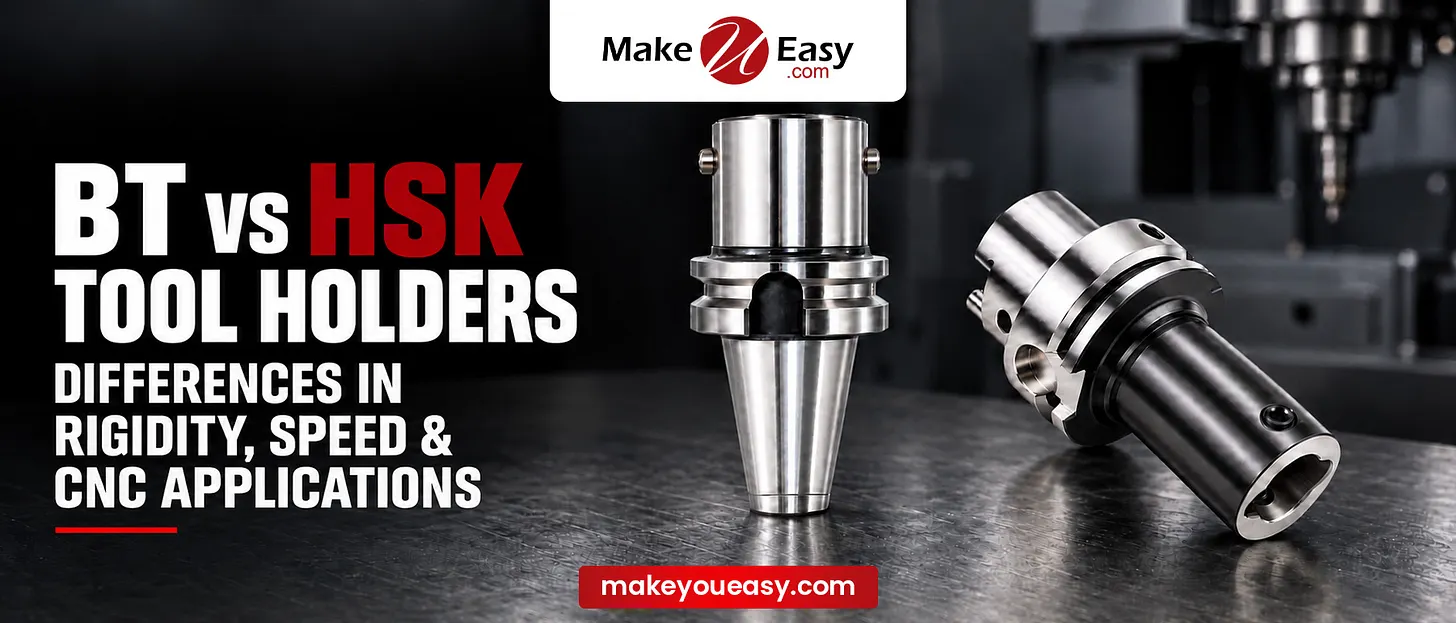
BT vs HSK Tool Holders: Differences in Rigidity, Speed & CNC Applications
Author : Surya makeyoueasy | Published On : 24 Oct 2026
Introduction
Choosing the right CNC tool holder is essential for machining accuracy, spindle performance, and productivity. Two widely used systems are BT and HSK tool holders, each designed to secure cutting tools in CNC machining centres.
BT holders are common in general-purpose CNC machining, particularly across Asian manufacturing industries. HSK holders are especially popular in high-speed and high-precision applications because of their hollow taper design and dual-contact interface.
Although both systems hold cutting tools securely, they differ in clamping mechanism, spindle contact, rigidity, speed capability, and cost. Understanding these differences helps manufacturers select the right toolholding system for their machining requirements.
What Is a BT Tool Holder?
BT stands for Bottle Taper, a toolholder interface widely used in CNC milling machines and machining centres. It uses a 7:24 steep taper and is commonly manufactured according to Japanese BT interface standards.
A BT holder is pulled into the spindle by a drawbar that engages a retention knob, also called a pull stud. In a conventional BT system, the taper provides the primary locating contact with the spindle.
Key characteristics:
-
Available in common sizes such as BT30, BT40 and BT50.
-
Compatible with automatic tool changers when the holder matches the machine specification.
-
Suitable for general-purpose milling, drilling, tapping and machining operations.
-
Widely used in production workshops and industrial machining centres.
-
Often economical to purchase and maintain compared with specialised high-speed systems.
Typical applications: General CNC milling, mould machining, component production and conventional metal-cutting operations.
What Is an HSK Tool Holder?
HSK stands for Hohlschaftkegel, meaning hollow taper shank. It uses a short, hollow 1:10 taper and an internal clamping mechanism that grips the holder from inside the shank.
HSK is designed for simultaneous contact between the taper and the spindle face when correctly clamped in a compatible spindle. This dual-contact arrangement helps maintain positioning accuracy and rigidity, particularly in high-speed machining.
Key characteristics:
-
Hollow, short taper design.
-
Internal clamping mechanism instead of a conventional external pull stud.
-
Dual-contact interface between taper and spindle face.
-
Good performance potential in high-speed and high-precision machining.
-
Available in different forms, including HSK-A and HSK-E, for different machine and application requirements.
Typical applications: High-speed milling, precision finishing, die and mould machining, aerospace components, and applications requiring consistent tool positioning.
BT vs HSK Tool Holders: Key Differences
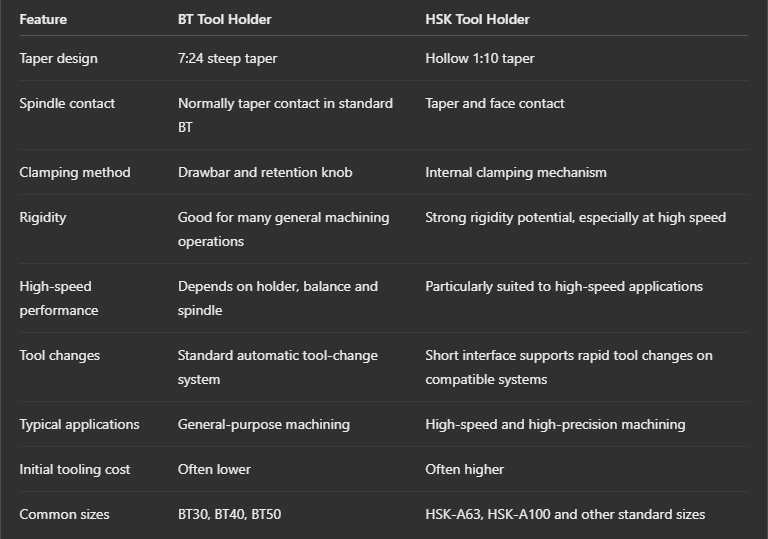
Important: BT and HSK holders are different spindle interfaces and are not interchangeable. Dual-contact BT variants, such as BBT systems, also exist and require a compatible spindle.
1. Rigidity and Machining Accuracy
Rigidity determines how well a tool-holding system resists deflection and vibration under cutting loads.
Conventional BT holders provide reliable performance for a wide range of milling and drilling operations. However, their standard taper-only contact can allow changes in the holder’s seating behaviour as spindle speed increases.
HSK’s short taper and dual-contact design help support stable positioning and resist axial movement at high speeds. This can benefit precision machining and demanding finishing operations.
Actual rigidity also depends on the holder size, tool clamping method, tool overhang, spindle condition, cutting forces, and machine structure. HSK does not automatically eliminate chatter or guarantee better accuracy in every application.
2. Spindle Speed and High-Speed Machining
BT holders are suitable for many conventional and moderately high-speed CNC operations when correctly specified and balanced.
HSK holders are particularly advantageous in high-speed machining because their hollow shank and internal clamping system are designed to maintain effective contact as the spindle rotates. This can help preserve stability and accuracy at elevated speeds.
However, there is no universal maximum RPM for either system. The permitted speed depends on the exact holder, tool assembly, balance grade, spindle, clamping system, and manufacturer’s rating.
Always check the rated maximum speed of the complete assembly before high-speed operation.
3. Tool Clamping and Automatic Tool Changes
A BT holder uses a retention knob engaged by the spindle drawbar. This is a well-established arrangement widely supported by conventional CNC machining centres.
An HSK holder uses internal clamping segments that engage the hollow shank. The short taper and compact interface can support fast automatic tool changes in machines designed for HSK.
In both systems, correct holder dimensions and clamping components are essential. Using the wrong interface or an incompatible retention component can prevent proper seating and may damage equipment.
4. Cost and Maintenance
BT tooling is often more economical for workshops that perform general-purpose machining and already operate BT-compatible machines. Its widespread use can also make replacement tooling easier to source.
HSK systems may involve higher initial costs because of their precision interface, specialised clamping mechanism and machine compatibility requirements. They can be a worthwhile investment when high-speed performance, precision and reduced machining variation are important.
For both systems, keep spindle tapers and contact faces clean, inspect holders for damage, verify balance requirements and follow the manufacturer’s maintenance instructions.
Which Tool Holder Should You Choose?
Choose BT when:
-
Your machine has a BT spindle.
-
You perform general-purpose milling, drilling or tapping.
-
Your cutting speeds and accuracy requirements are within the BT system’s rated capabilities.
-
You want to use an established, widely available tooling platform.
Choose HSK when:
-
Your machine is designed for an HSK interface.
-
High-speed machining is a key production requirement.
-
You need stable tool positioning for precision finishing.
-
Your process benefits from the compact design and dual-contact arrangement.
The spindle interface is the deciding factor when replacing or purchasing holders for an existing machine. For a new machine investment, compare the intended cutting operations, required spindle speed, tooling budget and long-term production needs.
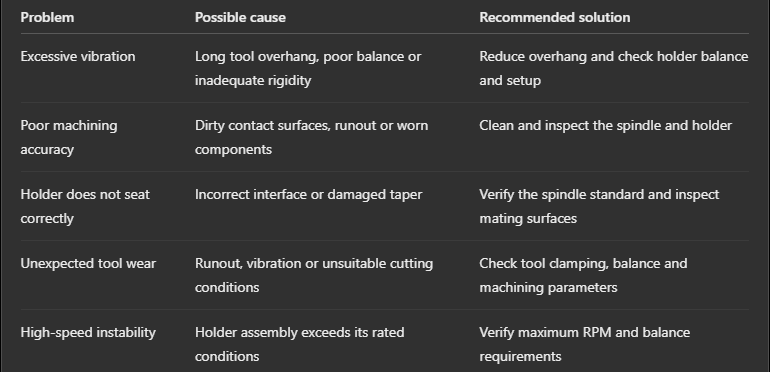
Common Tool Holder Problems and Solutions
Why Choose MakeYouEasy?
At MakeYouEasy, machining resources help manufacturing professionals understand CNC tooling, toolholder selection, and practical machining requirements. Understanding the differences between BT and HSK systems helps users make better-informed decisions about toolholding compatibility and machining performance.
Conclusion
BT and HSK tool holders serve different machining needs. BT is a practical and widely used choice for general-purpose CNC operations, while HSK is particularly suited to high-speed and high-precision applications that benefit from its hollow taper and dual-contact design.
The best option depends on the machine spindle, cutting conditions, accuracy requirements, tool assembly, and budget. Always match the holder to the spindle interface and verify the manufacturer’s speed and clamping specifications before machining.
Frequently Asked Questions
1. What is the main difference between BT and HSK tool holders?
BT uses a 7:24 steep taper with conventional drawbar clamping, while HSK uses a hollow 1:10 taper with internal clamping and dual-contact seating.
2. Is HSK more rigid than BT?
HSK can provide improved rigidity and positioning stability in suitable high-speed applications, but actual performance depends on the complete machine and tool setup.
3. Which tool holder is better for high-speed machining?
HSK is specifically well suited to high-speed machining when the holder, spindle, and cutting-tool assembly are correctly rated and balanced.
4. Can a BT holder fit an HSK spindle?
No, BT and HSK use different spindle interfaces and cannot be used interchangeably.
5. Is BT or HSK more economical?
BT is often less expensive for general-purpose machining, while HSK may justify its higher cost in applications requiring high-speed performance and precision.
Popular Search Keywords
BT vs HSK tool holders, BT tool holder, HSK tool holder, CNC tool holder comparison, BT40 vs HSK63, HSK spindle interface, BT taper vs HSK taper, CNC toolholding systems, high-speed CNC tool holders, CNC machining tool holder selection
