Bridging Gap: Integrating ERP Systems into Small Textile Mills
Author : Ayesha Diaz | Published On : 25 Sep 2026
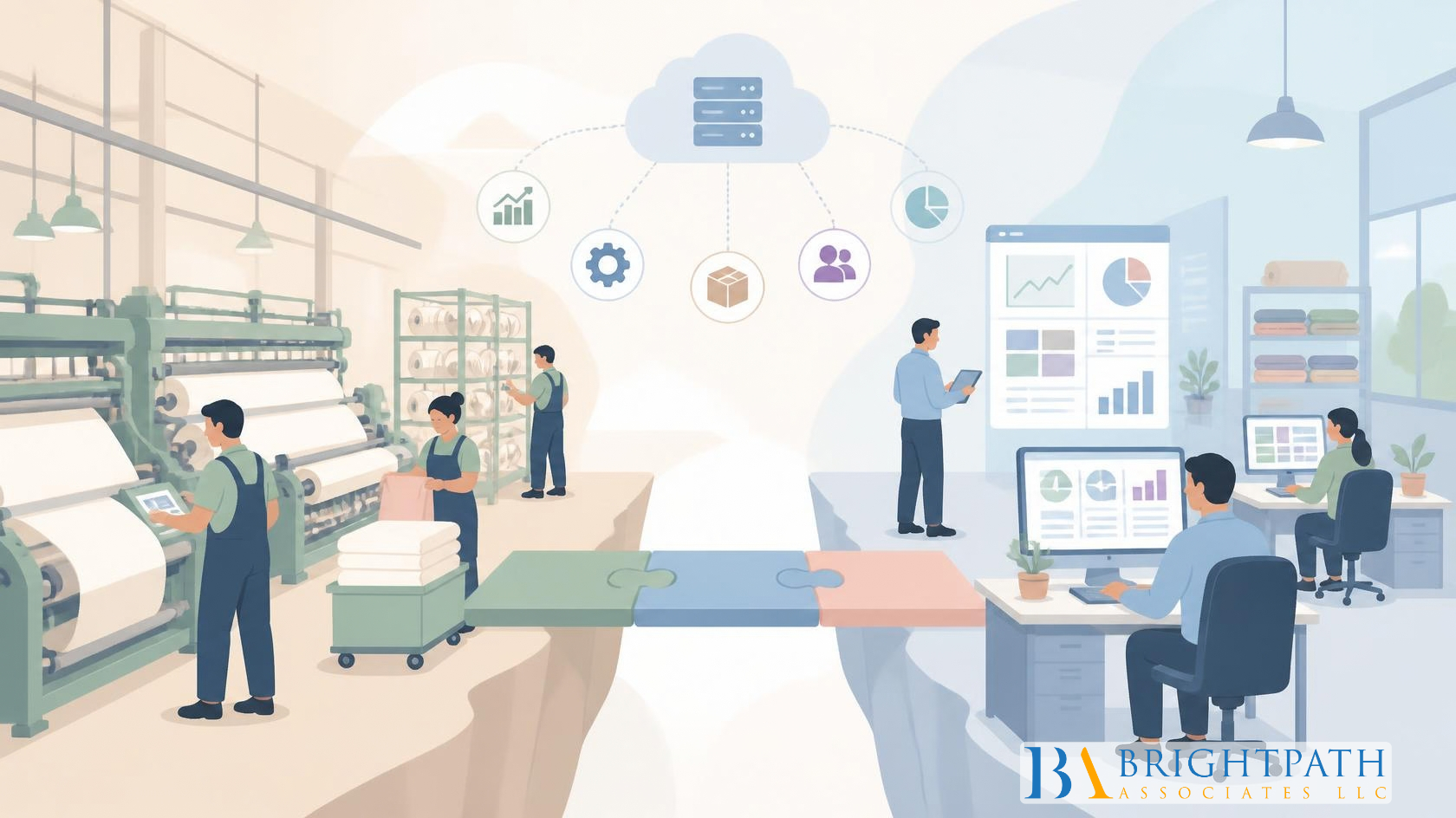
Small textile mills operate in an environment where margins, production schedules, raw-material costs, customer expectations, and workforce availability can change quickly. While large manufacturers have often had access to sophisticated enterprise systems, smaller mills have historically relied on spreadsheets, standalone software, paper records, and manual communication between departments.
Modern textile manufacturing involves interconnected activities ranging from purchasing and inventory management to production planning, quality control, order fulfillment, accounting, and customer service. When these functions operate independently, information can become fragmented and decision-making can slow down.
Enterprise resource planning, or ERP, offers a way to bring these activities into a more coordinated operating framework. However, for a small textile mill, implementing an ERP system is not simply a technology purchase. It is an organizational transformation that requires careful planning, leadership commitment, employee participation, and a realistic understanding of operational needs.
Why ERP Matters for Small Textile Mills
An ERP platform can provide a centralized environment for managing information across different business functions. Instead of maintaining separate records for inventory, purchasing, production, sales, and finance, a properly configured system can connect these activities.
How much raw material is available? Which orders are currently in production? What capacity is available? Which customer commitments are approaching? How much material has been consumed? Where are quality issues occurring? What is the true cost of producing a particular product?
When information is fragmented, answering these questions may require multiple employees to reconcile different spreadsheets or systems. An integrated ERP environment can make relevant information more accessible and consistent. This does not automatically guarantee better decisions. The value comes from giving managers reliable information at the right time.
Connecting Production With Inventory
Inventory management is one area where ERP integration can have significant implications for textile manufacturers. Mills may manage fibers, yarns, dyes, chemicals, packaging materials, work-in-progress inventory, and finished products. Each category can have different requirements for purchasing, storage, traceability, and production planning.
An ERP system can help connect material requirements with production schedules and customer orders. Instead of purchasing based primarily on historical assumptions, purchasing teams can work from more coordinated information about expected demand and available inventory.
This can help reduce two opposing problems: excess inventory that ties up working capital and shortages that disrupt production. For smaller mills operating with limited financial flexibility, that visibility can become particularly valuable.
Making Production Planning More Responsive
Textile production is rarely a completely linear process. Different products can require different sequences involving spinning, weaving, knitting, dyeing, finishing, inspection, or other specialized activities.
ERP integration can provide a more connected view of production schedules, available capacity, material requirements, and order priorities. Managers can use this information to identify potential bottlenecks before they become urgent problems.
The goal is not necessarily to automate every production decision. Instead, ERP can give plant and operations leaders a clearer foundation for making those decisions. This distinction matters for smaller organizations. Technology should support operational expertise rather than attempt to replace the knowledge accumulated by experienced textile professionals.
ERP Integration Is Not Just an IT Project
One of the most common challenges with ERP implementation is treating it primarily as a software installation. In reality, ERP affects how people work.
Employees may need to change how they record production information, approve purchases, track inventory, document quality issues, and communicate between departments. If processes are poorly defined before implementation, the software can simply digitize existing inefficiencies.
Production managers, finance professionals, inventory specialists, sales teams, maintenance personnel, and shop-floor employees all have different perspectives on how information flows through the business. Their participation can help ensure that the ERP system reflects actual operational requirements rather than theoretical workflows.
Leadership Determines Whether Integration Delivers Results
ERP implementation also highlights an increasingly important issue within the textile industry: the need for leaders who understand both traditional manufacturing and digital transformation.
Today's textile executives may need to balance production efficiency with technology investments, sustainability requirements, supply-chain resilience, workforce development, and changing customer expectations. BrightPath Associates' broader textile-industry perspective reflects how digitization and advanced manufacturing technologies are changing the capabilities required across the sector.
This is especially important for smaller organizations, where one senior leader may influence multiple operational areas. A strong implementation leader does not necessarily need to be a software specialist. However, they should be capable of translating business objectives into operational requirements and ensuring that employees understand why the transformation matters.
From ERP Installation to Continuous Improvement
ERP integration should not be considered complete when the software goes live. After implementation, textile mills should monitor whether the system is improving inventory accuracy, production visibility, scheduling, reporting, purchasing, cost analysis, and decision-making.
Regular reviews can identify processes that need adjustment or additional automation. For a deeper look at the specific challenges smaller textile manufacturers face when integrating enterprise systems, explore BrightPath Associates' analysis, Bridging the Gap: Integrating ERP Systems Into Small Textile Mills.
Building the Digitally Connected Textile Mill
ERP integration represents more than replacing spreadsheets with software. Done thoughtfully, it can create a common information foundation connecting production, inventory, purchasing, finance, sales, and leadership.
For small textile mills, that foundation can become increasingly important as competition, customer expectations, supply-chain complexity, and manufacturing technology continue to evolve. But technology alone will not create the transformation.
The most important questions may be organizational: Do leaders understand the business case? Are processes ready for integration? Is the data reliable? Are employees prepared? And does the company have the leadership capability to sustain continuous improvement?
