Breakeven ROAS: The Number to Know Before You Scale
Author : radhiya arora | Published On : 02 Apr 2026
The “Breakeven” Calculator: The Only Number That Matters Before You Scale
Every D2C founder eventually faces a moment that feels exciting and terrifying at the same time — the scaling decision.
Your ads finally start performing. The numbers look great. Your Meta Ads dashboard shows 3.5x ROAS, orders are coming in regularly, and the Shopify notification sound keeps popping every few minutes.
Naturally, the next thought is simple: “Let’s increase the budget.”
So you double the ad spend from ₹10,000 to ₹20,000 per day. More spend should mean more sales, right?
A few weeks later the revenue numbers look amazing. You sold more products than ever before. But then your accountant calls and tells you something you didn’t expect — the company is losing money.
This confusing situation happens more often than most founders realize. The reason is simple: the campaign was scaled below its breakeven point.
Why ROAS Alone Can Be Misleading
Many founders assume that any campaign above 2x or 3x ROAS is profitable. But that assumption is often wrong.
The real number that matters is your breakeven ROAS — the exact return on ad spend required just to cover all your costs.
At breakeven, the business makes zero profit and zero loss.
If your campaign is running below breakeven, every rupee you spend on ads increases your losses.
The formula is actually very simple:
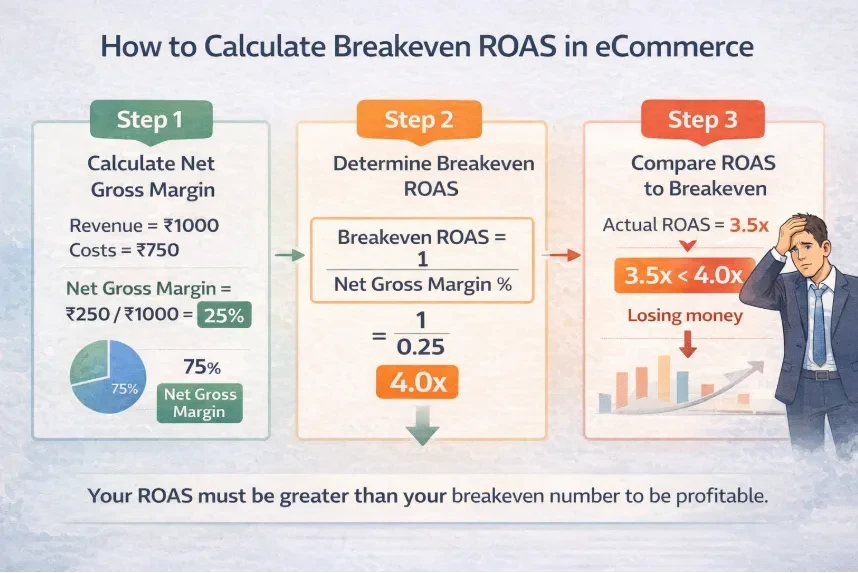
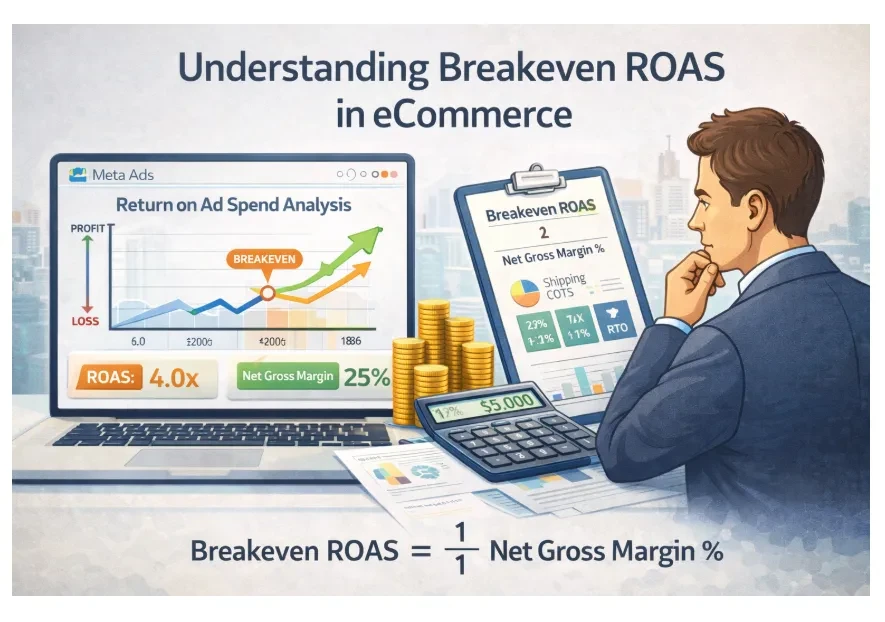
Breakeven ROAS = 1 / Net Gross Margin %
But the tricky part is calculating the real margin.
The Biggest Mistake Founders Make
Most founders only calculate margins based on manufacturing costs.
For example:
-
Product selling price: ₹1,000
-
Manufacturing cost: ₹300
At first glance it looks like a 70% margin.
Using the formula:
1 / 0.70 = 1.42x breakeven ROAS
So the founder believes that any campaign above 1.5x ROAS is profitable.
But that calculation ignores several real-world costs that quietly reduce margins.
The Hidden Costs That Kill Your Margin
When you sell a product online, the ₹1,000 revenue doesn’t stay ₹1,000. Many costs get deducted before you see the actual profit.
Some of the most common costs include:
-
GST and taxes (often 12–18%)
-
Shipping and packaging costs
-
Payment gateway fees (2–3%)
-
Return-to-Origin (RTO) losses, especially with COD orders
When all these costs are included, the real margin can drop dramatically.
In many cases, what looked like a 70% margin turns into 25% or less.
If the margin is 25%, the breakeven calculation changes completely:
1 / 0.25 = 4.0x breakeven ROAS
This means a campaign running at 3.5x ROAS is actually losing money, even though it looks profitable in the ad dashboard.
Why Scaling Too Early Is Dangerous
Scaling ads without knowing your breakeven point is like driving a car without checking the fuel gauge.
You might move fast for a while, but eventually the system collapses.
When founders scale campaigns below breakeven:
-
Ad spend increases
-
Orders increase
-
Revenue increases
But cash flow slowly disappears.
Instead of scaling profits, the company ends up scaling losses.
How Smart Brands Use Breakeven Before Scaling
Successful D2C brands treat breakeven ROAS as a hard rule.
Before increasing ad budgets, they always check one thing:
Is the campaign safely above breakeven?
If it is, they scale confidently.
If it isn’t, they focus on improving their unit economics first.
This can include:
-
Increasing product prices
-
Reducing shipping costs
-
Lowering RTO rates
-
Increasing Average Order Value (AOV) through bundle
At Eventum, this is one of the first numbers we calculate when analyzing a brand’s performance. Scaling ads without understanding the economics behind them is one of the fastest ways to destroy cash flow.
The Bottom Line
Advertising dashboards often make campaigns look more profitable than they really are.
But the real truth of a business lies in the numbers behind the numbers.
Before touching the ad budget slider, every founder should know their exact breakeven point.
Because in performance marketing, one rule always stays true:
You cannot out-scale bad math.
At Eventum, we always tell founders the same thing — fix the numbers first, then scale the ads.
Once the math works, growth becomes much easier.