Beyond Hypersonics: Quiet Revolution in Thermal Management Materials
Author : Alyssa Miller | Published On : 16 Sep 2026
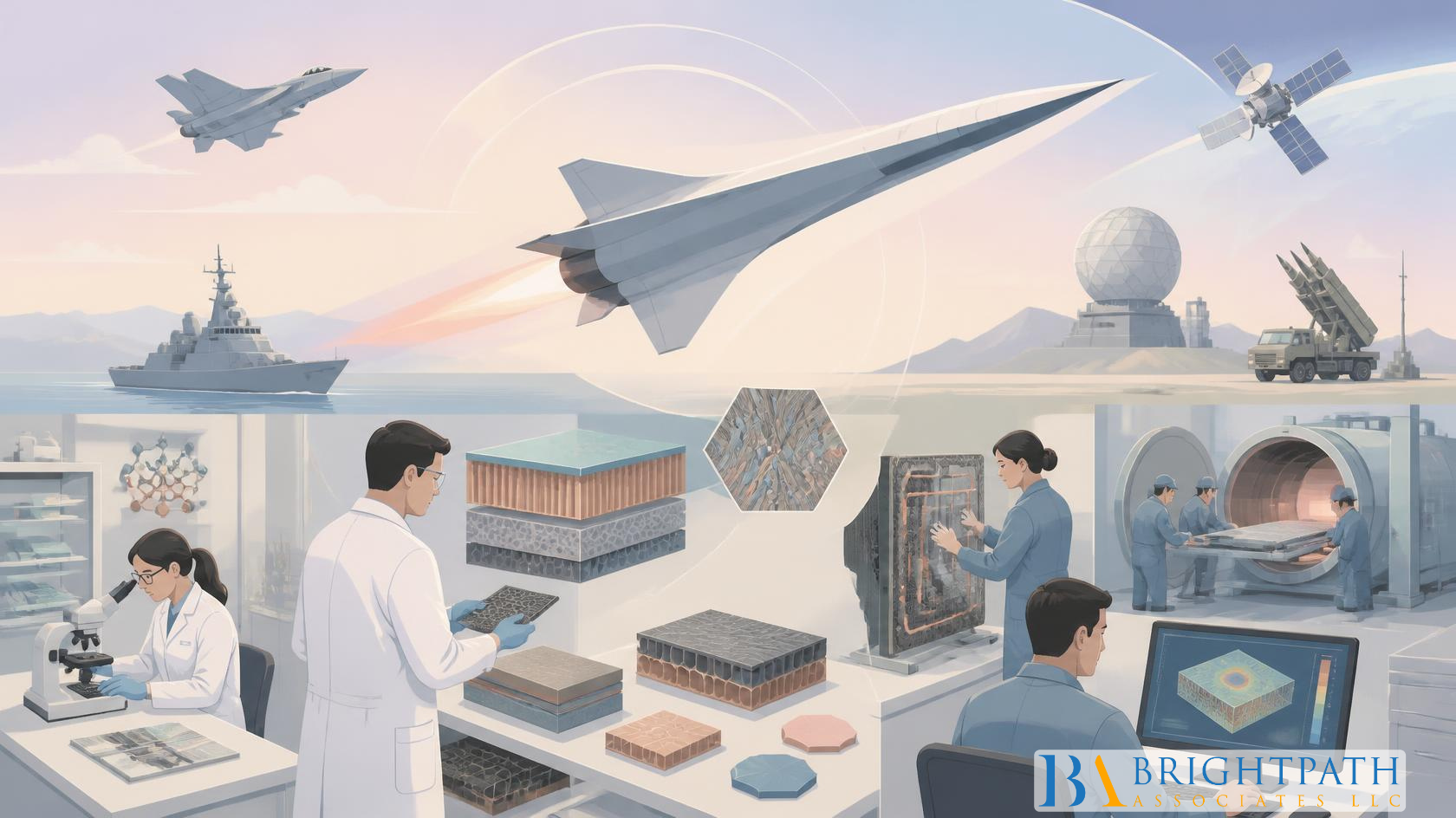
When people think about the future of defense and space technology, they often picture hypersonic vehicles, reusable launch systems, autonomous spacecraft, satellites, advanced propulsion, and increasingly sophisticated sensors. Yet one engineering challenge sits behind many of these technologies: how to control heat.
As aerospace platforms become faster, smaller, more powerful, and more autonomous, thermal management is becoming much more than a supporting engineering function. It is increasingly influencing system architecture, material selection, electronics design, manufacturing processes, and mission reliability.
This shift creates an important opportunity for defense and space companies—particularly small and mid-sized businesses developing specialized technologies—to reconsider how they approach thermal engineering, materials innovation, and technical talent.
Why Heat Is Becoming a System-Level Challenge
High-speed atmospheric vehicles experience intense aerodynamic heating. Spacecraft encounter dramatic temperature changes between sunlight and shadow. Satellites increasingly carry powerful processors and communications equipment that generate substantial heat. Autonomous systems pack motors, sensors, batteries, computing hardware, and communications equipment into increasingly compact spaces.
Heat must be generated, transferred, distributed, isolated, or dissipated without adding unnecessary weight, consuming excessive power, or compromising other components.
The challenge is therefore no longer simply finding a material that can tolerate high temperatures. Engineers must understand how thermal behavior interacts with structural integrity, electronics, propulsion, sensing, power systems, and mission requirements.
Advanced Materials Are Changing the Equation
Traditional metallic materials remain essential to aerospace manufacturing, but emerging platforms increasingly require combinations of properties that conventional materials cannot always provide.
Engineers are exploring ceramic matrix composites, carbon-based materials, advanced polymers, thermal barriers, conductive composites, specialized coatings, and other engineered materials designed to perform under demanding environments.
A material that performs exceptionally well in a laboratory may still face obstacles when engineers attempt to manufacture it consistently at commercial scale. Bonding, thickness, porosity, surface characteristics, dimensional tolerances, and repeatability can all influence performance.
The transition from laboratory innovation to mission-ready production therefore requires close collaboration between materials scientists, manufacturing engineers, quality professionals, and program leaders.
Space Electronics Are Increasing Thermal Demands
Modern spacecraft and satellites increasingly depend on high-performance processors, communications systems, sensors, radar, navigation systems, and autonomous computing. As electronics become smaller and more powerful, heat can become concentrated in increasingly limited physical spaces.
In conventional environments, engineers can often rely on familiar cooling mechanisms. Space creates different constraints. There is no atmosphere available for ordinary air-based cooling, meaning spacecraft designers must rely heavily on conduction, radiation, heat pipes, thermal interfaces, coatings, and carefully designed thermal pathways.
Even small inefficiencies at the interface between a processor and its cooling structure can affect overall performance. This makes thermal materials and interfaces an important part of spacecraft architecture rather than an afterthought.
Robotics Introduces Another Layer of Complexity
Space robotics provides another example of why thermal management is becoming increasingly important. Robotic systems may contain actuators, motors, batteries, processors, cameras, sensors, and communications equipment, each operating under different thermal conditions.
A robotic arm performing a precise operation may need to maintain dimensional stability despite significant temperature changes. A planetary exploration vehicle may need to protect electronics during extreme environmental conditions. An autonomous inspection system may have limited opportunities for physical maintenance.
Thermal reliability can consequently influence mobility, precision, battery performance, computing capability, and mission duration. As robotic platforms become more autonomous, onboard systems may also increasingly monitor their own thermal conditions and respond to potential problems before they become mission-threatening failures.
The Talent Challenge Behind Thermal Innovation
The technical complexity of modern thermal systems is creating an equally complex hiring challenge. A traditional job description may ask for a thermal engineer, materials engineer, or aerospace engineer. But emerging programs increasingly require people capable of connecting several technical domains.
A leader working on advanced thermal technologies may need to understand materials science while communicating effectively with manufacturing teams. They may need to evaluate simulation results while considering qualification timelines and production costs.
The same person may also need to understand how technical decisions affect a customer's mission requirements. For companies operating in this environment, hiring solely according to a narrow list of credentials may not identify the full range of capabilities required.
The Defense & Space Industry increasingly brings together aerospace engineering, advanced manufacturing, satellites, cybersecurity, robotics, autonomous systems, and specialized technical leadership. As these disciplines converge, companies may need recruitment strategies that account for interdisciplinary experience rather than conventional job categories alone.
The Next Competitive Frontier May Be Invisible
Hypersonics and space exploration will continue attracting attention because they represent visible demonstrations of technological progress. But many of the breakthroughs enabling these systems may occur in less visible areas such as thermal materials, interfaces, coatings, simulation, manufacturing processes, and embedded sensing.
BrightPath Associates' original analysis, Beyond Hypersonics: Quiet Revolution in Thermal Management Materials, explores this broader shift and the growing connection between thermal technologies and modern aerospace systems.
As aerospace systems become more computationally intensive and operational environments become more demanding, thermal management will increasingly influence what those systems can accomplish.
The companies preparing for that future will need more than innovative materials. They will need interdisciplinary engineering expertise, advanced manufacturing capabilities, strong program leadership, and people who can translate complex technology into practical business outcomes.
