Best AI Ad Generators in 2026 — A Model Comparison
Author : Sivi Ai | Published On : 23 Jul 2026
Search for "best AI ad generator" in 2026 and you'll find the same article over and over: ten tools, ten screenshots, ten affiliate links, and no real explanation of what happens when you actually click "generate." Most roundups compare marketing copy, not technology.
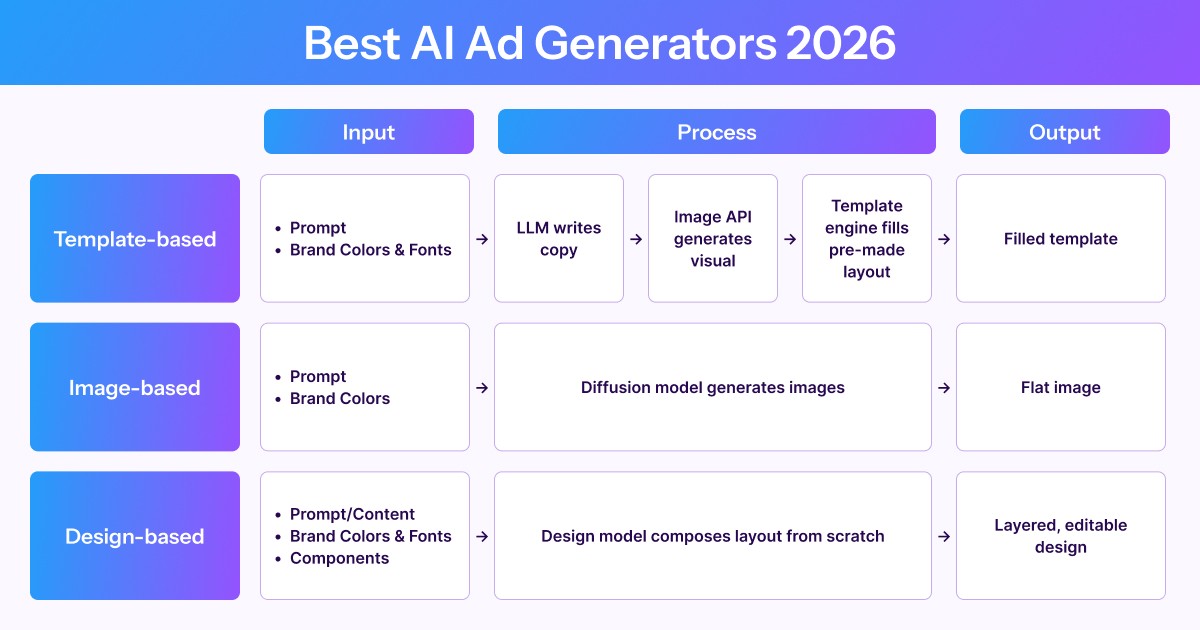 After four years spent building a design model at Sivi, the team has a different vantage point. Working on the underlying technology changes how you evaluate the market — you stop comparing feature lists and start comparing architectures. Once you do that, the 30+ tools calling themselves "AI ad generators" collapse into just three real categories: some generate designs, some generate images, and most simply fill templates.
This is a breakdown of the AI ad generators actually worth knowing about in 2026, organized by what they do under the hood rather than by their marketing claims.
Three Ways AI Tools Generate Ads in 2026
Before looking at individual tools, it helps to understand the three underlying approaches:
- Design generation — AI composes a layout from scratch, producing separate, editable layers for text, images, and vector elements.
- Image generation — AI produces a single flat image that looks like an ad but can't be edited element by element.
- Template-based generation — AI fills pre-built layouts with your copy and images; the structure itself isn't generated.
Understanding which bucket a tool falls into tells you far more about its real capabilities than any feature list does.
Tool-by-Tool Breakdown
Sivi runs on its own Large Design Model (Sivi Gen-2.7), placing it in the design-generation category. It composes layered, editable ad designs — not templates, not flat images — and offers a free tier of 12 AI credits per month.
Recraft is an image-generation tool built on Recraft V4. It offers daily credits, though images generated on the free tier are public, and outputs come as flat images or SVGs rather than editable layered files.
Canva blends templates with image decomposition. It uses Leonardo AI's Phoenix model to generate images, then attempts to break those images into partial layers. Canva also relies on template replacement as a core mechanism. It has a free plan, though its AI features are limited on that tier.
Lapis is template-based, combining an LLM with image APIs. Its free tier is capped at 5 ads per month.
AdCreative.ai is also template-based, but its real differentiator is a "Creative Scoring AI" layer that predicts how well an ad variation will convert. The underlying generation process is still templates — pre-made layouts filled in with AI-generated copy and images — but the scoring model is genuinely useful for teams running large-scale A/B tests. It offers a 7-day free trial with 10 credits, though a credit card is required upfront, and paid plans start at $39/month. It's best suited to paid media teams with budget who specifically want AI-predicted conversion scores; it can't generate unique designs, and the scoring model predicts performance rather than guaranteeing it.
Quickads is template-based as well, pairing an LLM with Nano Banana Pro, and offers a free plan.
Creatify combines templates with proprietary video generation and offers 10 credits per month, shared across static and video outputs.
Quick Comparison Table
| Tool | Type | Model / Engine | Free Tier | Output Format |
|---|---|---|---|---|
| Sivi | Design generation | Sivi Gen-2.7 (LDM) | 12 AI credits/month | Layered, editable design |
| Recraft | Image generation | Recraft V4 | Daily credits, images are public | Flat image or SVG |
| Canva | Template + image decomposition | Leonardo Phoenix + templates | Free plan, AI features limited | Template |
| Lapis | Template-based | LLM + image APIs | 5 ads/month | Template |
| AdCreative.ai | Template-based + scoring | LLM + image APIs | 7-day trial, credit card required | Template |
| Quickads | Template-based | LLM + Nano Banana Pro | Free plan | Template |
| Creatify | Template + video | Proprietary video + templates | 10 credits/month | Template + video |
Video Ad Tools
Video ads require two distinct layers of tooling: a generation model to produce the raw footage, and an editor to assemble the finished ad. Neither layer currently has a genuinely free option that's production-usable — generation models are compute-intensive, and free editor tiers come with watermarks attached.
On the generation side, models like Veo 3.1 and Runway Gen-4.5 handle raw video generation directly from text prompts.
Frequently Asked Questions
Can image generators like Recraft or Nanobanana 2 make ads? They can produce images that look like finished ads, but the output is a flat file with every element fused into pixels. You can't click on the headline to edit it, you can't change the CTA text, and you can't resize the ad for a different platform without regenerating the entire image from scratch. That makes image generators genuinely useful for early concept exploration — but they don't scale for production ad campaigns that need iteration and resizing.
Are there any free AI video ad generators? No production-ready free options exist in 2026. InVideo offers a free plan, but exports carry a watermark. Creatify provides 10 free credits per month, shared across both video and static outputs. For usable, watermark-free video ads, expect to pay at least $25/month, which is roughly the entry point for InVideo's Plus plan.
What model does Canva use for AI ad generation? Canva uses Leonardo AI's Phoenix model for image generation. Leonardo generates flat images, which Canva's system then attempts to decompose into partial editable layers. Canva also leans on template replacement as a secondary mechanism. Neither approach actually composes a free-form design from scratch — Canva's core product remains fundamentally template-based.
What is a Large Design Model? A Large Design Model (LDM) is an AI system built specifically to generate free-form, multi-layered graphic designs directly from text input. Unlike image generators, which output flat, fused pixels, an LDM composes layouts where text, images, and vectors exist as separate, independently editable layers. Sivi's LDM is a production system supporting brand kits, custom sizing, 72+ languages, and exports to JPG, PNG, PDF, and HTML.
The Bottom Line
The AI ad generator market in 2026 isn't really thirty different products — it's three different technical approaches wearing thirty different brand names. Template-fillers are fast and familiar but structurally limited. Image generators are great for exploring concepts but can't support iterative, production-grade campaigns. Design generation — the Large Design Model approach — is the only category that produces genuinely editable, brand-consistent, multi-format ad creative from scratch.
Knowing which category a tool falls into, before you sign up for a trial or hand over a credit card, is the difference between picking a tool that fits your workflow and discovering its limits three campaigns in.
