Ball Nose End Mill Effective Cutting Diameter Explained: Understanding Tool Contact
Author : Surya makeyoueasy | Published On : 21 Nov 2026
Introduction
Ball nose end mills are widely used for 3D contouring, mould finishing, curved surfaces and precision profile machining. However, unlike flat end mills, their cutting diameter changes according to the contact position between the tool and workpiece. This is known as the effective cutting diameter (ECD). Understanding this concept helps machinists calculate suitable spindle speeds, improve cutting conditions and achieve consistent surface finishes.
What Is Effective Cutting Diameter in a Ball Nose End Mill?
The effective cutting diameter is the diameter of the cutting area that actively engages with the workpiece at a particular axial depth of cut.
A ball nose end mill has a spherical cutting end. When it cuts near the centre of the ball, the contact diameter is smaller than its nominal diameter. As the contact point moves towards the ball’s widest section, the effective diameter increases.
For example, a 6 mm ball nose end mill does not always cut using its full 6 mm diameter. At shallow depths, only a smaller portion of its spherical cutting edge engages with the material.
This affects actual cutting speed and spindle speed requirements.
Nominal Diameter vs Effective Cutting Diameter
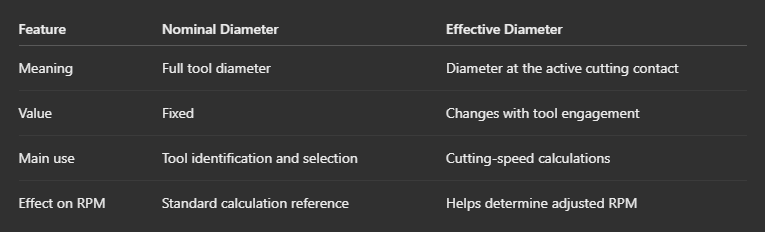
Using the nominal diameter for every ball nose milling operation can result in an incorrect cutting-speed calculation, particularly when machining close to the tool tip.
Effective Cutting Diameter Formula
For a vertically oriented ball nose end mill cutting a horizontal surface, the effective cutting diameter can be calculated using:
Formula:
[
D_e=2sqrt{Dtimes a_p-a_p^2}
]
Where:
-
(D_e) = Effective cutting diameter (mm)
-
(D) = Nominal tool diameter (mm)
-
(a_p) = Axial depth of cut (mm)
This formula applies to the specified horizontal-surface contact condition. Ramping, inclined surfaces and straight-wall machining require different contact geometry considerations.
Practical Calculation Example: 6 mm Ball Nose End Mill
Consider a 6 mm diameter ball nose end mill with an axial depth of cut of 0.6 mm.
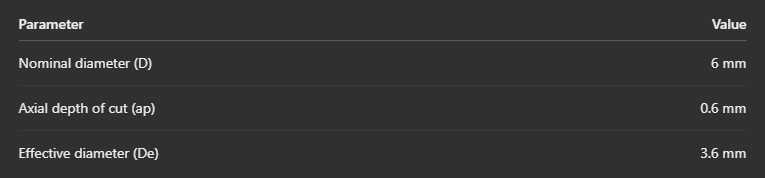
Calculation:
[
D_e=2sqrt{6times0.6-0.6^2}
]
[
D_e=2sqrt{3.24}
]
[
boxed{D_e=3.6text{ mm}}
]
Although the cutter has a nominal diameter of 6 mm, its effective cutting diameter at this engagement is only 3.6 mm.
How Effective Diameter Affects Spindle Speed
Cutting speed is directly related to the diameter of the active cutting area. When the effective diameter decreases, the actual cutting speed also decreases at the same RPM.
The spindle speed formula is:
[
n=frac{1000times V_c}{pitimes D_e}
]
Where:
-
(n) = Spindle speed (RPM)
-
(V_c) = Target cutting speed (m/min)
-
(D_e) = Effective cutting diameter (mm)
Example RPM Calculation
Assume a target cutting speed of 150 m/min and an effective diameter of 3.6 mm.
[
n=frac{1000times150}{3.1416times3.6}
]
[
boxed{napprox13,263text{ RPM}}
]
This is the theoretical RPM required to achieve the target cutting speed at the effective diameter. Actual settings must remain within the tool manufacturer’s recommendations and the machine’s spindle-speed limit.
Effective Diameter at Different Cutting Depths
For a 6 mm ball nose end mill, the effective diameter changes as the axial depth of cut increases.
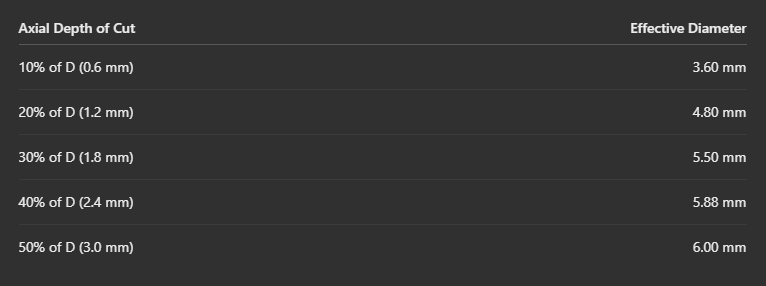
The effective diameter approaches the nominal diameter as the cutting contact moves towards the widest section of the ball.
Why Tool Contact Position Matters
1. Cutting Speed Variation
Near the ball tip, the effective diameter is small, resulting in a lower cutting speed at a given spindle RPM. This can affect cutting performance and tool wear.
2. Surface Finish
The contact location influences the cutting action and the resulting surface quality. Incorrect tool engagement can contribute to rubbing, uneven finishing and unwanted surface marks.
3. Tool Wear
Machining continuously near the ball tip can create unfavourable cutting conditions. Suitable toolpath strategies and contact positioning can help distribute cutting action more effectively.
4. Machining Efficiency
Correctly accounting for effective diameter helps machinists select more appropriate spindle speeds and avoid unnecessarily low cutting speeds.
How to Improve Ball Nose Milling Performance
-
Use suitable tool tilt: Tilting the cutter can move the contact area away from the exact tool tip, depending on the toolpath and surface geometry.
-
Calculate effective diameter: Consider the actual cutting engagement rather than relying only on nominal diameter.
-
Check machine RPM limits: Do not exceed the permitted spindle speed when applying diameter compensation.
-
Optimise step-over: Select a suitable step-over based on the required surface finish and machining time.
-
Maintain tool rigidity: Reduce unnecessary tool overhang and check tool-holder runout.
-
Follow manufacturer data: Adjust cutting speed and feed rate according to the specific cutter, material and machining conditions.
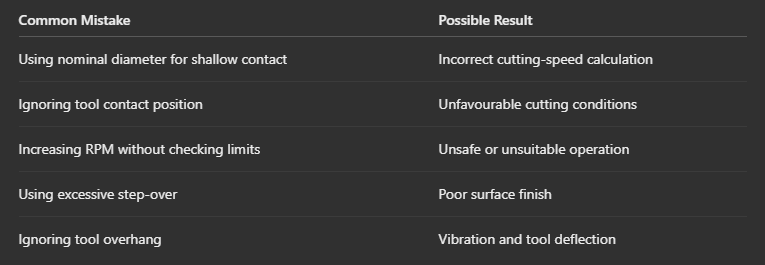
Common Mistakes in Ball Nose Milling
Why Choose the Right Ball Nose End Mill?
Selecting the correct ball nose end mill helps achieve accurate 3D profiles, consistent surface quality and reliable machining performance. MakeYouEasy offers access to CNC cutting tools and machining accessories for different manufacturing requirements. Check tool diameter, flute geometry, coating and manufacturer-recommended cutting conditions before selecting a cutter.
Conclusion
Effective cutting diameter is an important factor in ball nose end milling because the active cutting diameter changes with tool contact position and axial depth of cut. Using the correct effective diameter helps calculate suitable spindle speeds and understand actual cutting conditions.
For better machining results, consider tool engagement, contact position, step-over, machine capability and manufacturer-recommended parameters.
Explore CNC milling tools and accessories at MakeYouEasy.com.
FAQs
1. What is the effective cutting diameter of a ball nose end mill?
It is the diameter of the active cutting area that engages with the workpiece at a particular contact position.
2. Why does effective diameter change in ball nose milling?
It changes because the spherical cutting edge engages with the workpiece at different positions depending on the depth of cut and tool orientation.
3. How do I calculate effective cutting diameter?
For vertical cutting on a horizontal surface, use (D_e=2sqrt{Dtimes a_p-a_p^2}).
4. Does effective diameter affect spindle speed?
Yes. A smaller effective diameter requires a higher RPM to achieve the same theoretical cutting speed.
5. Can tool tilt improve ball nose milling performance?
Yes. Suitable tool tilt can move the contact area away from the tool tip and improve cutting conditions, depending on the machining strategy.
Popular Search Keywords
ball nose end mill effective cutting diameter, effective diameter calculation, ball nose cutter contact point, ball nose end mill RPM calculation, ball nose milling cutting speed, CNC ball nose milling, ball nose end mill depth of cut, ball nose cutter tool engagement, 3D contour milling, ball nose end mill machining parameters
