Auto Parts E-Commerce Data Report 2026
Author : John Bennet | Published On : 25 Sep 2026
Auto Parts E-Commerce Data Report 2026 - Product, Price, and Competitor Insights
Introduction
Mexico's automotive aftermarket is becoming increasingly data-driven as consumers, workshops, distributors, and retailers move more product discovery and purchasing activity online. The country has a particularly strong automotive manufacturing and parts ecosystem: in 2024, Mexico recorded approximately US$75.4 billion in total international trade of motor-vehicle parts and accessories, including US$41.1 billion in international sales and US$34.3 billion in purchases. (Economía)
At the same time, Mexico's broader digital commerce environment has expanded rapidly. The Mexican Association of Online Sales (AMVO) reports that online retail sales reached MXN 789.7 billion in 2024, while its 2026 study highlights MXN 941 billion in online retail market value and 77.2 million digital buyers. (AMVO)
The Auto Parts E-Commerce Data Report 2026 examines how structured automotive marketplace information can support product discovery, price benchmarking, assortment intelligence, and competitor analysis. The report focuses on Auto parts data covering product listings, prices, sellers, categories, availability, reviews, and marketplace positioning.
Mercado Libre is particularly relevant because its Mexican marketplace includes extensive automotive categories such as car and truck accessories, tires, lubricants, vehicle tools, motorcycle products, and replacement parts. (Mercado Libre)
The analysis below uses 2020–2026 as a strategic timeline to explain the evolution of digital automotive commerce and the growing importance of structured marketplace intelligence.
Measuring Mexico’s Automotive Digital Opportunity
Market Snapshot
| Indicator | Latest Available Benchmark |
|---|---|
| Mexico motor-vehicle parts trade, 2024 | US$75.4B |
| Mexico motor-vehicle parts exports, 2024 | US$41.1B |
| Mexico motor-vehicle parts imports, 2024 | US$34.3B |
| Mexico online retail sales, 2024 | MXN 789.7B |
| Mexico digital buyers, 2026 study | 77.2M |
| Mexico online retail market, 2026 study | MXN 941B |
The scale of the automotive sector and the expansion of digital retail make automotive marketplace data increasingly valuable. Data México reports that Mexico's largest international sales of vehicle parts in 2024 came from states including Coahuila, Querétaro, Guanajuato, Mexico City, and Nuevo León. (Economía)
The market has also developed beyond conventional physical distribution. Consumers can now discover replacement parts, accessories, tires, lubricants, batteries, lighting products, filters, brake components, and other automotive products through digital marketplaces. This shift has increased the importance of the Mexico Auto Part Market Intelligence Benchmark, enabling businesses to compare product availability, pricing, assortment, and competitive positioning across rapidly evolving online automotive channels.
2020–2026 Evolution
From 2020 onward, automotive e-commerce benefited from changing consumer purchasing habits and increased reliance on digital channels. During 2020–2021, online product discovery became more important as consumers sought alternatives to physical shopping. From 2022 to 2023, automotive sellers increasingly needed structured information about pricing, product availability, and marketplace competition.
By 2024, the broader Mexican online retail market had reached MXN 789.7 billion, demonstrating the scale of the digital opportunity. (AMVO) The automotive aftermarket itself generated approximately US$27.2 billion in revenue in 2024, according to Research and Markets, with revenue growing at a 5.6% annual rate in that year. (Research and Markets)
In 2025, eBay reported that Mexican consumers spent an average of MXN 3,319 on auto parts during the previous year, while 35% of surveyed buyers were new to the category. (eBay Inc.)
By 2026, the opportunity extends beyond simply selling parts online. Retailers and brands increasingly require structured intelligence to understand which products are listed, how sellers position them, how prices change, and which competitors gain visibility.
Building a Reliable Pricing Intelligence Foundation
Dataset Structure
| Data Attribute | Business Use |
|---|---|
| Product name | Product identification |
| Brand | Brand benchmarking |
| SKU / Part number | Product matching |
| Category | Category analysis |
| Price | Competitive benchmarking |
| Discount | Promotion analysis |
| Seller | Seller comparison |
| Availability | Stock intelligence |
| Rating | Customer perception |
| Review count | Demand/engagement signal |
| Product URL | Listing validation |
| Timestamp | Historical tracking |
A structured Mexico Auto Parts Dataset for Pricing Data can help retailers compare automotive products across sellers, categories, and marketplace listings. The value comes from combining product attributes with pricing information rather than treating each price as an isolated observation.
For example, a retailer could compare listings for brake pads, oil filters, spark plugs, car batteries, headlights, windshield wipers, tires, or engine components through E-commerce data scraping, while accounting for brand, vehicle compatibility, part number, and pack configuration.
2020–2026 Evolution
Between 2020 and 2021, many automotive businesses focused primarily on establishing online product visibility. From 2022 onward, pricing became a more important part of marketplace strategy as sellers faced increasing digital competition.
By 2023–2024, structured price histories became useful for identifying discount cycles, seller price gaps, and changes in product positioning. Mexico's automotive parts trade reached US$75.4 billion in 2024, emphasizing the depth of the underlying industry. (Economía)
In 2025, digital auto-parts purchasing gained further attention. eBay's Mexico-focused research found that 95% of surveyed consumers performed repairs themselves, indicating the importance of accessible product information and digital purchasing journeys. (eBay Inc.)
In 2026, pricing datasets can support more advanced applications: historical price indexes, seller benchmarking, price anomaly detection, promotion monitoring, and category-level intelligence. The key is maintaining consistent product identifiers so that a price change reflects a genuine market movement rather than a different product or pack size.
Understanding Marketplace Assortment and Seller Positioning
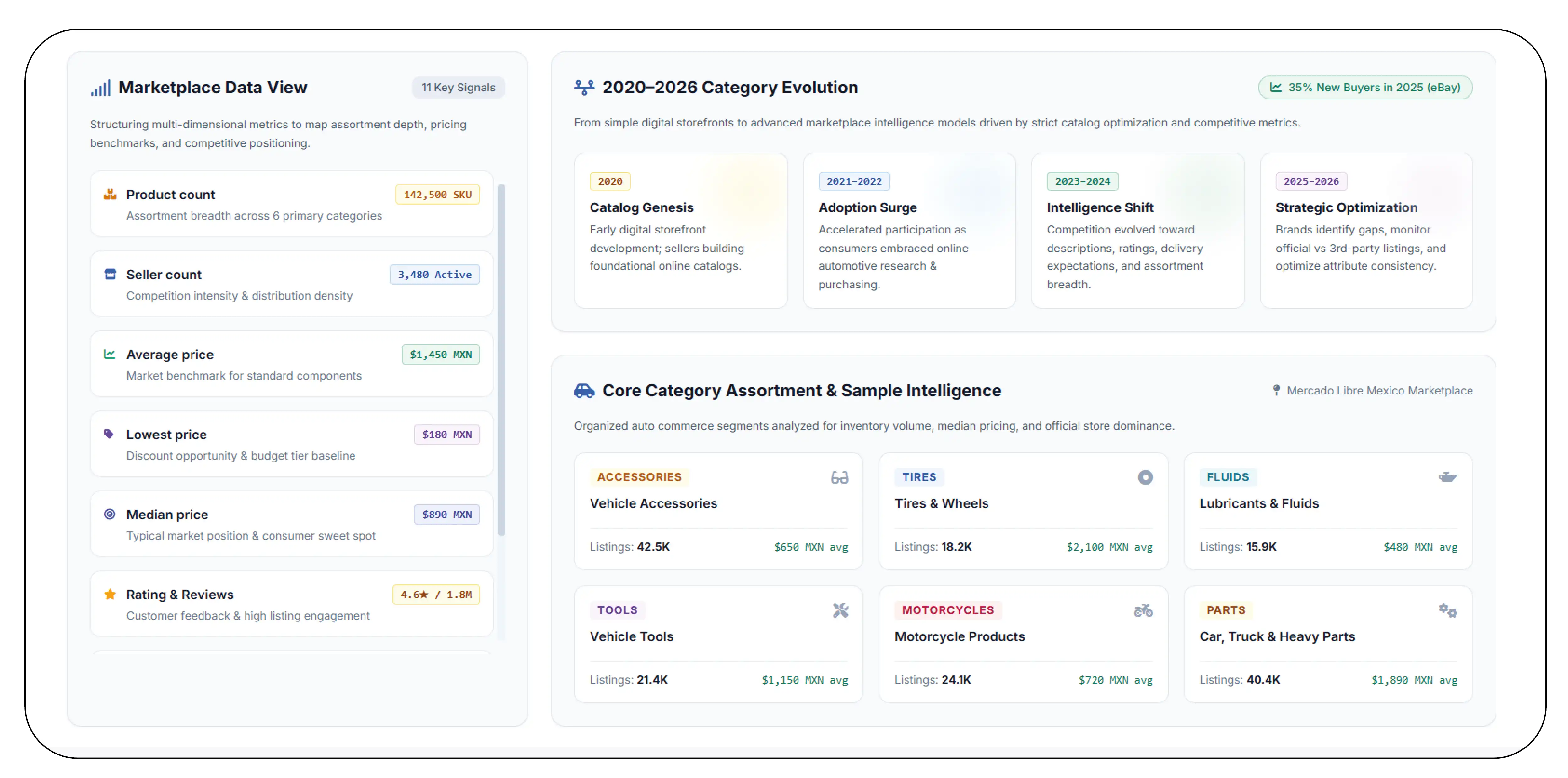
Marketplace Data View
| Marketplace Signal | Example Analysis |
|---|---|
| Product count | Assortment breadth |
| Seller count | Competition intensity |
| Average price | Market benchmark |
| Lowest price | Discount opportunity |
| Median price | Typical market position |
| Rating | Customer feedback |
| Review volume | Listing engagement |
| Availability | Stock visibility |
| Official-store presence | Brand positioning |
| Category placement | Discoverability |
Scrape Mercado Libre Mexico Auto Parts Data can provide a structured view of one of the region's most important online marketplaces. Mercado Libre Mexico currently organizes automotive commerce into areas including vehicle accessories, tires, lubricants and fluids, vehicle tools, motorcycle products, and replacement parts for cars, trucks, and heavy vehicles. (Mercado Libre)
This breadth makes marketplace data valuable for brands trying to understand assortment depth and seller competition.
2020–2026 Evolution
In 2020, many automotive sellers were still developing their digital storefronts and product catalogs. During 2021–2022, marketplace participation became more important as consumers became comfortable researching and purchasing automotive products online.
From 2023 onward, sellers increasingly competed on product descriptions, pricing, ratings, availability, delivery expectations, and assortment breadth. This shifted competitive analysis from simple price comparison toward a broader marketplace intelligence model.
By 2024, Mexico's online retail market had reached MXN 789.7 billion, demonstrating the broader scale of digital commerce. (AMVO) In 2025, digital automotive purchasing continued gaining momentum, with eBay reporting that 35% of surveyed Mexican auto-parts buyers were new to the category. (eBay Inc.)
In 2026, marketplace assortment analysis can help brands identify underrepresented product categories, discover competing sellers, compare official and third-party listings, and monitor product availability. It can also support catalog optimization by showing which attributes are commonly presented across competing listings.
Tracking Price Movement at Marketplace Speed
Monitoring Framework
| Monitoring Metric | Recommended Frequency |
|---|---|
| Product price | Daily / scheduled |
| Discount | Daily |
| Availability | Daily / intraday |
| Seller count | Daily / weekly |
| Search position | Daily / scheduled |
| Rating | Weekly |
| Review count | Weekly |
| Product assortment | Weekly |
| Competitor price gap | Daily |
| Historical benchmark | Continuous |
Real-Time Mexico Auto Parts Price Monitoring is increasingly valuable because marketplace prices can change due to promotions, inventory levels, seller competition, import conditions, seasonal demand, and broader cost pressures.
For automotive products, a small price difference can influence purchasing decisions, especially for frequently compared components such as batteries, tires, brake pads, filters, lubricants, spark plugs, and lighting products.
2020–2026 Evolution
The 2020–2021 period accelerated digital purchasing and made online price visibility more important. In 2022–2023, sellers increasingly needed recurring monitoring to understand how competitors reacted to changing market conditions.
During 2024, Mexico's automotive parts industry remained substantial, with US$75.4 billion in international trade across parts and accessories. (Economía) The aftermarket generated US$27.2 billion in revenue, while average revenue growth reached 5.6% in 2024. (Research and Markets)
In 2025, consumer adoption continued to strengthen. eBay's research found that Mexican consumers spent an average of MXN 3,319 on auto parts over the previous year. (eBay Inc.)
By 2026, recurring price monitoring can support automated alerts when competitor prices move beyond defined thresholds. Retailers can use these signals to review pricing strategies, while manufacturers can monitor whether marketplace sellers maintain recommended positioning.
Turning Marketplace Signals Into Competitive Decisions
Intelligence Layer
| Intelligence Area | Business Question |
|---|---|
| Price gap | Are we above or below competitors? |
| Seller concentration | Who dominates the listing? |
| Assortment | Which products are missing? |
| Availability | Which competitors have stock? |
| Ratings | Which listings perform well? |
| Reviews | What products attract engagement? |
| Brand share | Which brands appear most often? |
| Promotions | Which sellers discount most? |
| Category movement | Which categories are changing? |
A Mexico Auto Parts Competitive Intelligence API can transform recurring marketplace information into machine-readable data for dashboards, pricing systems, catalog platforms, and internal analytics environments.
Instead of manually reviewing marketplace listings, businesses can integrate structured product and pricing signals into their own workflows. This makes it easier to build dashboards that compare brands, sellers, product categories, and price movements.
2020–2026 Evolution
The first stage of digital automotive commerce focused heavily on catalog availability. From 2020 to 2022, sellers prioritized getting products online and improving digital product discovery.
Between 2023 and 2024, competitive intelligence became more sophisticated. Businesses began looking beyond individual prices toward seller behavior, assortment gaps, reviews, product ratings, and availability. The broader growth of Mexican e-commerce strengthened the need for structured information; AMVO's 2025 study reported more than 67 million people purchasing products or services online during the previous year. (Amvo Blog)
In 2025, automotive e-commerce research also highlighted the emergence of new digital auto-parts buyers. (eBay Inc.)
In 2026, API-driven intelligence can connect marketplace data with pricing engines, BI dashboards, competitor-alert systems, and product-information platforms. This creates a more proactive model in which businesses can detect competitive changes and respond quickly instead of waiting for periodic reports.
Extending Automotive Marketplace Intelligence Across LATAM
Regional Expansion Opportunities
| Expansion Area | Intelligence Opportunity |
|---|---|
| Mexico | Product and price benchmarking |
| Brazil | Marketplace assortment monitoring |
| Argentina | Seller and price intelligence |
| Colombia | Product availability tracking |
| Chile | Competitive price comparison |
| Peru | Category and assortment analysis |
| Regional LATAM | Cross-market benchmarking |
The ability to Extract Mercado Libre Data LATAM's marketplace ecosystem creates opportunities for brands operating across multiple Latin American markets. Instead of analyzing Mexico in isolation, businesses can develop standardized data models that support country-level comparisons.
2020–2026 Evolution
From 2020 onward, Latin American e-commerce increasingly became an important channel for product discovery. Between 2021 and 2023, marketplace ecosystems expanded their role in automotive parts and accessories, creating larger volumes of product and seller information.
From 2024 onward, the focus shifted toward extracting more actionable signals from marketplace data. For Mexico specifically, online retail reached MXN 789.7 billion in 2024, while AMVO's 2026 study reports MXN 941 billion and 77.2 million digital buyers. (AMVO)
Mexico's automotive parts ecosystem also provides a strong foundation for regional intelligence. Data México recorded US$75.4 billion in international trade of vehicle parts and accessories in 2024. (Economía)
Looking toward 2026, a standardized LATAM dataset can help automotive manufacturers and distributors compare product availability, pricing, seller competition, and category trends across markets. The biggest advantage comes from using consistent fields and definitions so that regional comparisons remain meaningful despite differences in currencies, tax structures, product naming, and marketplace behavior.
Why Choose Product Data Scrape?
Product Data Scrape combines structured marketplace collection with product normalization, price monitoring, seller intelligence, historical tracking, and analytics-ready delivery. The approach is designed for businesses that need more than raw listings and want datasets that can support actual commercial decisions.
With Scrape Mercado Libre Mexico Product data, organizations can monitor automotive listings across categories, sellers, brands, and product types while capturing important fields such as product title, price, discount, availability, seller information, ratings, reviews, and URLs where accessible.
The platform can also support recurring collection schedules, allowing businesses to create historical datasets instead of one-time snapshots. Normalization helps match products by SKU, part number, brand, model, variant, and other relevant attributes.
Another advantage is scalability. A monitoring framework can begin with a focused group of automotive categories and expand to additional products, sellers, regions, or marketplaces as requirements grow.
The Auto Parts E-Commerce Data Report 2026 highlights why this approach matters: Mexico combines a large automotive parts ecosystem with a rapidly expanding digital commerce environment. Structured marketplace data gives manufacturers, retailers, distributors, and automotive brands a practical way to connect these two trends.
Conclusion
Mexico's automotive market has a strong industrial foundation and an increasingly important digital sales channel. The country recorded US$75.4 billion in international trade of motor-vehicle parts and accessories in 2024, while online retail reached MXN 789.7 billion. (Economía) The continued growth of digital buyers creates new opportunities for automotive brands and retailers to use marketplace intelligence.
The Auto Parts E-Commerce Data Report 2026 demonstrates how product, price, seller, assortment, rating, review, and availability data can help businesses make better decisions. From Mexico-focused monitoring to broader LATAM expansion, structured data can support pricing intelligence, competitive benchmarking, catalog optimization, and marketplace strategy.
As automotive e-commerce becomes more competitive, Scraping data from Mercado Libre and other digital marketplaces can provide the recurring visibility needed to identify market changes faster and respond with greater precision.
Build a smarter automotive e-commerce strategy with structured product, pricing, and competitor data from Product Data Scrape!
Source : https://www.productdatascrape.com/auto-parts-ecommerce-data-report.php
Original https://www.productdatascrape.com
#AutoPartsECommerceDataReport2026,
#MexicoAutoPartMarketIntelligenceBenchmark,
#MexicoAutoPartsDatasetForPricingData,
#ScrapeMercadoLibreMexicoAutoPartsData,
#RealTimeMexicoAutoPartsPriceMonitoring,
#MexicoAutoPartsCompetitiveIntelligenceAPI
📩 Email: [email protected]
