Are Brain Wearables Really Worth It in 2026? A Look at the Evidence
Author : Sychedelic Headphones | Published On : 03 Sep 2026
The popularity of neurotech wearables has created a new kind of consumer technology market. Instead of simply counting steps or monitoring sleep, these devices can track physiological signals, provide feedback, deliver electrical stimulation, or adapt audio based on a person's changing state. That sounds futuristic, but the technology itself is becoming increasingly accessible. The bigger challenge is understanding what these products can genuinely deliver.
In 2026, the evidence is pointing toward a more balanced conclusion. Some technologies are already useful for measurement. Certain stimulation approaches have meaningful evidence in specific circumstances. Broad promises about becoming smarter, dramatically improving focus, or permanently changing cognitive ability are much harder to support.
The difference comes down to the details.
The First Question: What Is the Device Measuring?
Not every wearable marketed as a brain device actually measures the brain.
EEG is the technology most directly associated with measuring brain activity. Electrodes positioned on the scalp detect electrical signals produced by cortical neurons. Consumer EEG devices can be useful for observing broad changes in brainwave power and may support meditation, focus, or sleep-related applications.
However, consumer EEG is much simpler than the systems used in clinical settings. Consumer headbands typically contain around one to fourteen dry channels, while clinical EEG systems can use between 19 and 256 wet electrodes.
The signal itself is also extremely delicate. Blinking, jaw movement, sweat, body movement, and even hair can interfere with measurements.
PPG works differently. It uses light to measure changes in blood volume and can calculate heart rate and heart-rate variability. Because PPG sensors are already common in smartwatches, they are inexpensive and practical for continuous monitoring.
HRV can provide useful information about autonomic activity and physiological state, but it is not a measurement of brain activity.
That distinction should be one of the first things consumers check when evaluating a wearable.
Sensing and Stimulation Are Not the Same
Neurotechnology becomes easier to understand when products are divided into two groups.
Sensing devices observe what is happening. Stimulating devices attempt to change what is happening.
EEG, PPG, and fNIRS fall into the sensing category. tDCS and transcutaneous vagus nerve stimulation are examples of stimulation technologies. Binaural audio is another intervention that has been studied for influencing outcomes such as anxiety and attention.
Then there are closed-loop systems, which combine sensing with intervention. These devices can monitor a physiological signal and use that information to determine whether stimulation should occur.
This approach is particularly interesting because it moves away from applying the same intervention to everyone at the same time.
Instead, the device can potentially respond to the user's current state.
tDCS Has Real Science Behind It, But the Claims Need Context
Transcranial direct current stimulation, or tDCS, has been researched for decades. The technology uses a weak constant electrical current, commonly around 1 to 2 mA, between electrodes placed on the scalp.
The current does not simply "switch on" neurons. It changes their membrane potential and can make them more responsive to incoming signals.
That mechanism is real. The question is what happens afterward.
This is where some consumer claims become difficult to reconcile with the research.
A 2015 analysis by Horvath, Forte, and Carter examined 59 analyses and 42 replicated outcomes. When tDCS was used alone in a single session with rested healthy adults, the overall cognitive effect was approximately zero.
A 2016 review covering 31 articles similarly found no reliable working-memory improvement from tDCS alone in healthy adults.
However, another review covering 61 studies found small but significant effects when stimulation was delivered while participants were performing a cognitive task. Reported effect sizes were approximately 0.3 to 0.4.
This difference is important.
The evidence does not suggest that simply putting on a stimulation device makes a person cognitively better. Instead, some evidence suggests that stimulation may have greater value when it is paired with active cognitive work.
Training May Change the Picture
Repeated stimulation combined with cognitive training has also produced interesting findings.
A 2017 Scientific Reports study involving 71 participants examined multi-session tDCS alongside working-memory training. The researchers reported sustained transfer effects lasting as long as nine months.
That result is promising, but it should not be interpreted as proof that every consumer stimulation protocol will produce long-term improvements.
The details matter. Research protocols specify factors such as stimulation intensity, electrode placement, timing, number of sessions, and the task being performed.
Changing those elements can change the outcome.
This is why consumers should be skeptical of products that talk about tDCS as though it were a single standardized intervention.
Medical Evidence Is Not the Same as Productivity Evidence
There is a stronger evidence base for some clinical applications of tDCS.
A 2025 systematic review and meta-analysis of home-based tDCS for depressive disorders found significant symptom reductions compared with sham treatment. The analysis included 438 participants for depression outcomes and 211 for anxiety outcomes.
The regulatory landscape also changed significantly in late 2025.
On December 8, 2025, the FDA granted premarket approval to Flow Neuroscience's FL-100 for moderate-to-severe major depressive disorder in adults. The treatment is prescription-based and intended for a defined clinical indication.
This is an important milestone, but the scope of the approval matters.
The approval does not cover other tDCS devices. It does not cover focus, productivity, memory, or cognitive enhancement in healthy adults.
In fact, according to the source, no tDCS device has regulatory approval anywhere for cognitive enhancement in healthy adults.
That is a useful reality check when reading advertisements for consumer brain stimulation.
What About Binaural Beats?
Binaural audio has become increasingly popular among people looking for ways to relax, concentrate, or improve their mental state.
The concept is based on presenting slightly different frequencies to each ear, producing a perceived rhythmic beat.
Research has produced some encouraging findings, particularly around acute anxiety.
A 2025 systematic review and meta-analysis examining perioperative binaural audio found significant reductions in anxiety across 14 trials involving 1,047 participants. The analysis also found reductions in postoperative pain, systolic blood pressure, and heart rate.
Compared with ordinary non-binaural music, binaural audio also showed an advantage for anxiety across eight trials involving 598 participants.
But there is an important qualification.
The anxiety studies showed very high heterogeneity, with an I² value of 91.6%. This means that the results varied substantially between studies.
Research on cognition and attention is even less straightforward.
A high-density EEG study involving 31 participants found no significant improvement in vigilance and no evidence of cortical entrainment from the tested 7 Hz and 16 Hz binaural beats.
Another 2025 study involving 80 participants tested 16 different binaural configurations. It found that brain rhythms could respond to beat frequency, but improvements in general attention appeared only under a specific configuration involving gamma beats, a low carrier tone, and white-noise masking.
The takeaway is that binaural audio cannot be reduced to a single "focus frequency."
The exact parameters matter.
Why Product Specifications Matter
When comparing neurotech products, consumers often focus on design, sensors, battery life, or the number of features.
Those things matter, but stimulation products require deeper questions.
How much current does the device deliver?
How long does each session last?
Where are the electrodes positioned?
Are there hardware limits on current?
Is there an automatic session timer?
Does the device prevent stimulation when electrode contact is poor?
These details define the actual protocol.
The source recommends looking for protections such as a hardware current ceiling, hardware session timer, and impedance monitoring. Hardware-based safeguards are particularly useful because they do not depend entirely on an app behaving correctly.
Transparency matters too.
If a company describes its stimulation protocol only as a proprietary technology without providing measurable parameters, consumers have little ability to compare the intervention with published research.
Regulatory Badges Can Be Misleading
Another common mistake is assuming that every certification represents evidence of effectiveness.
FDA premarket approval means that a specific device has been evaluated for safety and effectiveness for a specific intended use.
FDA 510(k) clearance is different. It is based on substantial equivalence to an existing legally marketed device.
A CDSCO licence in India provides authorization to manufacture, import, or sell a medical device under the applicable regulations. It does not mean that the device has received FDA approval.
IEC 60601-1-2 addresses electromagnetic compatibility. It does not demonstrate that a treatment improves focus or memory.
Even the phrase "clinically proven" has no standardized regulatory meaning by itself.
For consumers, the safest approach is to ask what exactly the certification or approval covers.
Your Data May Be More Valuable Than You Think
Neurotechnology also raises a major privacy issue.
Wearables can collect detailed physiological information, and some neurotech devices may collect data associated with brain activity or nervous system function.
A 2024 audit by the Neurorights Foundation examined 30 consumer neurotechnology companies and found that 96.7% reserved the right to transfer neural data to third parties.
Fewer than 20% mentioned encryption in their policies, 16.7% committed to breach notification, and only 10% adopted all of the core data-safety measures reviewed.
That should make privacy part of the purchasing process.
Before using a neurotech wearable, find out whether your data is processed on the device or uploaded to the cloud. Check whether you can export your information and whether you have the ability to delete your session history.
Most importantly, find out whether the company reserves the right to sell or transfer physiological information.
Safety Should Never Be an Afterthought
The safety requirements of a heart-rate sensor are different from those of an electrical stimulation device.
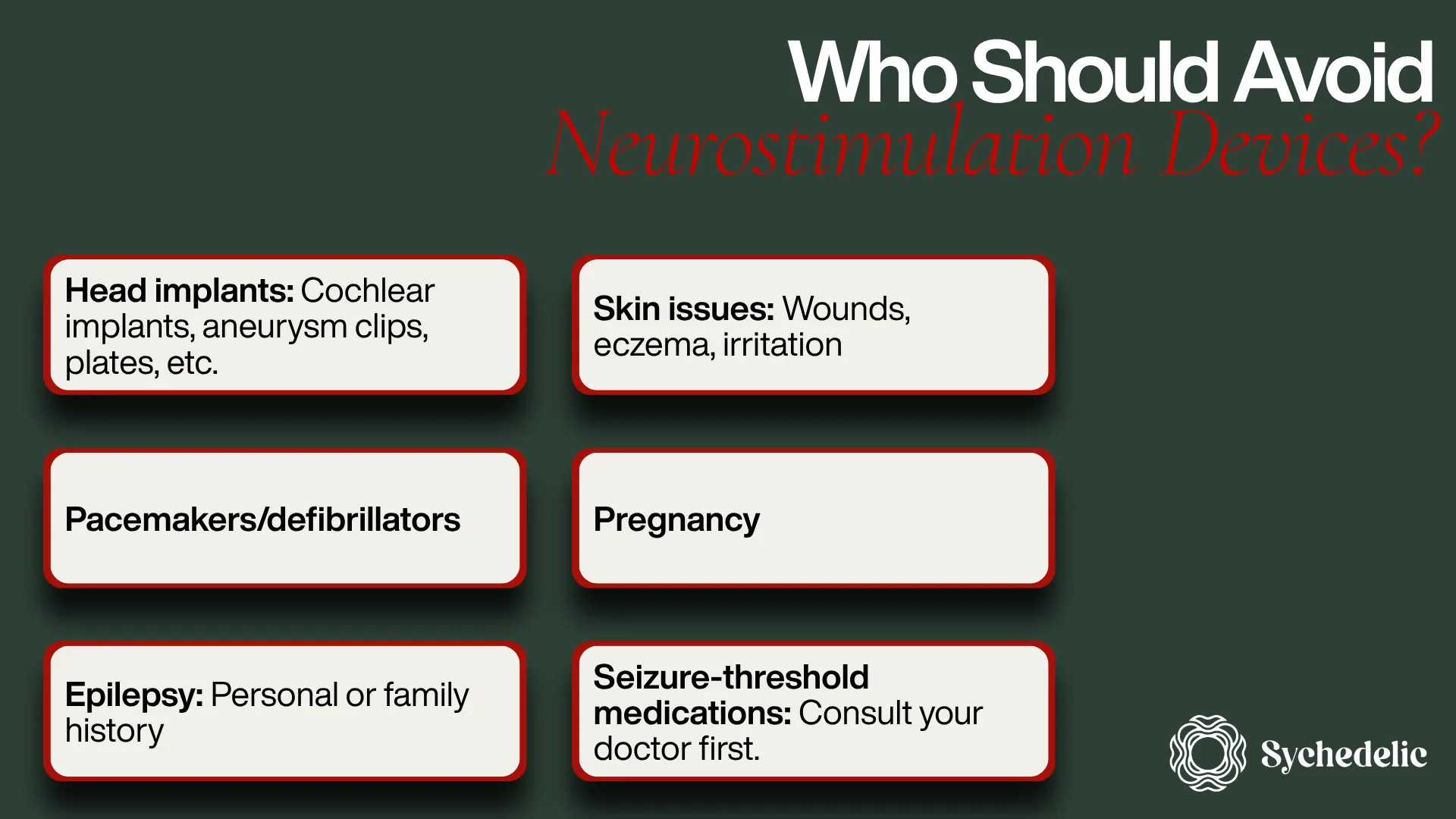
The source identifies several situations in which tDCS or electrical stimulation should be avoided or discussed with a physician. These include certain metal implants in or near the head, pacemakers or implanted defibrillators, a personal or family history of epilepsy or unprovoked seizures, active skin problems at electrode sites, pregnancy, and certain medications that lower seizure threshold.
The safety record under established research conditions is relatively strong. A 2016 review examined more than 33,200 tDCS sessions across over 1,000 participants and found no serious adverse events at currents up to 4 mA and durations up to 40 minutes.
Mild temporary effects can still happen, including tingling, itching, scalp redness, and occasional mild headaches.
The evidence becomes thinner when considering extended, consecutive, unsupervised consumer use. That is an important limitation that should not be ignored.
A Better Way to Choose a Neurotech Wearable
Instead of starting with price, start with purpose.
If you want to track physiological state throughout the day, PPG may be a practical option.
If you want session-based brainwave information, EEG may be more relevant.
If you are considering stimulation, look closely at the actual protocol rather than relying on broad claims about "brain optimization."
Ask whether the company publishes its stimulation intensity, session duration, electrode placement, and safety controls.
Then examine the evidence.
Does the company cite studies that support its exact approach? Does it acknowledge research that found no effect? Can you understand how the product's protocol relates to the research?
Finally, consider usability.
A technically impressive device has no practical value if you stop using it after a week.
Adherence May Be the Most Important Specification
One of the simplest observations in the source is also one of the most useful: adherence beats specification.
The best device on paper is not necessarily the best device for a real person.
A clinical EEG system may offer substantially better signal quality than a consumer headset, but it is not designed for someone to wear casually while working, commuting, or relaxing.
Comfort, convenience, session length, setup requirements, maintenance, and cost all influence whether someone continues using a device.
The real-world effect of a wearable therefore depends partly on whether it becomes part of someone's routine.
A device sitting unused in a drawer cannot deliver any benefit, regardless of how impressive its specifications look.
The Future Is Moving Toward Closed-Loop Technology
The next stage of consumer neurotechnology may be less about adding more features and more about making devices responsive.
Closed-loop systems can continuously monitor physiological information and potentially adjust or delay stimulation depending on the user's current state.
This changes the basic question.
Instead of asking, "Can this device stimulate my brain?" we can ask, "Is stimulation appropriate for me right now?"
That distinction could become increasingly important as personalization becomes more common.
The source identifies several trends pointing in this direction. Ear-based sensing is becoming attractive because the form factor is familiar and can support technologies such as PPG. Personalization is replacing fixed protocols as researchers recognize how differently individuals can respond. Regulation is also developing around both devices and neural data.
The Bottom Line for 2026
The science behind neurotech is more nuanced than the marketing.
EEG can provide useful brain activity measurements, but consumer systems have technical limitations. PPG is practical for continuous physiological monitoring, but it should not be confused with direct brain measurement.
tDCS has meaningful evidence in specific clinical applications and shows more promising results when paired with cognitive tasks. At the same time, evidence for tDCS alone as a general cognitive enhancer in healthy adults remains weak.
Binaural audio has promising evidence for acute anxiety, while research into focus and cognition remains mixed and highly dependent on the exact audio configuration.
The smartest approach is therefore not to ask whether neurotechnology "works."
Ask a more specific question: What does this particular device do, under what conditions, and what evidence supports that exact use?
That question cuts through much of the noise.
As the industry continues to develop, the most valuable neurotech products will likely be those that combine useful sensing, controlled intervention, personalization, safety, privacy, and honest communication about their limitations.
The future of brain wearables is promising. But in 2026, understanding the evidence is still the most powerful technology a consumer has.
