Application Development Consulting vs In-House Team: Which Is Better?
Author : kanna dhasan | Published On : 23 Nov 2026
Quick answer: An in-house team is better when software is your core product, you have continuous development work, and you can hire and keep skilled engineers. Application development consulting is better when you need specialist skills quickly, have a project with a clear end, or want to reduce hiring risk. For many companies, a hybrid works best: a consulting partner builds and stabilizes the application while a small internal team takes ownership over time.
This is rarely an either-or decision, but it is usually framed that way. Leaders ask "should we hire developers or hire a firm?" when the better question is "which work should we own permanently, and which work do we need help with right now?" The sections below compare both options on cost, speed, skills, control, and risk so you can answer that honestly.
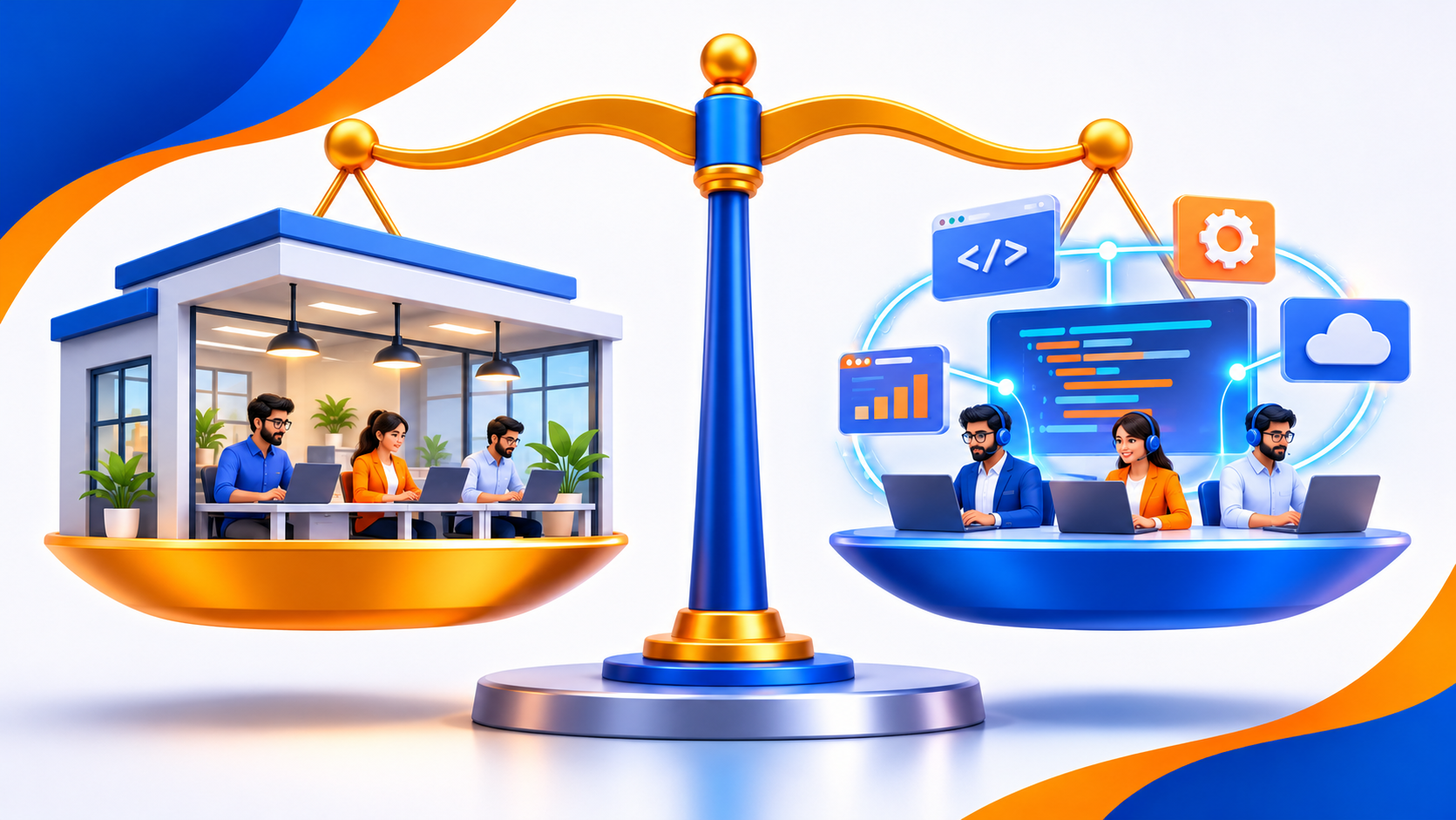
What Is the Difference Between Consulting and an In-House Team?
An in-house team is made up of your own employees. They work for one company, build up deep knowledge of its systems, and are available continuously.
An application development consulting partner is an outside firm that provides expertise and delivery capacity. You engage them for a project, a set period, or an ongoing retainer. They bring experience from many similar projects, and you do not carry the cost of employing them year-round.
Each model buys you something different. In-house buys continuity and control. Consulting buys speed, breadth, and flexibility.
How Do the Costs Compare?
The comparison is not as simple as a salary versus an invoice.
The real cost of an in-house team
- Salaries and benefits for each developer.
- Recruiting costs and the time it takes to hire. Finding experienced engineers can take months.
- Management time, tools, licences, and equipment.
- Training and ongoing skill development.
- Turnover. When a key developer leaves, knowledge leaves with them.
- Idle capacity between projects.
The real cost of consulting
- Higher hourly cost than an employee's salary equivalent.
- Time spent briefing the team and transferring knowledge.
- Ongoing fees if you keep a retainer for support.
- Dependence on the vendor if documentation is poor.
Where each model wins on cost
Consulting usually costs less when work is temporary or specialized, because you pay only for what you use. In-house usually costs less when work is constant and long-term, because you spread fixed costs across years of output. The break-even point depends on how steady your workload really is. Many companies overestimate this. If your development needs rise and fall, a permanent team will sit partly idle during quiet periods.
How Do They Compare on Speed?
Hiring takes time. Recruiting, interviewing, onboarding, and getting a new developer productive can take several months. A consulting partner can usually start within weeks, with an established team that already works together.
If you have a deadline, such as a compliance date, a contract commitment, or a product launch window, consulting typically gets you moving faster. If speed is not critical and you are building something you will evolve for years, hiring slowly and carefully is reasonable.
How Do They Compare on Skills?
A small in-house team usually has depth in your business and a narrow technical range. A consulting firm has broader technical range, since its people work across industries and technologies.
This matters when your project needs skills you will use once or rarely, such as a cloud migration, security hardening, AI integration, or an unusual integration with a legacy ERP. Hiring a full-time specialist for a six-month need rarely makes sense. Conversely, deep knowledge of your own processes is something an outside firm can only build gradually.
How Do They Compare on Control and Knowledge?
An in-house team is easier to direct day to day. Priorities change, and you can redirect people immediately. Knowledge stays inside the company.
With consulting, control depends on how the engagement is structured. Clear requirements, regular demos, and shared access to code repositories keep you in control. The biggest risk is knowledge sitting only in the vendor's heads. Protect yourself by requiring documentation, code ownership, and handover sessions from the start.
How Do They Compare on Risk?
| Risk | In-house team | Consulting partner |
|---|---|---|
| Hiring the wrong person | High impact, slow to correct | Lower impact, partner can swap people |
| Key person leaving | High risk for small teams | Lower risk when the firm has depth |
| Skill gaps | Common in small teams | Reduced through broader expertise |
| Vendor lock-in | Not applicable | Possible without documentation and code ownership |
| Cost predictability | Fixed salaries, but hidden hiring and turnover costs | Depends on pricing model and scope control |
| Knowledge retention | Strong when people stay | Needs deliberate handover |
| Idle capacity | Paid even when work is light | Pay only for the engagement |
When Should You Choose an In-House Team?
Choose in-house when:
- Software is central to your product or competitive advantage.
- You have a steady, multi-year roadmap that needs constant work.
- You can offer competitive pay and a career path for engineers.
- Your applications need deep, daily knowledge of internal processes.
- You have technical leadership to manage and review the team's work.
When Should You Choose Application Development Consulting?
Choose consulting when:
- You have a defined project with a start and an end.
- You need skills your team does not have, such as cloud, security, or AI.
- You are under time pressure and cannot wait for hiring.
- You are unsure what to build and need an expert opinion first.
- You want to try a new idea before committing to permanent headcount.
- You do not have technical leadership in-house to manage developers.
If you are still deciding what to build in the first place, it helps to read our build vs buy software decision framework before choosing who builds it. And if your question is really about the tooling, our guide to low-code versus custom development can narrow the field.
Is a Hybrid Model the Best Answer?
For many mid-sized companies, yes. A typical hybrid looks like this:
- A consulting partner leads discovery, architecture, and the first release. This gets a stable application live quickly with proven practices.
- A small internal team shadows the work. They learn the code, the design decisions, and the deployment process.
- Ownership gradually shifts. The internal team handles routine changes and priorities.
- The partner stays available for specialist work. Security reviews, major upgrades, and new integrations still benefit from outside expertise.
This approach captures the speed and expertise of consulting while building the continuity of an in-house team. It also reduces the worst failure mode of pure outsourcing, which is a working system nobody inside the company understands.
DESSS supports this model through its application and software development consulting, including documentation and knowledge transfer so your team can take over when you are ready. For a broader view of what to evaluate in any partner, see our application development buyer's guide.
A Simple Decision Checklist
Answer these five questions honestly:
- Will we have development work every month for the next three years?
- Can we hire and retain engineers at the salary the market requires?
- Do we have someone technical enough to manage and review the work?
- Do we need results in the next three to six months?
- Is the skill we need something we will use continuously or only now?
If you answered yes to the first three and no to the last two, in-house is likely the right base. If the pattern is reversed, start with consulting. A mix of answers points to a hybrid.
Key Takeaways
- In-house teams offer continuity, control, and deep business knowledge, at a high fixed cost.
- Consulting offers speed, specialist skills, and flexibility, with a risk of vendor dependence.
- Consulting usually wins for temporary, specialized, or time-sensitive work.
- In-house usually wins for constant, long-term development of a core product.
- A hybrid model, with knowledge transfer built in, suits many mid-sized businesses.
Frequently Asked Questions
Is it cheaper to hire developers or use a consulting firm?
It depends on how steady your workload is. For continuous work over several years, employees are usually cheaper per hour of output. For temporary or specialized work, consulting is usually cheaper because you do not pay for idle time or recruitment.
How long does it take to build an in-house development team?
Hiring and onboarding experienced developers commonly takes several months, and building a team that works well together takes longer.
Can a consulting firm work alongside my internal team?
Yes. Many engagements are set up exactly this way, with the partner providing architecture, specialist skills, or extra capacity while your team handles day-to-day priorities.
How do I avoid vendor lock-in with a consulting partner?
Own the source code, require documentation, use standard technologies, and schedule handover sessions. Confirm all of this in the contract.
What if I do not have a technical leader?
That is a strong reason to start with consulting. A good partner can act as your technical lead during the project and help you plan what to hire for later.
Which option is better for a small business?
Usually consulting, because a small business rarely has enough steady work to justify a full development team. Start with a partner and revisit the question as your needs grow.
