AI Chatbot for Travel: How Travel Businesses Turn Visitors Into Bookings
Author : Media post | Published On : 18 Nov 2026
A traveler lands on your website at 11 p.m. and wonders whether your sunset kayak tour is suitable for kids, what happens if it rains, and whether the price includes gear. Nobody is online to answer, so they open a competitor’s tab. An AI chatbot for travel closes that gap. It answers questions around the clock, in the visitor’s language, using your own tour details and policies, and it passes real sales conversations to your team.
This guide is written for digital agencies, SaaS companies and small-to-medium travel businesses. You’ll learn what a travel chatbot can and can’t do, which use cases pay off first, how to keep answers accurate, what it costs, and how to launch one step by step.
What Is an AI Chatbot for Travel?
An AI chatbot for travel is a conversational assistant on a travel website, app or messaging channel that answers visitors’ questions in natural language and helps them move toward a booking. Trained on a business’s own content, such as itineraries, policies and FAQs, it can reply instantly, collect traveler details and hand complex requests to a person.
There are two very different kinds of travel chatbot, and it helps to separate them:
-
Traveler-facing assistants are general tools like ChatGPT or Gemini that individuals use to plan their own trips.
-
Business-deployed chatbots live on your website, speak for your brand and answer from your information.
This guide is about the second kind. Older rule-based bots could only follow fixed menus. Modern AI chatbots understand free-form questions such as “Is the hike okay for a nine-year-old?” and respond conversationally.
What an AI Travel Chatbot Can (and Can’t) Do
Before you build anything, be clear about where a chatbot is strong and where it needs help. A consumer test by Thrifty Traveler found that popular chatbots were useful for itineraries, packing lists and logistics, but weak on flights and vacation rentals. The same pattern applies to business chatbots.
|
Handles well |
Needs a live data source or a person |
|
Tour, room and destination FAQs |
Live prices and availability |
|
Cancellation, refund and house policies |
Visa, entry and health requirements |
|
Itinerary details and what to bring |
Flight changes and disruptions |
|
Collecting preferences and contact details |
Payments and booking changes |
|
Booking a call or consultation |
Group, custom or high-value trips |
Treat this table as your design brief. Let the bot do what it does well, connect it to live systems where accuracy depends on real-time data, and route everything else to a human.
Why Travel Businesses Are Adding Chatbots
Travel demand is global and always on, while your team works set hours. A well-built travel customer support chatbot helps in five practical ways:
-
24/7 coverage across time zones. Visitors get answers when they are actually planning, which is often evenings and weekends.
-
Multilingual service. Platforms such as AI-Chatbot.ai support 95+ languages, so one bot can serve guests who speak several.
-
Seasonal scaling. Peak-season question volume doesn’t require extra hires.
-
Automatic lead capture. Every conversation can end with a name, email and trip details instead of a closed tab.
-
More time for high-value work. Your team stops repeating the same ten answers and focuses on custom trips and closing sales.
When you present this to a client or manager, tie each benefit to an outcome such as more leads, faster response times or hours saved, not just a feature.
AI Chatbot Use Cases by Travel Business Type
Tour operators and activity providers
The chatbot answers meeting points, inclusions, age and fitness limits, weather policies and what to bring. It then offers to capture a booking request or send the visitor to the booking page.
Boutique hotels, B&Bs and lodges
Guests ask about check-in times, parking, breakfast, pets and local recommendations. A bot trained on your guest handbook handles these instantly and flags date-specific questions for staff.
Vacation rental hosts and managers
Rentals are a known weak spot for general-purpose AI. A chatbot trained on your own listings, house rules and arrival instructions can answer the repetitive questions that fill a host’s inbox, then pass availability and pricing questions to you.
Travel agencies and DMCs
Use the bot as a first-line qualifier. It asks about travel dates, group size, budget and interests, then books a consultation with the right advisor and sends that context along.
Travel SaaS and booking platforms
In-app support is the main win. A bot trained on help articles can deflect common how-to and account questions and escalate billing or technical issues.
Digital agencies building for travel clients
Agencies can repeat the same setup for each client: train on the client’s content, apply their branding, set guardrails and connect their CRM. Per-user pricing hurts agencies, so look for plans with unlimited users.
Real Conversation Examples
These illustrative exchanges show how a well-configured bot behaves. Build similar ones in your own platform with your own content before publishing.
Example 1: A pre-booking question answered from your content
Visitor: Is the sunrise hike suitable for kids? Bot: Yes. The sunrise hike is open to children aged 8 and up with an adult. It takes about two hours on a gentle trail, and we provide headlamps. Would you like to see available dates?
Takeaway: The answer comes from the operator’s own tour page, so it’s specific and consistent.
Example 2: A question the bot should not answer
Visitor: Do I need a visa for this trip? Bot: Entry rules depend on your passport and change often, so I can’t give reliable advice on that. Please check the official government site for your destination. I can also connect you with our team to help with trip planning.
Takeaway: A safe redirect protects the traveler and your reputation.
Example 3: A high-value inquiry captured and handed off
Visitor: We’re a group of 12 looking at a week in Portugal next May. Bot: That sounds great. Group trips are best planned with a specialist. Can I take your name, email and rough budget so a travel advisor can follow up today?
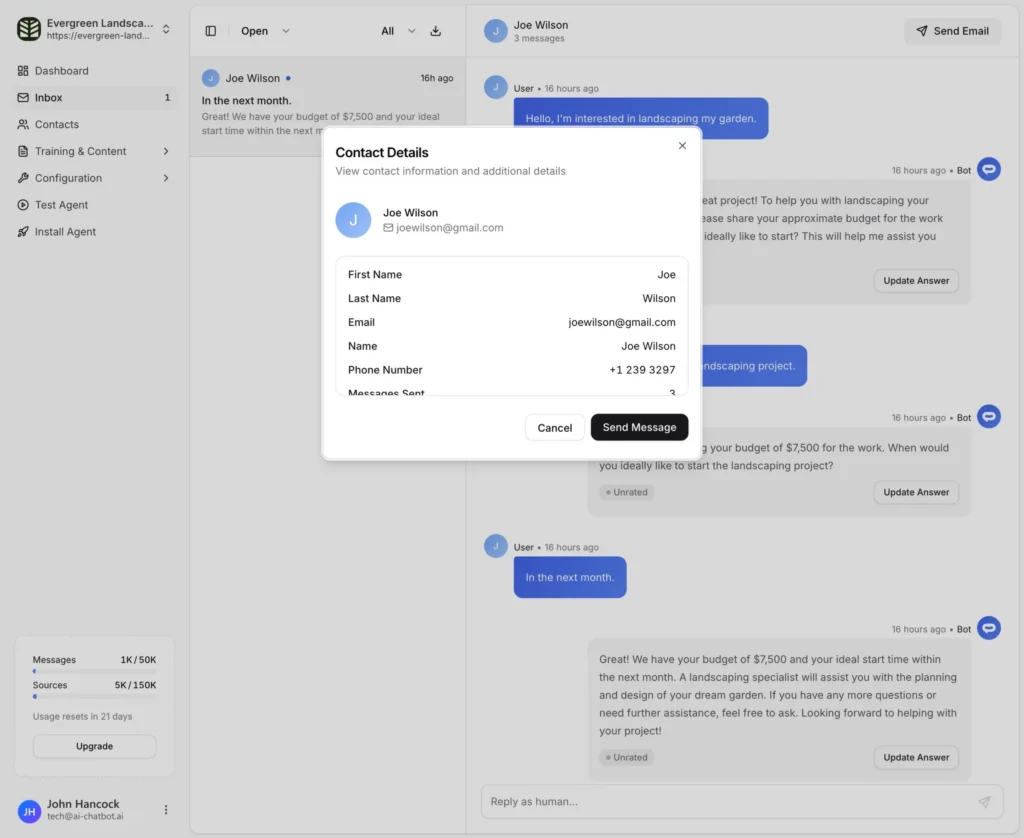
Takeaway: The bot qualifies the lead and passes the full conversation to a person, so the customer doesn’t repeat themselves.
How to Keep a Travel Chatbot Accurate
Accuracy is what separates a useful travel chatbot from a risky one. Four habits keep it reliable.
1. Ground the bot in your content. Train it on your website, PDFs, policies and help documents so it answers from your information instead of guessing. AI-Chatbot.ai, for example, trains on websites, knowledge bases, PDFs and videos.
2. Connect live data where it matters. Prices, availability and booking status change constantly. If you want the bot to reference them, connect your booking or inventory system through an API or integration. Otherwise, send visitors to your booking page.
3. Set clear guardrails. Decide what the bot must never state, such as prices not found in your content, visa rules, safety advice or medical guidance. Give it a default fallback like “Let me connect you with our team.”
4. Refresh your knowledge base on a schedule. Review it before each season and any time policies, prices or itineraries change. An outdated bot is worse than no bot.
Human Handoff: When the Bot Should Step Aside
A chatbot should never trap a customer. Define handoff rules before launch. Common triggers include:
-
Group, corporate or custom itinerary requests
-
Complaints or refund disputes
-
Disruptions, cancellations and emergencies
-
Payment or booking-change issues
-
Any question the bot cannot answer confidently
The best setups pass the full conversation history to your team through a shared inbox or live chat, so the traveler doesn’t have to start over. Write your triggers down, test them, and review handoffs weekly.
Features to Look For in a Travel Chatbot
Use this checklist when comparing platforms:
-
Training on your own content (website, PDFs, video) so answers are specific to you
-
Live-data integrations for availability, CRM and calendars
-
Human handoff and shared inbox with conversation history
-
Lead capture and meeting booking to turn chats into pipeline
-
Multilingual support for international visitors
-
Brand customization so the bot matches your site
-
Analytics showing what visitors ask and where the bot struggles
-
Choice of AI model
More
