Agentic AI Development: A Complete Enterprise Guide
Author : Alignminds Technologies | Published On : 31 Jul 2026
For the last two years, most “AI adoption” inside enterprises has really meant one thing: a chatbot with a nicer prompt. That phase is over. In 2026, the conversation has shifted from what can this model say to what can this system do on its own — and that shift has a name: agentic AI development.
If you’re evaluating whether to build AI agents in-house, hire an agentic AI development company, or bolt autonomy onto an existing product, this guide walks through what agentic AI development actually involves in 2026 – the process, the architecture decisions, the governance requirements, and the real costs, without the vendor fluff.
What Is Agentic AI Development?
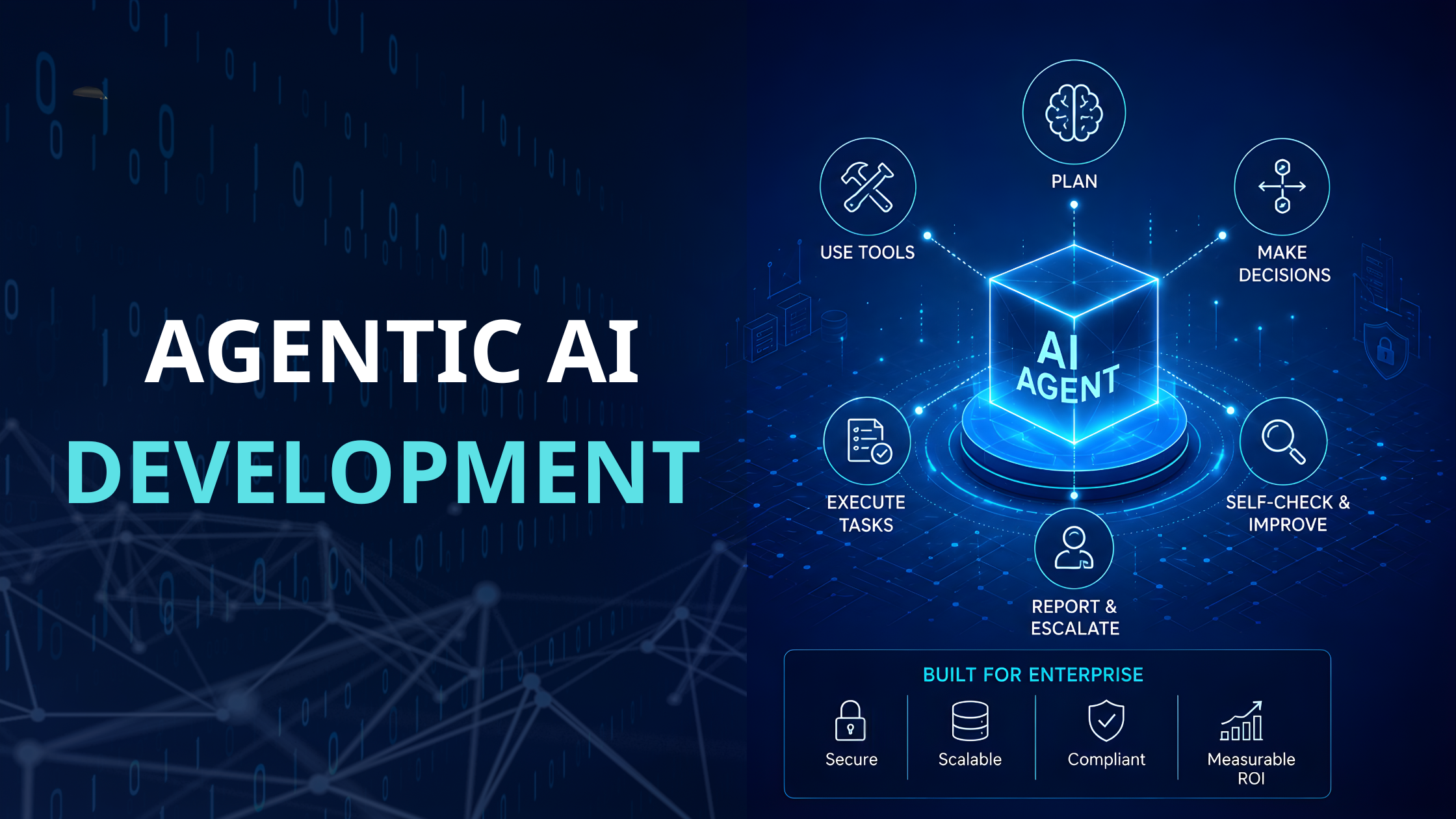
Agentic AI development is the practice of building AI systems that can plan, use tools, make decisions, and complete multi-step tasks with minimal human intervention — as opposed to traditional generative AI, which mostly responds to a single prompt and stops.
Where a chatbot answers a question, an agent:
1.Breaks a goal down into steps
2.Decides which tools or APIs it needs to call
3.Executes those steps in sequence (or in parallel, with other agents)
4.Checks its own output and self-corrects
5.Reports back or escalates when it hits a wall
Industry analysts are tracking this shift closely. Gartner’s 2026 Hype Cycle places agentic AI at the “Peak of Inflated Expectations,” noting that while enterprise experimentation is intense, most production deployments remain narrowly scoped, full end-to-end autonomy is still rare outside well-defined workflows. That’s an important reality check for anyone scoping a first agentic project: start narrow, prove reliability, then expand scope, not the other way around.
Why 2026 Is the Inflection Year
A few converging signals explain why agentic AI development has moved from “interesting experiment” to board-level priority:
1.Adoption is accelerating fast.
Gartner projects that 40% of enterprise applications will embed task-specific AI agents by the end of 2026, up from under 5% just a year earlier.
2.Multi-agent orchestration is replacing single-agent workflows.
Anthropic’s 2026 Agentic Coding Trends Report describes an architecture shift where an orchestrator agent coordinates several specialized sub-agents working in parallel, each with its own dedicated context – a pattern that lets teams tackle task complexity that a single agent’s context window simply can’t hold.
3.Governance has become a first-class design concern,
not an afterthought bolted on after deployment. Gartner’s Hype Cycle explicitly calls out agentic AI governance, agentic AI security, and FinOps for agentic AI as emerging categories in their own right – a signal that “ship it and see” is no longer an acceptable rollout strategy for autonomous systems.
The Agentic AI Development Process: Step by Step
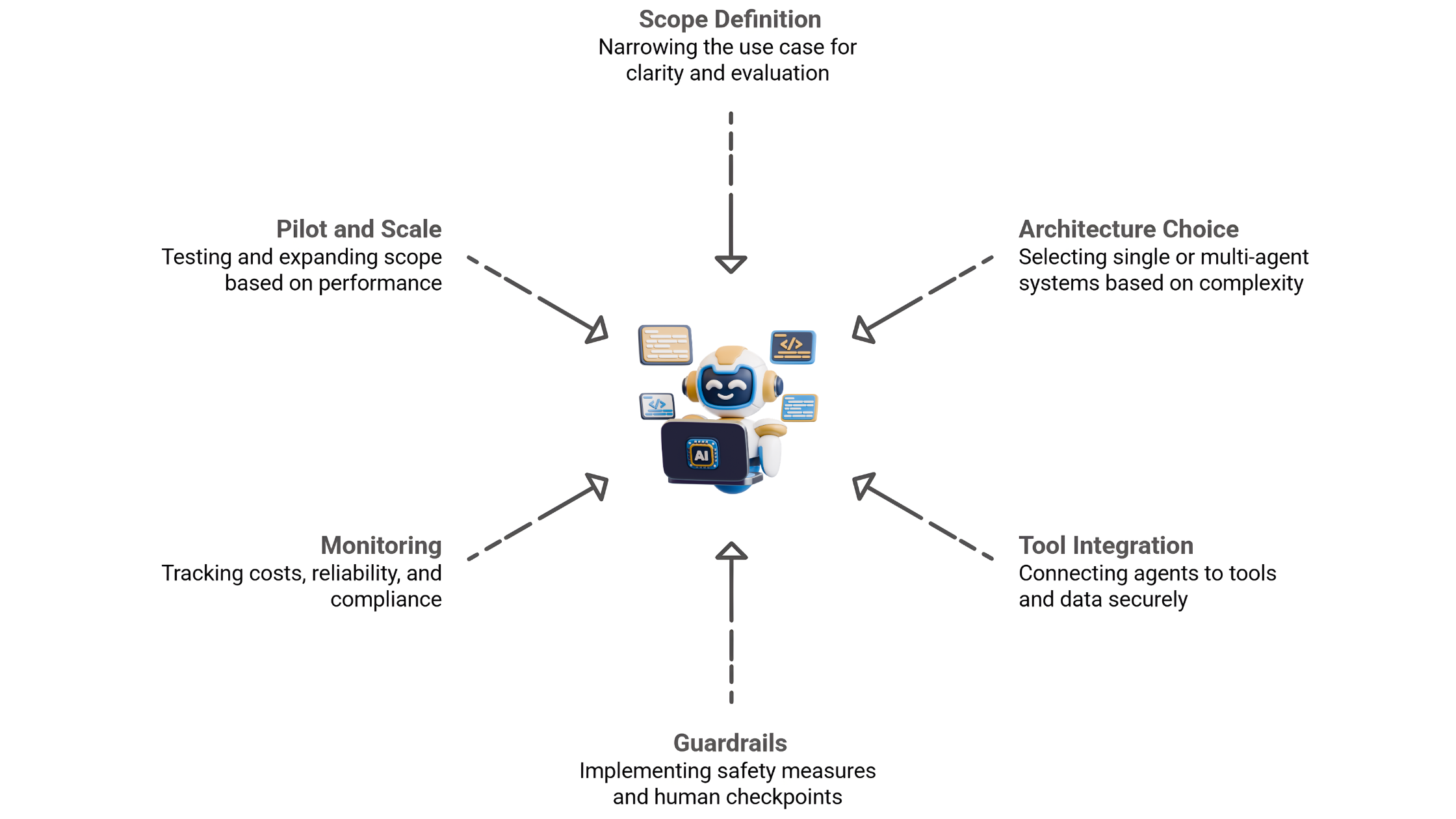
1. Scope a narrow, well-bounded use case
The enterprises getting real ROI in 2026 aren’t chasing general-purpose autonomy – they’re deploying domain-constrained agents with clearly defined rules and objectives: a reconciliation agent in finance, a contract-review agent in legal, a dependency-update agent in engineering. Narrow scope makes evaluation tractable and failure modes easier to catch.
2. Choose the right architecture: single-agent vs. multi-agent
Simple, linear tasks (data lookup, summarization, basic workflow automation) are usually fine as a single agent. Once a task needs specialized reasoning across domains — research plus execution plus compliance checking, for example — a multi-agent architecture with an orchestrator layer becomes the more reliable pattern. This is the same pattern AlignMinds uses inside Musiris, our proprietary Generative AI framework, which chains multiple prompts and agents together in a connected, sequenced workflow rather than relying on a single monolithic model call.
3. Decide how your agents connect to tools and data
This is where Model Context Protocol (MCP) has become one of the defining technical decisions of 2026. MCP has seen a strong resurgence this year specifically because it handles what CLI-based agent tooling struggles with: OAuth and delegated authentication, per-tenant data scoping for multi-tenant products, and audit-trail-ready enterprise governance. If your agents need to touch multiple internal systems securely — CRM, ERP, ticketing, databases — MCP is worth building around from day one rather than retrofitting later.
4. Build in guardrails and human-in-the-loop checkpoints
The trend among mature organizations isn’t full automation for its own sake — it’s designing systems that combine dynamic AI execution with deterministic guardrails and human judgment at the decision points that actually matter. Full autonomy isn’t always the goal; reliable, supervised autonomy is.
5. Instrument for monitoring, cost, and compliance from day one
Once an agent is live, it’s interacting with real systems, calling real APIs, and potentially modifying real data — which means errors have real consequences. Treat agent cost (token spend, tool-call volume), reliability monitoring, and audit logging as architectural requirements, not post-launch add-ons.
6. Pilot, measure, then scale scope — not headcount of agents
Resist the temptation to spin up ten agents at once. Prove reliability on one workflow, measure the automation yield (tasks completed without human intervention), and only then expand into adjacent processes.
Agentic AI Governance: The Part Most Teams Underestimate
Governance conversations used to happen after a pilot succeeded. In 2026, that’s changed — governance is now a design constraint from day one, not a compliance checkbox added at the end. Practically, that means:
 Runtime supervision, not just model-level oversight — monitoring what an agent actually does in production, not just what it was trained to do
Audit trails for every autonomous action and every memory the agent retains or discards
Identity- and permission-based access controls, so an agent can only reach the systems and data it’s explicitly scoped to touch
Clear escalation paths for when an agent hits a case outside its defined boundaries
Teams that build this in early tend to scale faster afterward — strong governance turns out to be an enabler of broader deployment, not a brake on it, because it’s what earns the organizational trust needed to expand an agent’s scope.
What Does Agentic AI Development Cost?
Costs vary widely based on scope, but three cost centers show up consistently across enterprise agentic AI projects:
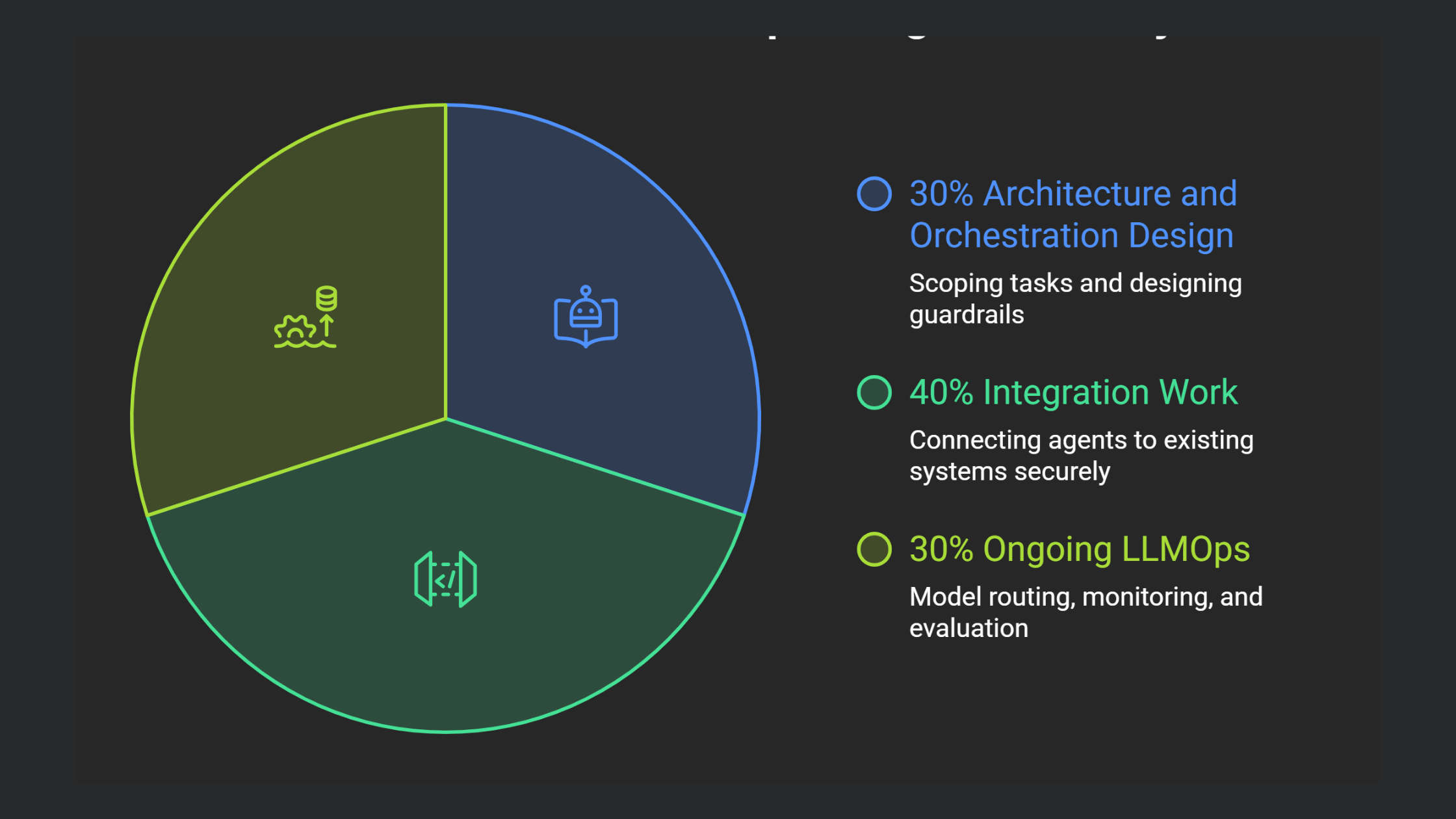
Architecture and orchestration design —
scoping which tasks need single-agent vs. multi-agent handling, and designing the guardrails around them
Integration work —
connecting agents securely to existing systems (this is where MCP-based approaches often reduce long-term engineering overhead compared to custom point-to-point integrations)
Ongoing LLMOps —
model routing (sending simple queries to cheaper models, complex reasoning to higher-performance ones), monitoring, and continuous evaluation
Organizations that treat cost governance as part of the architecture — rather than retrofitting it after launch — consistently see better long-term ROI than teams that scale agent count before scaling cost discipline.
How AlignMinds Approaches Agentic AI Development
At AlignMinds, agentic AI development sits at the center of how we build AI-driven products — from generative and cognitive agents to full-scale automation ecosystems. Our approach is grounded in the same principles outlined above: start with a well-bounded use case, architect for multi-agent orchestration where the task demands it, and build governance and monitoring from the start rather than after the fact.
Our proprietary Musiris Generative AI Framework is built specifically to compress this process — offering pre-built AI architecture, reusable agent components, and intelligent prompt-chaining workflows that take custom agentic builds from a months-long engineering effort down to a matter of days, without giving up the reliability enterprises need from production systems.
If you’re scoping your first agentic AI initiative or trying to figure out why your current pilot hasn’t scaled past a demo, explore our AI Development services or get in touch with our team to talk through your specific use case.
