Academic Transcript Translation for ICA Dependant Pass Applications in Singapore
Author : Letter crafts | Published On : 08 Aug 2026
When a family relocates to Singapore on the back of an Employment Pass or S Pass, the excitement of a new chapter often collides quickly with a very practical reality: paperwork. Specifically, the kind of paperwork that arrives in Mandarin, Hindi, Arabic, Korean, or any one of dozens of other languages and must somehow satisfy the exacting standards of Singapore's Immigration and Checkpoints Authority (ICA).
Academic transcripts are among the most commonly mishandled documents in the Dependant Pass application process. Families often assume that because their spouse's or child's credentials are obvious, translating them is a mere formality. It rarely is. A poorly translated transcript that's missing grades, uses informal terminology, or lacks proper certification can push an application timeline back by weeks.
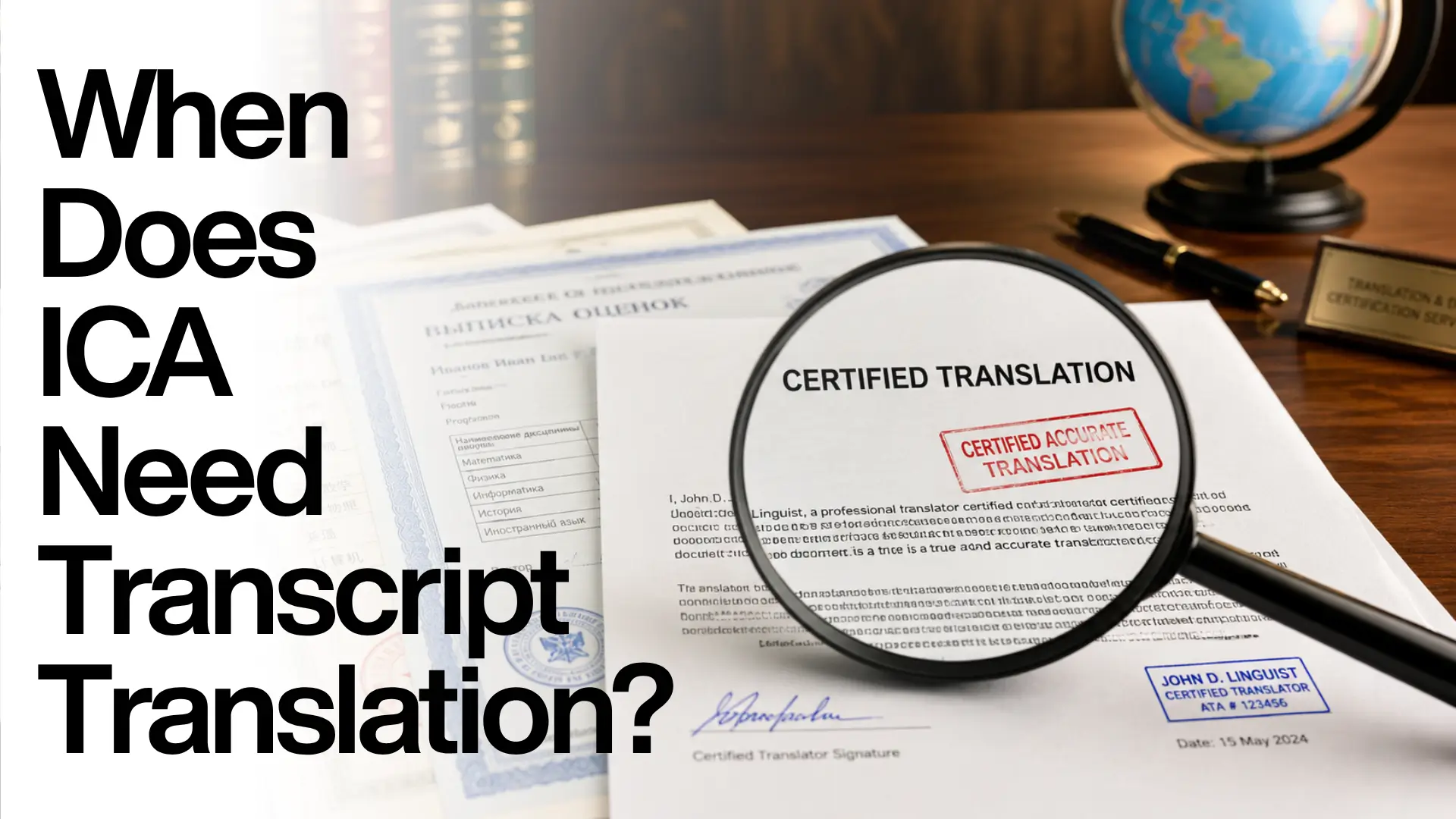 This guide explains what ICA actually expects when it comes to academic document translation, when it's required, how to get it done correctly, and what pitfalls to avoid.
What Is Academic Transcript Translation?
Academic transcript translation for ICA applications is the process of converting an official educational record — including grades, subjects, institutional details, and academic standing — from its original language into English, in a format that meets Singapore's immigration documentation standards. The translation must accurately reflect every element of the source document.
A transcript is the detailed record behind a qualification: the subjects studied, the marks achieved, the academic terms completed, and the institution's grading scale. Both a certificate and a transcript may be required for a Dependant Pass application depending on the circumstances, but transcripts tend to be the more complex translation task because of their technical and institution-specific terminology.
Accuracy matters because ICA uses these documents to verify the educational background of dependants — particularly when assessing whether children will be enrolling in Singapore's school system, or when a spouse's prior qualifications are relevant to the review. A translation that omits a grade column, mistranslates a subject name, or fails to reflect an institution's grading nomenclature correctly can create discrepancies that flag an application for closer review or outright rejection.
When Does ICA Require Academic Transcript Translation?
In practical terms, translation is needed in several scenarios:
- For dependent children: If school or university records are being included to support a child's application — for example, to facilitate enrollment in a Singapore school — those records must be translated if they aren't already in English.
- For dependent spouses: ICA may, in certain application reviews, request or consider the educational qualifications of a dependent spouse. Any academic records submitted must be in English or accompanied by certified translations.
- During document verification: Singapore's verification process cross-references submitted records. If a translated document doesn't align clearly with the original, it triggers further scrutiny.
- When applying for school placement: The Ministry of Education (MOE) and individual schools may separately require translated academic records to determine which year level a child should enter. This is distinct from the ICA application itself, but families often need translated transcripts for both purposes at once.
The safest approach: if a document is in a language other than English and forms part of a Dependant Pass application, have it professionally translated. Don't assume an official-looking foreign-language document will be accepted as-is.
Certified Translation vs. Ordinary Translation
There's a meaningful difference between a translation and a certified translation. A bilingual friend or colleague can produce a translation. A certified translation, on the other hand, comes with a formal declaration — typically a signed statement from the translator confirming their competence in both languages and the accuracy of the work — making it suitable for official submission.
ICA expects certified translations for immigration-related documents. Submitting an uncertified translation is one of the most common causes of document rejection and application delays.
Certification matters because it establishes accountability (a named, credentialed translator stands behind the work), enforces accuracy standards (complete, properly formatted translations rather than selective summaries), meets institutional recognition requirements (government agencies and embassies expect a defined presentation format), and reduces risk (applications built on certified translations are far less likely to be questioned on documentation grounds).
Important distinction: for Dependant Pass applications, certified translation is the standard requirement. However, if the same academic documents are also being used for a PR or Citizenship application, or for legal proceedings, notarisation and SAL authentication may additionally be required.
Common Transcript Translation Mistakes That Delay Applications
- Incomplete translations — Some translators only render the "important" parts (subjects and grades) and skip institutional details, dates, headers, footnotes, and grading scale explanations. ICA requires the complete document to be translated; partial translations are typically rejected.
- Missing or misrepresented grade information — Grading systems vary significantly by country: percentages, letter grades, or numerical scales that sometimes run in reverse of Western conventions. A translator unfamiliar with the source country's grading system may transcribe grades literally without the contextual explanation needed to interpret them, creating confusion at review.
- Incorrect subject terminology — Academic subjects have official names in every education system, and these don't always translate literally. A subject officially titled something equivalent to "Natural Science Fundamentals" might get rendered informally as "Basic Science." However minor it seems, this kind of discrepancy can raise questions about document authenticity.
- Formatting that doesn't reflect the original — A certified translation should mirror the layout of the source document where possible.
- Missing certification statements — Translations lacking a certification statement that identifies the translator, confirms their competence, and attests to the accuracy of the work are not suitable for ICA submission — even when the translation itself is technically accurate.
- Machine-translated documents — Tools like Google Translate or DeepL are useful for personal understanding but inappropriate for official submission. They can't be certified, they handle specialist terminology poorly, and they leave no accountability trail.
- Name and date inconsistencies — Transliterating names from non-Latin scripts (Arabic, Chinese, Devanagari, Cyrillic) can produce multiple plausible romanised versions. If a name on a translated transcript doesn't match the passport exactly, it creates an identity verification issue that must be resolved before the application can proceed.
Step-by-Step: Getting Your Transcript Translated
- Gather your original documents — Collect all transcripts, certificates, and educational records, ideally certified true copies rather than personal photocopies, with clear and legible scans.
- Confirm which documents need translation — Identify anything not already in English and note the source language.
- Choose a certified translation provider — Look for demonstrable experience with Singapore immigration document translation. Don't decide purely on price or turnaround time.
- Share application details — Tell the provider the purpose (ICA Dependant Pass application), the country and institution of origin, and any known formatting or certification requirements.
- Review the completed translation — Check that all sections are translated, names and dates match passport details exactly, and the certification statement is present and complete.
- Prepare your submission package — Submit each translated document alongside its original; ICA typically expects to see both. Keep copies of everything.
- Submit and monitor — Include translated documents as specified in ICA's submission guidelines and respond promptly to any follow-up requests.
Choosing a Reliable Translation Service in Singapore
Not all translation services are equal. Look for providers who can confirm translators are native or near-native in the source language, have specific experience with Singapore immigration documents (not just general translation work), offer a clear and explainable certification process, translate documents in full rather than selectively, maintain clear confidentiality practices, and offer reasonable turnaround with an actual quality-review step — typically 2–5 business days for a certified academic transcript translation.
Conclusion
Academic transcript translation is not a bureaucratic afterthought in the Dependant Pass application process. For families relocating to Singapore from countries where education records aren't in English, it's one of the details that most often causes avoidable delays.
To get it right: work with a qualified provider who understands ICA submission standards, review the completed translation before submission, and keep copies of everything. Families most often run into trouble when they assume the process is simpler than it is — trusting a bilingual colleague's help, relying on machine translation, or hoping an uncertified translation will pass review.
The translation itself may take only a few days; the delays that arise from getting it wrong can take far longer to resolve.
