A Resident’s Room Wasn’t Cleaned for 3 Days. Housekeeping Says It Was. You Can’t Prove Eitherï
Author : Centrim Life UK | Published On : 04 Jun 2026
A Resident’s Room Wasn’t Cleaned for 3 Days. Housekeeping Says It Was. You Can’t Prove Either Side.
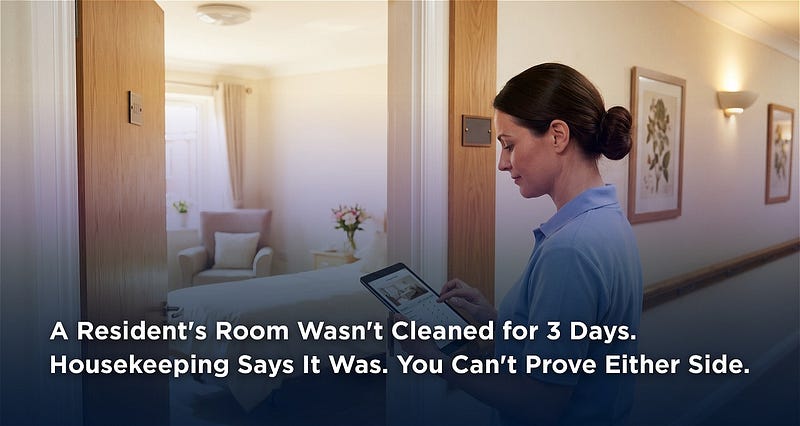
This is one of the more uncomfortable complaints a UK care home owner has to deal with. A family member is sure their mother’s room has gone three days without a clean. The housekeeping team is just as sure that the work was done every morning on schedule. Both sides are certain of what they have seen or done. Neither side has anything stronger than their word to settle it with.
It rarely comes down to dishonesty. A clean might be done at 6 am before residents wake, leaving little visible change by mid-morning. A team member might tick a box for a room they meant to come back to later. A handover slips between shifts. A trolley breaks down halfway through the round. The result is the same: two confident accounts of the same room, and no record solid enough to confirm which is right.
For an owner or operations director looking at the complaint, the hard part is that it is almost never a question of whether the team works hard. It is a question of whether the work can be shown. In homes still using paper rotas and verbal handovers, the honest answer is often that it cannot.
This gap, between work that has been done and work that can be evidenced, is getting harder to ignore in UK care. The CQC’s single assessment framework expects providers to show, not say, how they look after cleanliness and the safety of the environment. Families are quicker to put complaints in writing. Local authorities are quicker to escalate them. The cost of a record-keeping system that cannot keep up no longer stops at the home’s front door. It shows up in inspection notes, in family reviews, in reputation, and in the end, in occupancy.
The Hidden Cost of “We Think It Was Done”
When an owner asks the home for proof of the cleaning, the answer often comes back as a photograph of a paper rota. Each row is signed. None of the rows has a timestamp. There is nothing to show which staff member entered the room at what time, or what state the room was in when they got there.
The conversation that follows is uncomfortable for everyone. The housekeeping lead feels accused of something she did not do. The deputy manager has to defend records she did not personally fill in. The owner is left with a complaint she cannot answer cleanly, a regulator she cannot reassure, and a family member who has lost confidence in the home.
This is the quiet cost of running housekeeping on paper. It is the slow loss of trust, the hours spent in defensive meetings, the steady drift in a home’s reputation, and the awkwardness of trying to explain away a complaint that should have been simple to settle.
Why Paper Records Cannot Carry the Weight Anymore
Paper rotas were built for a smaller, slower way of running a home: a single floor, a small team, a fixed list of rooms, and the same staff member walking the same route every morning. Care homes today look very different.
A typical morning in a 50-bed home now involves residents with very different needs, infection control routines that change at short notice, a housekeeping team that often includes agency or cover staff, and family visits arriving at all hours of the day. A clipboard on a trolley cannot keep up. By the time the shift ends and the rota gets filled in, half of what happened that morning has already been forgotten.
The CQC’s single assessment framework asks providers to show how they keep on top of cleanliness, infection prevention, and the safety of the environment. “We have a paper rota in the office” is a hard line to defend in an inspection.
For owners with more than one site, the problem grows. One manager keeps the rota carefully, another lets it slip in a busy week, a third uses a different format altogether, and a fourth has quietly moved to a notebook because the office printer has been out of toner since March. From the head office, no one has a clear view of how cleaning is actually being recorded across the group.
What Changes When Housekeeping Task Management Software Comes In
Picture the same dispute six months after the home has moved to a digital housekeeping system. The complaint comes in. The operations director forwards it to the owner. This time, the answer takes ninety seconds.
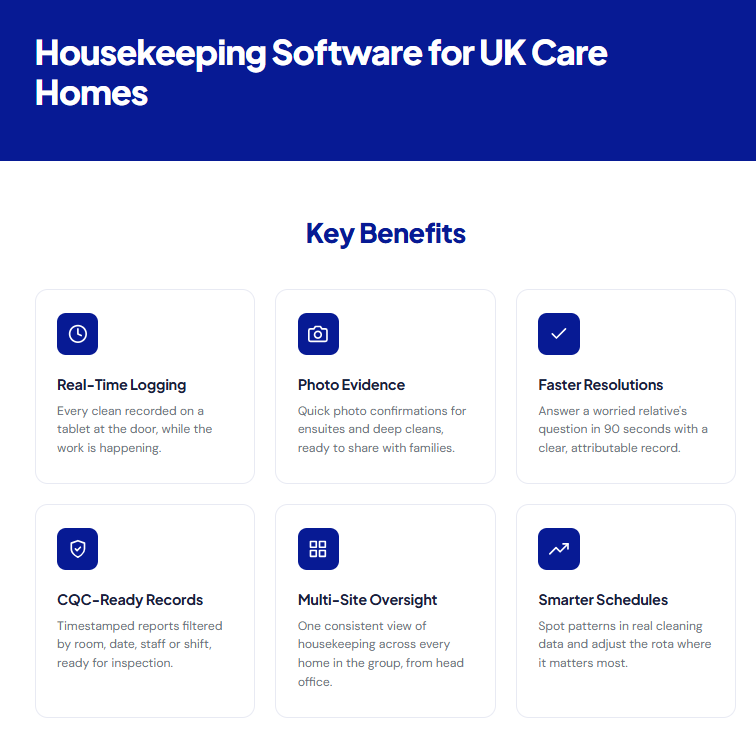
Each cleaning over the three days has been logged on a tablet at the door of the room. Every entry has a timestamp, the staff member’s name, a short note, and any flags that need passing on to clinical staff. Two of the entries also have a photo confirming that the bathroom was done. The owner can see, on screen, the exact minute each cleaning started and ended. She sends the report to the family with a short note inviting them to walk through the record together if they would like to.
The complaint does not grow into something bigger. The CQC inspection, when it comes, takes the housekeeping evidence at face value because it is timestamped, named, and there to read at any point.
This is what good housekeeping software for care homes is built to do. It does not replace the team or the work. It just makes the work easy to see, every day, in a form that holds up to questions.
Centrim Life’s housekeeping function is part of a wider operations platform used across UK care homes. It works alongside Maintenance for room-related repairs and Visitor Management for booked family visits, so housekeeping knows when a relative is expected, and the room is ready in time.
A Real-Life Example
Take a 60-bed residential home in Yorkshire, part of a small care group of four sites. The owner has been getting the odd complaint from families about cleaning standards in two of the homes. The home managers say their teams are working well. With paper records, no one can prove who is right.
The group brings in a digital housekeeping system across all four sites. Within six weeks, the owner has a clear picture for the first time. Three of the homes are running cleaning to schedule with very few exceptions. The fourth has a regular pattern of cleans starting earlier than the rota suggests, which is why family members coming in during the evening were not seeing recent activity in the rooms. The schedule in that home has changed. Complaints from that site will drop within the next month. Across the group, the owner now has weekly reports that give the head office a view of housekeeping performance without needing to ring each home.
This is an illustrative example rather than a specific home, but it reflects the kind of clarity owners describe after moving to verifiable cleaning records.
“As an owner, my worry was never that the team wasn’t working. My worry was always that we couldn’t show what they had done. Centrim Life closed that gap. The housekeeping records are now something I trust enough to forward straight to a family or to the local authority.”
Richard Pemberton — Owner and Director
Choosing the Right System for a Care Home Group
Not every digital tool is built for the way care homes actually work. A general facilities tool may track cleaning across an office or a hotel, but it does not understand resident routines, infection control rules, the way a CQC inspection actually unfolds, or the rhythm of a typical care home day.
For owners and operations directors, the right care home housekeeping software should record cleans at the door of the room, let clinical staff send urgent requests without picking up the phone, give back reports that match the questions families and inspectors actually ask, and offer the head office a single view across all sites.
The best systems are also quiet about themselves. They sit in the background, picking up the work as it happens, and only step forward when someone needs a clear answer to a difficult question.
Frequently Asked Questions
1. Does housekeeping task management software replace the housekeeping team?
No. The software supports the existing team by taking the paperwork out of the way and giving senior staff a clearer view of what has been done. Housekeeping staff carry on with the cleaning. The system just makes the work easy to see and easy to confirm if anyone asks.
2. How quickly can a UK care home start using housekeeping software for care homes?
Most homes are up and running within a few weeks. Setup involves loading the room list, bringing in the cleaning rota, showing housekeeping staff how to use the mobile interface, and linking the system into existing records. Onboarding support is in place from start to finish.
3. What kind of evidence does care home housekeeping software produce for CQC inspections?
The system keeps timestamped records of every completed clean, who did it, what time it took place, and any notes added on the spot. Reports can be filtered by room, by date range, by individual cleaner, or by shift. This kind of evidence sits well with what the CQC looks for under the single assessment framework, especially around safe and well-led services.
4. Can the software handle infection control routines and deep cleans?
Yes. Different cleaning types can be set up separately, including daily cleans, terminal cleans after illness, planned deep cleans, and one-off urgent requests. Clinical staff can send these requests to housekeeping the moment a resident’s situation changes, with no waiting for phone calls.
5. Is the software suitable for care home groups with multiple sites?
Yes. The platform works for single-site homes and multi-site care groups alike. Smaller homes get the benefit of less admin work, while larger groups get consistency across sites and a clear central view from head office, which makes it easier to spot issues and act on them early.
Conclusion
For most owners, the question is not whether housekeeping is being done. It is whether the home can show, calmly and quickly, that it has been done. The homes that close that gap protect their reputation, back their teams up, settle family worries before they grow, and give themselves the sort of evidence that makes CQC inspections shorter rather than longer.
If a clearer picture of housekeeping across one home or a whole group would help, the Centrim Life UK team is happy to walk through how the platform fits in with existing routines. A short demo gives a real feel for how the system works in everyday care home conditions before any commitment is made.
